
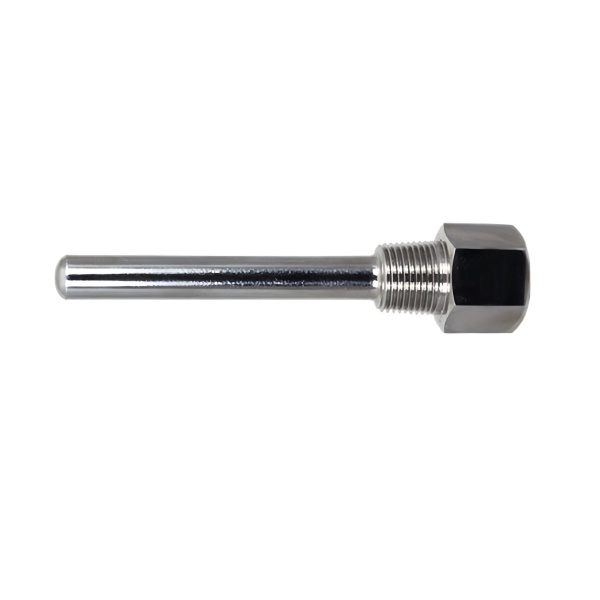
The Stainless Steel Thermowell with Hex Compression Nut is a sensing assembly where a stainless steel thermowell is closed at the top not by a welded cap but by a compression nut that clamps a ferrule onto the sensor’s stem, sealing and retaining the sensor inside the well. The compression nut is the interface between the replaceable sensor and the pressure boundary of the well, and it has to seal under process pressure while still letting the sensor be removed and replaced. Making that nut out of stainless steel rather than brass changes the whole character of the joint: it is stronger and more corrosion-resistant, but it galls, it needs more torque and it is far less forgiving of an over-tightened assembly. This page covers the compression seal, the stainless steel nut and the hex that drives it.
The compression nut is a serviceable seal, and that is its point
A welded or soldered cap makes a thermowell permanent; a compression nut makes it serviceable. The nut drives a ferrule into the well’s top cone, and the ferrule bites both the sensor stem and the cone to make a metal-to-metal seal that holds process pressure but can be broken to swap the sensor. That serviceability is the reason the fitting exists, and it sets the requirement: the seal has to be reliable enough to trust under pressure, and releasable enough to open without destroying the well.
- The top cone that the ferrule seals against is held to its angle and finish, because the ferrule seals on that surface and a rough or wrong-angle cone leaks under vibration.
- The ferrule is matched to the cone and the stem, so it bites both without extruding out of the joint.
- The seal is verified at the specified torque on the first article, proving the joint holds process pressure before the sensor is ever installed in service.
Stainless Steel on stainless steel: galling is the failure that ends the joint
When both the nut and the well are stainless steel, the nut’s thread and the well’s external thread are the same alloy family, and austenitic stainless steel against austenitic stainless steel is the classic galling combination. Under load the two threads can weld micro-welds and tear material off each other, and a galled compression nut cannot be removed – which defeats the entire purpose of a serviceable fitting. Preventing galling is therefore not a nicety on this assembly, it is what keeps the sensor replaceable.
- We specify a thread lubricant or an anti-gale coating on the nut thread as a functional requirement, not an optional extra.
- Nut and well threads are often specified in slightly different stainless steel grades or finishes to reduce the galling tendency of identical alloys.
- Assembly torque is controlled, because galling risk climbs with load and an over-torqued stainless steel nut is the one that seizes.
The hex is what turns torque into a seal without rounding
The nut carries a hex so the installer can apply a controlled torque, and that hex has to transmit the force the stainless steel joint needs without rounding off. Stainless Steel compression joints need more torque than brass ones because the stainless steel nut does not conform and seal as readily, so the hex on this assembly is doing more work than the hex on a soft-metal fitting. Its across-flats, depth and corner strength are all held against that higher torque.
- Across-flats and depth are sized for the stainless steel joint’s torque, so the wrench fully engages and the hex takes the load.
- Corner condition is held sharp, because a rounded corner on a high-torque stainless steel nut is where the wrench slips and the assembly gets gouged.
- The hex is checked to stay square to the well axis after tightening, so the ferrule is driven straight into the cone and seals evenly.
Torque window: stainless steel needs more, and punishes more
Every compression fitting has a torque window, and the stainless steel version has a narrower and higher one. Too little torque and the ferrule does not bite, so the joint leaks; too much and either the stainless steel nut galls and seizes, the ferrule extrudes, or the well’s top cone distorts. The window is real and it has to be communicated with the part, because an installer used to brass fittings will naturally under- or over-tighten a stainless steel one. We treat the specified torque as part of the deliverable.
- The torque window is established on the first article by leak-testing across a range, and the released window is the one that seals without galling.
- We document the window with the assembly, so the sensor is replaced at the right torque years later, not guessed at.
- Where the assembly sees vibration, we discuss a ferrule or retention design that resists the slow relaxation that loosens a plain compression joint over time.
The well still has to be a pressure boundary and a thermal path
All of the above happens at the top of the well, but the well’s real job is unchanged: hold process pressure at its closed tip and conduct heat to the sensor seated inside. The compression fitting sits above that and must not compromise it – the sensor has to seat against the inner wall for the thermal path, and the well tip has to hold the pressure. The top seal and the bottom tip are two separate boundaries and both are verified.
- Tip wall thickness and roundness are held against pressure, independent of the compression fitting above.
- Sensor seating depth and bore finish are controlled so the thermal path from tip to sensor stays short.
- Concentricity between the well bore and the nut’s thread is held, so the nut tightens straight and the ferrule seals evenly around the stem.
How we verify a stainless steel thermowell with a hex compression nut
Verification checks the well’s pressure boundary, the compression seal and the anti-gale provisions, because the assembly only works if all three hold.
- Well tip: thickness and roundness measured against pressure, with internal bore finish and sensor-seating depth confirmed.
- Top cone and threads: cone angle and finish verified, and the nut thread checked to turn freely with the specified anti-gale lubricant.
- Hex: across-flats, depth and corner condition checked against the stainless steel joint’s higher torque.
- Seal check: the nut torqued to the specified window and the joint leak-tested, confirming the ferrule seals at the stated torque and the nut does not gall.
- Material and passivation records per lot, confirming the stainless steel grades and that free iron was removed after machining.
- Service check: on the first article the nut is loosened and re-tightened, proving the joint is genuinely serviceable before the assembly ships.
First articles and retention samples are kept for the programme, and the verified torque window travels with them, so a repeat run seals and releases the same way. On a serviceable stainless steel joint whose whole value is that it can be opened and re-sealed without galling, that repeatable window is what keeps a sensor replaceable for the life of the installation.
This part sits inside our Sensor Housings range. Across the sensor housings pages you will find the process notes, common materials and inspection points behind every product in the family.
Specifications
| Item | Stainless Steel Thermowell with Hex Compression Nut |
|---|---|
| Brand | AUNOV |
| Designing | Send us your 2D drawing, or mail a sample for measurement, the quotation comes back with a manufacturability review attached. |
| Tooling | Dies designed and built in our own toolroom, each die held against your part number. |
| Samples | Approval samples of the nut ship with dimensional data and material certs. |
| Materials | Stock for this part leads with 304 / 316 stainless steel, alongside carbon steel (SPCC / DC01), aluminium, brass and copper, and the grade is fixed at the drawing review. |
| Surface finish | Finish options: plating, e-coat, powder coating, anodising or passivation, per your print. |
| Processing | Deep drawing in stages, in-line annealing where needed, then pierced and machined in house. |
| Equipment | Press capacity from 5 to 500 T across mechanical and hydraulic lines, in-house CNC cells and a temperature-controlled inspection room. |
| Tolerance | Tolerances to +/-0.1 mm as drawn, with machined features to +/-0.03 mm. |
| Delivery terms | Standard terms FOB, DDP offered to EU and US, payment T/T or L/C, D/P for repeat accounts, call-off schedules supported. |
Related Products


Frequently Asked Questions
Why is a compression nut the point of this thermowell?
The compression nut is a serviceable seal, and that is its point: it clamps a ferrule onto the sensor’s stem, sealing and retaining the sensor inside the well while still letting it be removed and replaced. A welded or soldered cap makes a thermowell permanent, while a compression nut makes it serviceable. The nut is the interface between the replaceable sensor and the pressure boundary of the well.
Why is galling the failure that ends the joint?
When both the nut and the well are stainless steel, the two threads are the same alloy family, and austenitic stainless steel against austenitic stainless steel is the classic galling combination. Under load the threads can weld micro-welds and tear material off each other, and a galled compression nut cannot be removed, which defeats the entire purpose of a serviceable fitting. Preventing galling is therefore not a nicety on this assembly, it is what keeps the sensor replaceable.
Why does the hex do more work on a stainless steel nut?
The nut carries a hex so the installer can apply a controlled torque, and that hex has to transmit the force the stainless steel joint needs without rounding off. Stainless steel compression joints need more torque than brass ones because the nut does not conform and seal as readily. Every compression fitting has a torque window, and the stainless steel version has a narrower and higher one.
What happens at the edges of the torque window?
Too little torque and the ferrule does not bite, so the joint leaks; too much and either the nut galls and seizes, the ferrule extrudes, or the well’s top cone distorts. The window is real and has to be communicated with the part, because an installer used to brass fittings will naturally under- or over-tighten a stainless steel one. On a serviceable joint whose value is that it can be opened and re-sealed without galling, that repeatable window is what keeps a sensor replaceable for the life of the installation.
Request a Quote for This Part
Send a drawing or sketch — get material advice, tooling cost and a per-piece price within 24 hours (working days).