
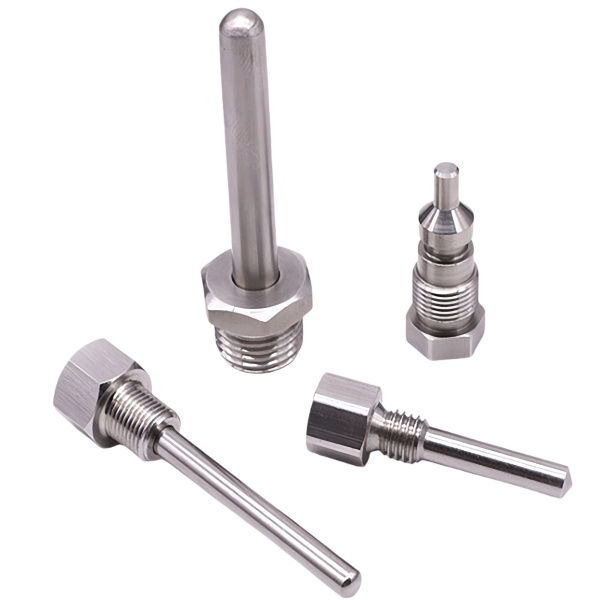
The Stainless Steel Tapered Tip Thermowell with Hex Nut is a thermowell whose sensing end is ground or formed to a taper rather than left as a flat or rounded closed tip, and which is secured in the port by a hex nut. The tapered tip is a deliberate choice: a taper seats into a matching tapered seat or a tapered bushing to make a tighter, better-located joint than a plain tube end, and it also presents less frontal area to the flow. The hex nut is the retention interface. Together they make a well that locates precisely at its tip and seals at its port, and the engineering is about holding the taper’s angle and concentricity while the nut does its job. This page covers the tapered tip, the seating it creates and the nut that holds it all.
A tapered tip seats, and seating is a location and a seal
A flat or rounded thermowell tip bottoms out or nests loosely in its seat; a tapered tip wedges into a matching taper and locates positively, both axially and radially. That positive location matters when the sensing tip has to sit at a known position in the flow, and it can also form part of the seal where the well has to close off its seat. The taper is therefore not just a pointy end – it is the feature that fixes where the well sits and, in some designs, what keeps process fluid from creeping up the annulus.
- Taper angle is held to the mating seat’s angle, so the contact band lands where the design expects and the well seats at the right depth.
- The taper’s concentricity to the well axis is checked, because a tip that is ground off-centre seats on one side and locates crooked.
- Where the taper is part of the seal, its surface finish is controlled, since a taper that seals needs a smooth, continuous contact band.
Grinding a taper into stainless steel without hurting the wall
The taper is usually produced by grinding or turning the closed tip down to the cone, and on stainless steel that operation has to be done carefully because the tip is the thinnest, most worked part of the well and it is the pressure boundary. A taper that is ground too aggressively can thin the wall below what the pressure needs, leave a work-hardened or stressed surface that later relaxes, or leave grinding marks that become crack initiation sites on a part that sees thermal cycling. The taper is finished, not just cut.
- Tip wall thickness after tapering is measured, because the taper removes material from exactly the section that has to hold pressure.
- The tapered surface is finished to a controlled roughness, and we avoid a heavily worked or burnished layer that would relax or crack in thermal service.
- Where the well sees rapid temperature cycling, the tip is inspected for the fine grinding cracks that stainless steel can develop if the taper was cut too hot.
The hex nut retains the well and has to hold the taper seated
The hex nut threads onto the well or the port and clamps the assembly so the tapered tip stays seated under internal pressure and vibration. Pressure is always trying to push the well out of its seat, and the nut is what resists that, so its thread engagement and its strength are a real structural requirement. At the same time the nut must not over-clamp and either distort the tapered seat or cock the well out of the very location the taper was made to provide.
- Nut thread engagement is set against the pressure load trying to back the well out, not against a generic rule.
- Nut torque is specified so it holds the taper seated without over-clamping and distorting the seat or cocking the well.
- The hex is checked to tighten square to the well axis, because a nut that pulls the well off-axis defeats the taper’s location.
Stainless Steel against stainless steel at the nut is a galling risk
As with any stainless steel nut on a stainless steel well, the nut thread and the well thread are the same alloy family, and that is the classic galling combination – especially on a part that is meant to be removable to service or replace the well. A galled nut cannot be taken off, and a thermowell that cannot be removed is a thermowell that has to be cut out. Preventing galling at the nut is what keeps the tapered-tip well serviceable.
- An anti-gale lubricant or coating on the nut thread is specified as functional, because the well is meant to come out again.
- Where possible the nut and well use slightly different stainless steel grades or finishes to reduce the identical-alloy galling tendency.
- Assembly torque is controlled, because galling risk climbs with load and an over-torqued stainless steel nut is the one that seizes.
How we verify a tapered-tip thermowell with a hex nut
Verification checks the taper, the wall under it and the nut that holds the taper seated, because the well only locates and holds if all three are right.
- Taper: angle verified to the mating seat, and concentricity to the well axis checked on the first article.
- Tip wall thickness after tapering measured against pressure, and the tapered surface inspected for grinding marks or fine cracks.
- Hex nut: across-flats, depth and thread engagement verified, with the nut checked to tighten square to the well axis.
- Seating check: the tapered tip seated into its matching gauge seat, confirming it locates at the right depth and runs true.
- Anti-gale and material records: nut-thread lubricant confirmed, and stainless steel grade and passivation recorded per lot.
- Pressure and service check: the assembly torqued to spec, pressure-tested to confirm the nut holds the taper seated, and the nut loosened and re-tightened to prove serviceability.
First articles and retention samples are kept for the programme, so a repeat run of the tapered-tip well is ground and seated to the same verified taper. On a part whose whole value is a taper that locates precisely and a nut that keeps it located under pressure, that baseline is what keeps a second batch seating as squarely – and coming out as cleanly – as the first.
This part belongs to our Sensor Housings range. The sensor housings pages collect the process notes, common materials and inspection points behind every product in the family.
Specifications
| Item | Stainless Steel Tapered Tip Thermowell with Hex Nut |
|---|---|
| Brand | AUNOV |
| Designing | Share your print, or send a part to be measured, you get a DFM review together with the quotation. |
| Tooling | Dies designed and built in our own toolroom, stored under your part number. |
| Samples | First-article samples ship with dimensional data plus material certs. |
| Materials | Stock for this part leads with 304 / 316 stainless steel, alongside carbon steel (SPCC / DC01), aluminium, brass and copper, and the grade is fixed at the drawing review. |
| Surface finish | Surface treatment per the drawing: plating, e-coat, powder coating, anodising, passivation, selected against the drawing requirement. |
| Processing | Progressive deep draw stages with in-line annealing as the draw ratio demands, with piercing and finish machining under the same roof. |
| Equipment | Mechanical presses 5-250 T and hydraulic presses 250-500 T, CNC turning centres, climate-controlled CMM room. |
| Tolerance | Tolerances to +/-0.1 mm as drawn, +/-0.03 mm after machining. |
| Delivery terms | FOB is standard; DDP offered for EU and US, T/T or L/C, with D/P for repeat business, scheduled call-offs welcome. |
Related Products


Frequently Asked Questions
Why taper the tip instead of leaving it flat or rounded?
A flat or rounded tip bottoms out or nests loosely in its seat, while a tapered tip wedges into a matching tapered seat or bushing and locates positively, axially and radially. It also presents less frontal area to the flow. The taper is not just a pointed end, it is the feature that fixes where the well sits and, in some designs, keeps process fluid from creeping up the annulus.
What is the risk when grinding a taper into stainless steel?
The taper is usually ground or turned down to a cone, and on stainless steel that has to be done carefully because the tip is the thinnest, most worked part of the well and it is the pressure boundary. Ground too aggressively, it can thin the wall below what pressure needs, leave a work-hardened surface that later relaxes, or leave grinding marks that become crack initiation sites. The taper is finished, not just cut.
What does the hex nut have to do for a tapered tip?
The nut threads onto the well or the port and clamps the assembly so the tapered tip stays seated under internal pressure and vibration. Pressure is always trying to push the well out of its seat, and the nut resists it, so its thread engagement and strength are structural requirements. At the same time it must not over-clamp and distort the seat or cock the well out of the very location the taper was made to provide.
Why is galling a specific risk on this removable well?
The nut and the well are the same alloy family, and that pairing is the classic galling combination, especially on a part meant to be removable for service. A galled nut cannot be taken off, and a thermowell that cannot be removed has to be cut out. The taper’s angle and concentricity have to be held while the nut does its clamping job.
Request a Quote for This Part
Send a drawing or sketch — get material advice, tooling cost and a per-piece price within 24 hours (working days).