
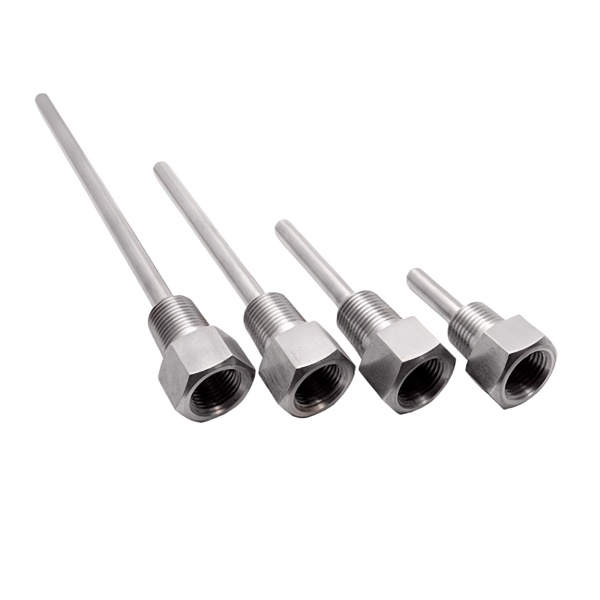
This fitting is supplied in four sizes, and the number is a deliberate one. Fewer sizes would leave gaps where an application has to be forced into the nearest available; more would multiply inventory and tooling for a benefit nobody uses. The set of four is a coverage decision, and this page is about how the sizes were chosen and what is common between them.
Four sizes because that is what covers the applications
A size range is defined by what it has to cover, not by round numbers. The four sizes here span the port diameters and immersion depths that come up repeatedly, with the steps between them chosen so that no common application falls into a gap and has to be served by a size that is wrong for it. Where a customer’s port sits between two sizes, we will say which of the two to use and why rather than leaving the choice to whoever is ordering.
Everything except the size is held common
The four sizes share their thread, their sealing arrangement, their tip and their material, so a plant holding the range carries one fitting family rather than four separate parts. That sharing is what makes the range a range instead of a catalogue: the same spanner, the same seal, the same torque and the same sensor fit across all four. It is also the constraint on the design – a change to the thread or the seat has to be made on every size at once.
The largest size is usually the one that needs attention
In a fitting range, the limiting member flips between products: it is the largest that has to carry the most load, and it is the one whose wall has the most metal to remove for the thread. The thread depth and the section behind it are checked on the largest size first, and the smaller ones follow, because a range sized from the small end up tends to produce a large size that is marginal where it screws into the port.
Material is common across the range for a reason
All four sizes are made in the same stainless steel, which matters because it keeps the thermal behaviour and the corrosion behaviour identical, so a fitting swapped for the next size up does not quietly change the reading or the service life. Where an application needs a different grade, that is a different part rather than a size option – and it is worth asking for, because the grades do not all draw and machine the same way.
How the range is checked before it ships
Each size is gauged on the shared thread and seat and measured for its own dimensions, so a four-size family that behaves identically can be demonstrated rather than assumed.
First articles and retention samples are kept per size for the programme, so a reorder reproduces the same shared features and the same dimensions. On a range bought to cover a spread of applications, that is what keeps the second order fitting the same ports.
Our Sensor Housings range is where this part sits. The sensor housings pages carry the process notes, common materials and inspection points behind every product in the family.
Where this part is used
Thermowell fittings supplied in four sizes are the standard way to cover an instrument range without four separate tooling programmes. We see them on pumps, compressors and hydraulic blocks where the same fitting family covers a size range, and in OEM instrument packages where one drawing set covers a whole product line.
Four sizes is a tooling decision as much as a product decision. If the sizes genuinely share a die family, the tool cost is spread across the range; if they do not, four tools are four tools and the quotation should say so plainly.
What we need to quote it
Send the size list with the expected volume per size and the thread standard for each, and confirm whether the four sizes may share a die family. If one size dominates the volume, tell us — it changes which size we optimise the tool for and which ones we accept as secondary.
Specifications
| Item | Stainless Steel Thermowell Fittings Four Sizes |
|---|---|
| Brand | AUNOV |
| Designing | Send drawings, or send a sample to be measured, DFM feedback is returned with the quote. |
| Tooling | Tooling designed and cut in house, with your part number on the tool record. |
| Samples | Pre-production samples ship with dimensional data and material certs. |
| Materials | 304 / 316 stainless steel leads the stock list for this part, alongside carbon steel (SPCC / DC01), aluminium, brass and copper, with the final grade confirmed at the drawing review. |
| Surface finish | Plating, e-coat, powder coating, anodising or passivation, as called out on your print. |
| Processing | Progressive deep draw stages with in-line annealing as the draw ratio demands, with piercing and finish machining under the same roof. |
| Equipment | 5-250 T mechanical presses plus 250-500 T hydraulic presses, CNC turning centres and a climate-controlled CMM room. |
| Tolerance | +/-0.1 mm on as-drawn features, +/-0.03 mm after machining. |
| Delivery terms | Standard terms FOB, DDP offered to EU and US, T/T and L/C accepted, D/P for established customers, call-off schedules supported. |
Related Products


Frequently Asked Questions
Why four sizes?
Fewer would leave gaps forcing applications into the wrong size; more would multiply inventory for no used benefit, so four covers the repeated port diameters and immersion depths.
How were the size steps chosen?
So no common application falls into a gap and has to take a wrong size, with the step between sizes set by what comes up repeatedly.
What if a port sits between two sizes?
AUNOV states which of the two to use and why rather than leaving the choice to the orderer.
Are the four sizes interchangeable in tooling?
They share common features and tooling logic while covering distinct port diameters, so the family is supplied as a coordinated set.
Request a Quote for This Part
Send a drawing or sketch — get material advice, tooling cost and a per-piece price within 24 hours (working days).