
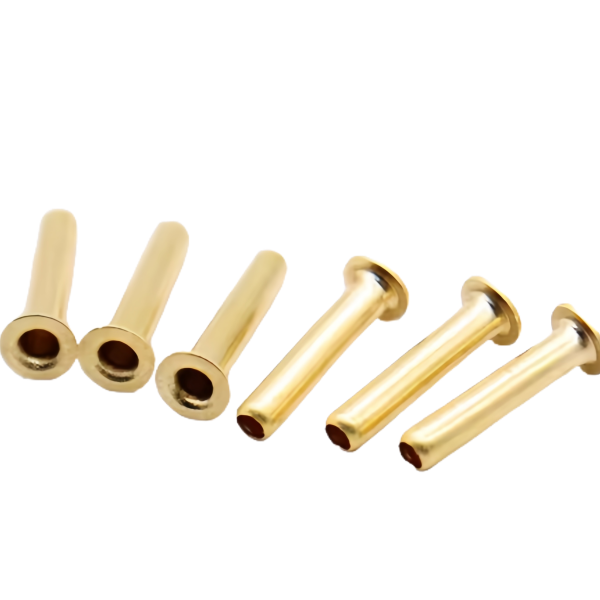
Brass sensor housing sleeves with flanged closed ends – the flange acts as a stop and seal shoulder, the closed end protects the element. Brass gives natural corrosion resistance and clean threads for fitting attachment.
Function and Design
What makes a flanged closed-end sensor hard is repeatability – the hundredth piece has to match the first one. The flanged closed-end sensor is produced to print, with the features that carry function inspected first.
Design Highlights
- The closed end is formed, not welded – a smooth radius with no heat-affected zone to corrode or crack.
- Flange and body are one pressing, which removes a welded joint and a leak path.
- Paperwork matches the parts: material certs and dimensional reports on request.
- Material: brass (H62 / H65) for the flanged closed-end sensor, with material certs issued together with the dimensional report.
- Process: deep drawing of the flanged closed-end sensor followed by CNC finishing on critical faces, flange trimmed and pierced in-die.
- Finish: Surface treatment for the flanged closed-end sensor is picked for its working environment, not from a catalogue.
- Size: The flanged closed-end sensor is built to your drawing – the family covers the common range, your dimensions are quoted per print.
- Custom: OEM/ODM to drawing; free samples of the flanged closed-end sensor and a manufacturability review before tooling.
Applications
Production volumes of this part run in HVAC and refrigeration sensors, thermowells for pipes and tanks, NTC and PT100 probe assemblies.
Our Production Advantage
Drawn shells are stress-relieved before critical faces are machined. First articles are dimension-checked and pressure-tested, and production is sampled against the approved part.
Request a quote and the flanged closed-end sensor is priced with real material, tolerance and tooling figures.