

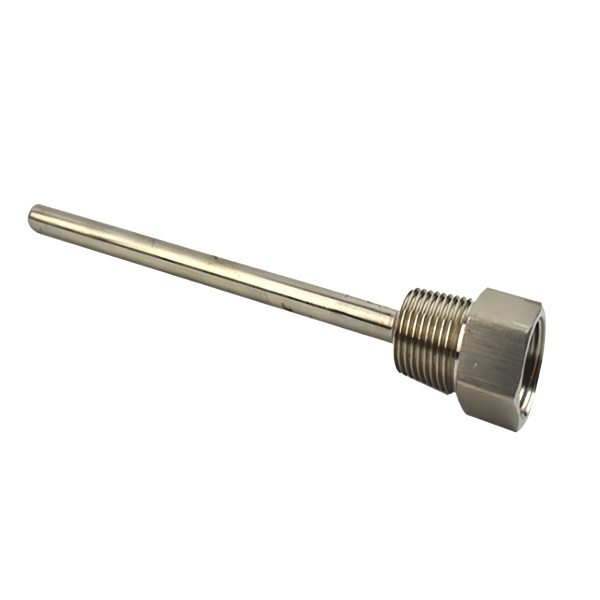
A hex-headed thermowell is a thermowell with a wrench on it, and that apparently small addition changes three things about the part: how it is installed, how it is specified, and how it fails. The hex is not a grip – it is an installation torque requirement, and it is the reason this thermowell behaves differently from a flanged or a threaded one in every service.
Deep drawing followed by CNC finishing on critical faces, at +/-0.01 mm on sealing faces and +/-0.05 mm on drawn profiles. So the tight band is on the sealing faces, and the hex – which looks like a feature – is not where the tight band goes.
What the hex actually does, which is more than take a wrench
A wrench on a thermowell is a torque-transmitting interface, and every requirement that follows from that is a requirement the drawing should carry.
- Installation torque becomes a specified value. A thermowell is screwed into a vessel or a nozzle and tightened to a torque. That torque is what compresses the gasket or the sealing face, and the torque’s value is a design output – it is the force that makes the seal. So the hex has to be strong enough to transmit it and the whole assembly – thread, hex, and the vessel’s boss – has to be designed around one number.
- Over-torque is a real failure mode. A hex that is too small for the required torque will round, and a rounded hex cannot be removed. And on a thermowell that has been welded into a vessel, a rounded hex is not a service inconvenience – it is a part that has to be cut off with a grinder, on a vessel that may be under process pressure.
- And under-torque is the other one. Too little torque and the seal leaks, and on a thermowell the leak is usually into the process side or the ambient side depending on where the well sits – both are bad, and one of them can be a pressure boundary failure.
- Which means the hex’s dimension is a torque-transmission specification, and it belongs on the drawing as width across flats with a tolerance and a note about what it transmits. On most thermowell drawings the hex’s width is stated and nothing else is, and then the torque specification is a separate document that refers to a wrench size nobody has checked.
The hex’s material requirement, which is different from the body’s
Carbon steel, 304 and 316 stainless steel, aluminium and brass. On a hex thermowell the body and the hex can reasonably be different materials, and the reason is worth understanding.
- The hex wants hardness so the corners do not round. A stainless steel hex is soft compared to the steel it is screwed into, and a stainless steel body with a stainless steel hex on a steel vessel will gall at the thread and round at the corners. Where a stainless steel thermowell is installed into a steel or cast-iron vessel – which is the common combination – the galling at the thread is a real and common problem.
- The body wants corrosion resistance to the process. 316L for a corrosive or a chloride-bearing service, and the L grade if it will be welded.
- And where the hex is a separate piece – a hardened insert, or a bronze or brass hex on a stainless steel body – that is a deliberate design choice: the hex takes the torque and the galling, the body takes the corrosion. It is worth asking whether the hex and the body are the same material, because if they are, one of them is going to be wrong.
What the thermowell has to do besides take a wrench
A thermowell is a pressure boundary, a thermal element, and a mounting. The hex adds the fourth: it has to be an installation interface. All four, and they are the same four as on any thermowell with the addition of the torque requirement.
- Pressure boundary. The process is inside the well and the wall carries the difference. The wall’s thickness is a calculation and the weld, if there is one, is part of it.
- Thermal element. The wall conducts the process temperature inward, and the wall’s thickness and its material set the response. A thicker wall holds pressure and responds slowly.
- Mounting. The thread that goes into the vessel, and its sealing – on a taper, on a face with a gasket, or on an interference fit with a bonded seal.
- And the installation interface, which is the hex, and which brings a torque specification that the other three do not.
The installation, and the failure modes that only appear on a hex part
The hex creates three failure modes that a threaded or flanged thermowell does not have, and all three come from the same place – the fact that it is tightened and expected to stay tight.
- Cross-threading during installation. A hex thermowell is started by hand and then torqued. If it starts off-axis, the thread damages and the installation has to be repeated, and on a vessel boss – which is the part that is not replaced – the damage is permanent. So the thread’s chamfer and its lead-in are functional, and the thread’s class matters more here than on a fitting.
- Over-torque damaging the vessel’s boss. The torque reacts through the thread into the boss, and if the boss is a thin casting the thread can strip in the vessel rather than in the well. On a thermowell this is an expensive failure because the vessel has to be repaired.
- And galling, which prevents removal. A stainless steel well in a steel boss will gall, and a galled well cannot be unscrewed. This is the most common field problem on a stainless steel thermowell and it is worth specifying a dissimilar grade pairing, a dry film lubricant, or an anti-seize compound on the assembly instruction – because it costs nothing on the drawing and it prevents the single most common service failure.
Material, and the specific case of a welded hex thermowell
Natural, plated or coated per the print, with the agreed finish travelling with the part number, and finish thickness and adhesion checked on the first article. On a hex thermowell the finish question has one unusual answer.
- The sealing face, unmasked. It is a seal and a plated seal face does not seal.
- The thread, masked or specified post-finish with an allowance, because a plated thread changes the fit, flakes at the roots, and on a thermowell the flakes go into the process.
- The hex, and this is the unusual one. The hex is often plated for appearance – and a plated hex is fine for that purpose. But a plated hex must not be plated with anything that will gall against the wrench or that will change the wrench fit, and the plating’s effect on the width across flats has to be in the dimensional scheme because a plating that adds thickness to the corners can change what size wrench fits.
- Where the thermowell is welded into the vessel at installation, the grade’s weldability is a requirement and 316L over 316 is the answer for exactly the reason that appears on every welded stainless steel part in this section.
Five dimensions are flagged on this housing, and the hex is not one
+/-0.01 mm on sealing faces and +/-0.05 mm on drawn profiles, with finer bands confirmed from capability data. On this part the flagged dimensions are five, and the hex’s is not among them.
- The sealing face: flatness and perpendicularity, measured as two values, against a named datum.
- The thread: class and pitch diameter, gauged, and the lead-in chamfer stated because it is functional on a part that gets screwed in by hand.
- Width across flats, as a fit to the wrench, with the corner condition stated – and with the tolerance tightened enough that the assembly torque it transmits is consistent.
- The bore’s concentricity to the thread axis, because a thermowell’s bore is not concentric and the sensor inside it will sit eccentrically, which on a well whose diameter is close to the sensor’s diameter is a fit problem.
- And the immersion depth, which is a functional dimension rather than a general one, because it is what sets the accuracy.
A hex thermowell fails at installation, not on the CMM
First articles verifying the whole flow before the run is released, in a climate-controlled inspection room. On a hex thermowell the inspection items that matter most are the ones that catch the installation failures before installation.
- The sealing face’s flatness and perpendicularity, on every part.
- Thread gauging, on every part.
- Width across flats and the corner condition, verified as a wrench fit, and ideally checked with the actual wrench that will be used.
- A functional leak test on every part – the thermowell is a pressure boundary and the weld or the face is where it fails.
- And a fit check against a representative vessel boss, if one is available. This is the only test that verifies the thread’s lead-in, the runout and the galling behaviour, and it is worth doing on a first article even though it is a nuisance.
What torque is this thermowell installed to, and with what wrench?
What torque is this thermowell installed to, and what wrench will be used – and is the vessel’s boss a casting or a machined steel? Three parts of one question, and they decide the hex’s width, the thread’s class, the material pairing and the assembly instruction. The torque decides the hex’s strength. The wrench decides whether the corners will round. And the boss’s material decides the galling question, which is the single most common field problem on a stainless steel thermowell and which is prevented by a dissimilar grade pairing or a lubricant on the assembly instruction – a specification that costs nothing on the drawing and is almost never written. There is a second question worth asking on this part, and it is about whether the well will be removed in service: is this thermowell welded into the vessel, or is it a threaded insert in a vessel that can be opened? Because on a welded-in well the hex exists only for installation, and if it rounds the only remedy is cutting it off. On a threaded well that can be removed, the same rounded hex is an annoyance. That difference should decide how much the hex has to be worth.
This part belongs to our Sensor Housings range. The sensor housings pages collect the process notes, common materials and inspection points behind every product in the family.
Specifications
| Item | Stainless Steel Stepped Sensor Housing with Top Port |
|---|---|
| Brand | AUNOV |
| Designing | Your drawing sets the part – unusual walls, threads or tolerances are feasibility-checked first; changes are priced before they are made. |
| Tooling | Dies, fixtures and gauges are made in our own toolroom, so no tooling step is outsourced, and the charge is refundable against agreed volumes. |
| Samples | Prototype and pre-production samples are provided against the drawing, so the approved first article becomes the gauge reference, and the signed sample is kept for future reorders. |
| Materials | Stock covers carbon steel (SPCC / DC01), 304 / 316 stainless steel, aluminium and brass; special grades are sourced to the drawing when volumes justify. |
| Surface finish | Natural, plated or coated as the print decides; the agreed finish is logged, and thickness and adhesion are checked on the first article. |
| Processing | After deep drawing, critical faces are CNC finished; the whole flow is verified on first articles before the run is released. |
| Equipment | Press line for drawing, CNC cells for finishing, backed by CNC turning centres and a climate-controlled inspection room. |
| Tolerance | +/-0.01 mm on sealing faces, +/-0.05 mm on drawn profiles; finer bands confirmed from capability data before quoting. |
| Delivery terms | FOB, with DDP offered for EU and US addresses, T/T or L/C, with D/P accepted on repeat business; call-off schedules are supported. |
Related Products



Frequently Asked Questions
What does the hex actually do beyond taking a wrench?
The hex is best read as a torque requirement wearing a wrench, and that changes how the part is installed, specified and failed. A wrench on a thermowell is a torque-transmitting interface, so every requirement that follows is one the drawing should carry. It is still a pressure boundary, a thermal element and a mounting, now with an added torque demand.
How does a hex thermowell fail at installation rather than on the CMM?
The hex creates three failure modes a threaded or flanged thermowell does not have, and all three come from being tightened and expected to stay tight. So the inspection items that matter most are the ones that catch those installation failures before installation. Deep drawing followed by CNC finishing on critical faces runs at +/-0.01 mm on sealing faces and +/-0.05 mm on drawn profiles.
Can the body and the hex be made from different materials?
On a hex thermowell the body and the hex can reasonably be different materials, and the reason is worth understanding. The body carries the pressure and thermal duty, while the hex carries the wrench load, so a tougher grade there can be justified. Carbon steel, 304 and 316 stainless steel, aluminium and brass are all held in stock.
What torque is this thermowell installed to, and with what wrench?
That question, plus whether the vessel boss is a casting or machined steel, decides the hex width, the thread class, the material pairing and the assembly instruction. A hex specified without its torque is only half specified. Five dimensions are flagged on this housing, and notably the hex is not one of them.
Request a Quote for This Part
Send a drawing or sketch — get material advice, tooling cost and a per-piece price within 24 hours (working days).