
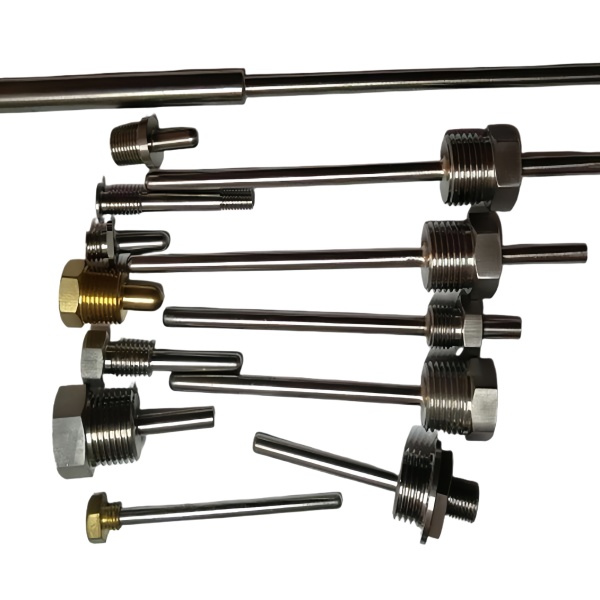
The Thermowell Probes with Hex Nuts Brass and Steel family supplies the same probe design in two materials – brass where machinability, conductivity and cost lead, steel where strength and pressure capability lead – each fitted with a hex nut that secures and seals it in the port. Offering one design in two metals is efficient for the customer but demanding for the shop, because the two materials do not cut, thread, seal or corrode the same way, and the hex nut has to work on both. The real engineering of this family is managing the material split so a brass probe and a steel probe from the same release both assemble, both seal and both survive their environment. This page covers the material split, the hex nut and the interface that has to serve both.
One design, two metals, and the differences are not cosmetic
On paper a brass probe and a steel probe with the same drawing are the same part in different metal. In production they diverge at almost every operation. Brass machines freely and takes a clean thread; steel needs more force, more attention to tool wear and a lubricant that will not break down. Brass seals readily in a compression or threaded joint because it conforms; steel holds pressure better but seals less forgivingly. The drawing has to be achievable in both, which often means specifying the tightest features – the thread class, the seal land – to what the harder material can hold.
- Thread class and seal geometry are set to a level both metals can achieve in production, not to what brass makes easily.
- Cutting parameters, tooling and lubricant are specified per material, and the setup sheet says which is which.
- Acceptance criteria can differ per material – a thread crest that is routine on brass is a galling risk on steel – and the inspection reflects that.
The hex nut has to work on both a soft and a hard probe
The hex nut is the common interface, and it has to secure and seal a brass probe and a steel probe with the same wrench and the same procedure. That is a real constraint, because the two probes take different torque: brass conforms and seals at lower torque, steel needs more and tolerates it better. The nut and its torque spec have to sit in a window that seals the brass probe without crushing it and seals the steel probe without galling it. Getting one nut to serve both is the heart of this family.
- Nut geometry – across-flats, depth, thread – is common, but the torque window is specified so it seals both materials.
- Where the two materials need very different torque, we flag it and either split the nut spec or adjust the seal design so one torque serves both.
- The nut is verified on both a brass and a steel probe at first article, because a nut that seals one and galls the other is not a common part.
Brass conducts and conforms; steel holds and resists
The reason to offer both metals is that they are genuinely better at different things, and the customer’s application decides which. Brass conducts heat well and conforms to make a reliable seal, which suits sensing and moderate pressure; steel holds higher pressure and resists deformation, which suits demanding service. The material choice is an engineering conversation at quotation, not a catalog option, because the two probes will not perform identically in the same port.
- Where thermal response leads, brass’s conductivity is an advantage and we lean that way.
- Where pressure, temperature or mechanical load leads, steel is the choice and we hold the wall and thread to the higher demand.
- Where both metals appear in one assembly, we raise the galvanic couple between them before it becomes a field failure.
Running two metals in one release without cross-contamination
A mixed-material release is a scheduling and cleanliness problem as much as an engineering one. Steel and brass share a plating line and an inspection bench, and the ways they contaminate each other are subtle: a steel burr left in a brass part is a corrosion starter, and brass smear on a steel part is a galvanic and a cosmetic defect. We segregate the two materials through machining, cleaning and packing so a “brass and steel” order is genuinely two clean products, not one blurred one.
- Tooling, fixtures and wash baskets are segregated or cleaned between materials, because cross-contamination is the hidden defect in a mixed release.
- Lot traceability is per material, so a problem on the steel probes does not quarantine the brass ones.
- Packing keeps the two materials separated or isolated, so a brass probe does not sit against a steel probe and start a galvanic couple in the box.
How we verify a brass and steel hex-nut probe family
Verification runs the shared routine on both materials and adds the material-specific checks that each one needs.
- Shared features: probe geometry, hex-nut across-flats and thread class verified to one specification across both metals.
- Material-specific thread check: brass threads inspected for a clean crest, steel threads inspected for galling or build-up.
- Seal and torque: the nut torqued to the specified window on both a brass and a steel probe, and each leak-tested, proving one torque seals both.
- Pressure-relevant checks on the steel probes where they carry higher load: wall and thread engagement verified to the higher demand.
- Material and finish certificates per lot and per material, traceable to the release.
- Segregation check: a sample from each material inspected for cross-contamination before the mixed release ships.
First articles and retention samples are kept per material for the programme, so a repeat release of the brass and steel family is made to the same verified common interface. On a family whose value is one design serving two very different metals, holding the shared nut and seal to a window that works on both is what keeps a brass probe and a steel probe dropping into the same port and both holding.
Parts like this one sit under the Sensor Housings range, whose overview page gathers the tooling logic, finishing options and tolerance notes shared across the family.
Specifications
| Item | Thermowell Probes with Hex Nuts Brass and Steel |
|---|---|
| Brand | AUNOV |
| Designing | Share your print, or send a part to be measured, you get a DFM review together with the quotation. |
| Tooling | Our own toolroom designs and builds every die, held and maintained under your part number. |
| Samples | Approval samples ship with a dimensional report and material certification. |
| Materials | Stock for this part leads with brass, alongside carbon steel (SPCC / DC01), 304 / 316 stainless steel, aluminium and copper, and the grade is fixed at the drawing review. |
| Surface finish | Surface treatment per the drawing: plating, e-coat, powder coating, anodising, passivation, per your print. |
| Processing | Deep drawing in stages, in-line annealing where needed, pierced and finish-machined on the same floor. |
| Equipment | Mechanical presses 5-250 T, hydraulic presses 250-500 T, CNC cells plus a temperature-controlled CMM room. |
| Tolerance | Tolerances to +/-0.1 mm as drawn, +/-0.03 mm on machined surfaces. |
| Delivery terms | FOB standard, DDP offered for EU and US, T/T and L/C; D/P on repeat accounts, scheduled call-offs welcome. |
Related Products


Frequently Asked Questions
Why offer one probe design in two metals?
The family supplies the same probe design in brass where machinability, conductivity and cost lead, and in steel where strength and pressure capability lead. That is efficient for the customer but demanding for the shop, because the two materials do not cut, thread, seal or corrode the same way. The real engineering is managing the split so both probes assemble, seal and survive their environment.
Why is the hex nut the hard part of a two-metal family?
The hex nut is the common interface, and it has to secure and seal a brass probe and a steel probe with the same wrench and the same procedure. That is a real constraint, because the two take different torque: brass conforms and seals at lower torque, steel needs more and tolerates it better. One drawing has to be achievable in both metals.
How do you keep the torque window valid for both metals?
The nut and its torque spec have to sit in a window that seals the brass probe without crushing it and seals the steel probe without galling it. Brass machines freely and takes a clean thread, while steel needs more force, more attention to tool wear and a lubricant that will not break down. The tightest features, the thread class and the seal land, are usually specified to what the harder material can hold.
What does running two metals in one release risk?
Steel and brass share a plating line and an inspection bench, and the ways they contaminate each other are subtle: a steel burr left in a brass part is a corrosion starter, and brass smear on a steel part is a galvanic and a cosmetic defect. We segregate the two through machining, cleaning and packing so the order is genuinely two clean products. First articles and retention samples are kept per material for the programme.
Request a Quote for This Part
Send a drawing or sketch — get material advice, tooling cost and a per-piece price within 24 hours (working days).