
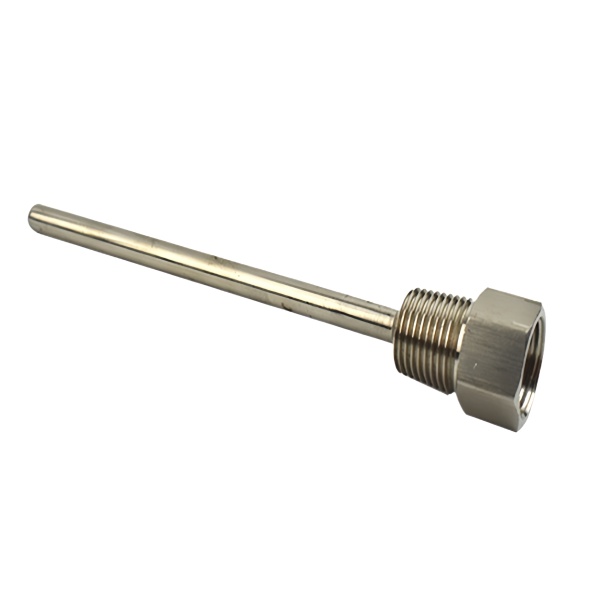
Brass is specified for thermowells because it moves heat. It is also the reason this part has a narrower installation window than the steel fitting it replaces, and most field failures on a brass thermowell are not material failures – they are torque failures. The hex nut and the soft body behind it have to be designed as a pair.
Brass is chosen for the thermal path, not for the pressure rating
The sensor sits inside the well, not in the process, so the reading depends on how fast the wall carries temperature from the immersed tip back to the sensor. Brass does that better than stainless steel, which is why it is specified where response time matters more than corrosion resistance. The wall thickness and the sensor seating are therefore set together: thick enough to hold the pressure, thin enough that the thermal path stays short, and seated so the sensor touches metal rather than an air gap.
The torque window on a brass body is narrower than on steel
Brass conforms readily to the seat, which is an advantage up to the point where it keeps conforming. Past that point the body dishes under the nut; it will still seal at the nut and will leak somewhere else, usually along the stem or at the sensor entry, where nothing was over-tightened. An installer working from habit on steel fittings will reliably exceed a brass window, so the window is specified on the part and passed on with it.
A distorted body seals at the nut and leaks elsewhere
This is the failure mode worth designing against, because it looks like success at the joint. The nut is tight, there is no weep at the seat, and the leak appears downstream where the distorted bore has opened a gap behind the sensor or cracked a brazed joint. We control the body wall and the shoulder under the nut together so the joint reaches seal before the body reaches yield, and that margin is what makes the difference between a fitting that seals and one that merely looks sealed.
Handling a long soft stem without losing it
Long plus soft is the worst combination for straightness. A stem that is true at the end of machining can pick up a bend in cleaning, in a loose tray or in transit, and brass will hold that bend. Support through every step after machining and packing that restrains the stem rather than letting it lie across a container is part of the process, not an afterthought.
How a brass thermowell with a hex nut is checked before it ships
The stem, its straightness and the seating surfaces are inspected together, and the part is checked as it will be assembled rather than as a loose body and a loose nut.
First articles and retention samples are kept for the programme, so a reorder reproduces the same wall, the same stem and the same torque window. On a part that has to seal without being crushed, that is what keeps the second batch as forgiving as the first.
You will find this part in our Sensor Housings range. Process notes, common materials and inspection points for every product in the family are collected across the sensor housings pages.
Where this part is used
Hex-nut long-stem thermowells are retained by a nut on the inside of a vessel or duct wall, which makes them the choice where the port cannot be threaded and the well has to be clamped in place. HVAC, food processing and OEM instrument builds use them where a probe is installed through a thin wall and has to be removable from the outside.
The nut is the interface, and it is the part most often left loose on the drawing. Whether it is supplied fitted or loose, and whether it has to be tightened to a torque, changes both the part and the packing.
What we need to quote it
Send the nut thread and across-flats, the stem length, and the wall thickness it passes through — that last one sets how much thread we leave. Tell us whether the nut ships fitted or loose, and whether the assembly has to be sealed against the wall from the outside.
Specifications
| Item | Brass Thermowell with Hex Nut Long Stem |
|---|---|
| Brand | AUNOV |
| Designing | A drawing file or a physical sample starts the review, a manufacturability review comes back with the quotation. |
| Tooling | Dies designed and built in our own toolroom, with your part number on the tool record. |
| Samples | The first-article set ships with a full dimensional report and material certification. |
| Materials | Brass leads the stock list for this part, alongside carbon steel (SPCC / DC01), 304 / 316 stainless steel, aluminium and copper, per the drawing. |
| Surface finish | Surface treatment per the drawing: plating, e-coat, powder coating, anodising, passivation, selected against the drawing requirement. |
| Processing | Staged deep drawing, with in-line annealing where the draw ratio requires, pierced and machined on the same floor. |
| Equipment | Mechanical presses 5-250 T and hydraulic presses 250-500 T, CNC turning and milling cells, a climate-controlled CMM room. |
| Tolerance | +/-0.1 mm on as-drawn features, with machined features to +/-0.03 mm. |
| Delivery terms | Standard terms FOB, DDP offered to EU and US, T/T and L/C accepted, D/P for established customers, call-off schedules supported. |
Frequently Asked Questions
Why specify brass for this fitting rather than steel?
For the thermal path. Brass moves heat several times faster than steel, so the sensing element follows the process more closely and reads sooner. It is not chosen for its strength or its pressure rating, and anyone specifying it because it costs less than stainless steel has taken it for the wrong reason.
Why is the installation window narrower than with a steel fitting?
Because brass yields sooner. The gap between tight enough to seal and tight enough to distort is smaller, and it narrows further once the fitting is warm. Stating a torque limit, rather than leaving it to whoever has the spanner, is what keeps the window inside the range a technician will actually apply.
If the body is overtightened, where does it leak?
Rarely where you would look. It seals convincingly at the nut, because that is where the load went, while the distortion it caused reappears further along the body at a joint nobody tightened. That mismatch between cause and symptom is why these investigations start by assuming nothing about location.
Why does a long stem need its own handling rule?
Because it is the shape most likely to arrive bent. A long, comparatively soft stem gets levered in transit, in stores and during installation, and once bent it changes insertion depth and can touch something it should not. Straightness on delivery is therefore as much a packing decision as a manufacturing one.
Related Products


Request a Quote for This Part
Send a drawing or sketch — get material advice, tooling cost and a per-piece price within 24 hours (working days).