
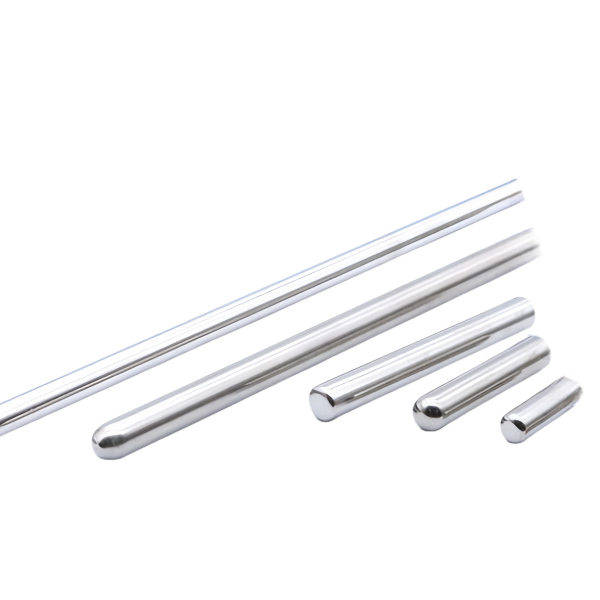
These are open-ended stainless steel tubes, not closed-end wells, and the difference changes what the part has to be good at. There is no formed tip holding pressure at the far end; instead the sensor is fed down the tube from the top and the pressure boundary sits at a fitting or a gland on the open end. The tube’s job is to be a clean, straight bore that the sensor goes into without binding, and an open end that will seal.
The pressure boundary is at the top, not in the process
On a closed-end well the tip is the pressure boundary and the difficult feature to make. On an open tube that responsibility moves to whatever seals the open end – a compression gland, a threaded fitting, a weld-in adaptor – which means the tube itself has to present a square, undamaged end for that seal to work on. Cutting the tube to length is therefore a sealing operation, not just a sizing one: a tube cut out of square, or burred on the end, will not seat in the gland no matter how good the bore is.
The bore is the functional surface
The sensor slides down this tube, so the bore is the feature the assembly actually feels. It has to be consistent along the length and from one length to the next, because a sensor that seats with clearance in one tube and binds in another makes the set unusable even though every tube is dimensionally correct. Bore consistency across the length range is held as one specification, which is what lets the same sensor fit every member of the set.
Several lengths, one sensor, one spare
The lengths exist to reach different immersion depths, and the point of supplying them as a range is that the same sensor and the same sealing arrangement work across all of them. That makes the set a spares proposition as much as a measurement one: one tube part number, one sensor, one gland covers every position in the plant. It only holds if the non-length features really are common – same bore, same wall, same end condition, same material.
A closed far end is for thermal contact, not for pressure
Where the tube has a closed far end, that end is not a pressure boundary; it is the surface the sensor tip rests against, and its job is to transfer temperature. That makes tip thickness and the contact between tip and sensor thermal decisions, and both are held with response time in mind rather than with a pressure calculation – a thin tip with good contact is a fast probe, and a heavy one is a lagging probe.
How a length range is checked before it ships
Each length is gauged on the bore and on its end condition, and measured for its own length, so a range that shares a sensor and a gland can be demonstrated rather than assumed.
First articles and retention samples are kept per length for the programme, so a reorder reproduces the same bore, the same end condition and the same lengths. On a tube whose value is that one sensor fits them all, that is what keeps the second batch interchangeable.
Parts like this one sit under the Sensor Housings range, whose overview page gathers the tooling logic, finishing options and tolerance notes shared across the family.
Where this part is used
Sensor probe tubes in multiple lengths are how OEM programmes standardise one tube across a product range: the same diameter and wall, ordered in a length schedule. Immersion sensors in tanks, ducts and pipes are the typical application, and the commercial logic is one drawing, one tool and a call-off schedule.
The shared diameter is what makes the family work. Once the diameter is fixed, the length becomes a scheduling question rather than a tooling question — provided the longest item still runs on the same press as the shortest.
What we need to quote it
Send the length schedule with quantities and confirm the diameter and wall are common across the set. Tell us whether the lengths may be grouped in one die family, and whether the schedule is a firm order or a call-off — a call-off changes how we hold the tool and the stock.
Specifications
| Item | Stainless Steel Sensor Probe Tubes Multiple Lengths |
|---|---|
| Brand | AUNOV |
| Designing | Send us your 2D drawing, or mail a sample for measurement, a manufacturability review comes back with the quotation. |
| Tooling | Tooling designed and cut in house, stored under your part number. |
| Samples | Samples for approval come with dimensional data plus material certs. |
| Materials | 304 / 316 stainless steel is the primary stock for this part, alongside carbon steel (SPCC / DC01), aluminium, brass and copper, per the drawing. |
| Surface finish | Finish options: plating, e-coat, powder coating, anodising or passivation, selected against the drawing requirement. |
| Processing | Multi-stage drawing, annealed in line where wall thinning calls for it, then pierced and machined in house. |
| Equipment | Our press floor runs 5-250 T mechanical and 250-500 T hydraulic presses, CNC turning centres, climate-controlled CMM room. |
| Tolerance | +/-0.1 mm as-drawn, with machined features to +/-0.03 mm. |
| Delivery terms | FOB standard, DDP offered for EU and US, T/T and L/C accepted, D/P for established customers, call-off scheduling supported. |
Frequently Asked Questions
Where is the pressure boundary on an open-ended probe tube?
At the top, where the fitting seals, rather than in the process. There is no formed tip holding pressure at the far end, so the tube is not itself the containment – the joint that mounts it is. Putting that boundary in the right place changes which component has to be strong and which merely has to survive.
If the tube is open, what is the bore actually doing?
Carrying the measurement. The sensor sits inside it, so the bore decides how well that sensor is centred, protected and in thermal contact with what it is reading. It is the functional surface in a way the outside diameter never is, even though the outside is what gets dimensioned first.
Why would a plant hold several lengths of the same tube?
Because ports differ. One process will have shallow points and another deep ones, and stocking several insertion depths under one specification lets maintenance fit any position without re-engineering the assembly. The saving shows up as fewer part numbers rather than as a cheaper part.
Why does it matter that the far end is closed for contact rather than for pressure?
Because the two readings lead to opposite designs. Treating the closed end as a contact surface keeps it thin and lets the sensor sit close to the process. Treating it as a pressure boundary thickens it for loads it will never see and slows the reading that justified the part in the first place.
Related Products


Request a Quote for This Part
Send a drawing or sketch — get material advice, tooling cost and a per-piece price within 24 hours (working days).