
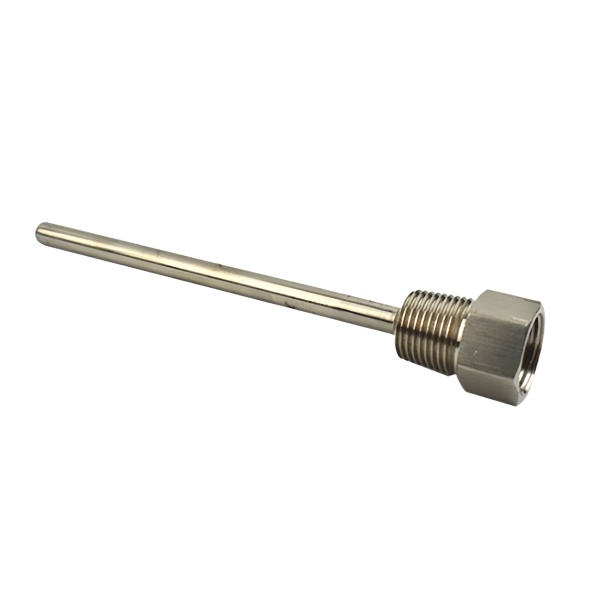
The Brass Thermowell Probe with Compression Nut is a sensing assembly: a brass thermowell – a closed-end tube that sits in the process and conducts heat to a sensor inside it – joined to a compression fitting with a nut that clamps a ferrule onto the sensor’s capillary or stem to seal and retain it. The thermowell’s job is thermal and mechanical: it has to transfer heat to the sensor quickly and hold pressure at its closed tip, while staying open at the top for the sensor to enter. The compression fitting’s job is a seal that tightens as the nut is torqued, and that seal depends on the ferrule biting evenly into the stem without crushing the well. This page covers the thermowell, the compression seal and how the two are held together.
A thermowell is a pressure boundary with a thermal job
The thermowell is the part of the assembly that touches the process fluid or gas, so it is a pressure boundary first: its closed tip and its wall have to hold the process pressure, and its tip thickness is set by that pressure and by the erosion or corrosion it will see. But a thermowell that holds pressure and responds slowly is useless, so the wall is also a thermal path – the thinner the wall at the tip, the faster the sensor inside sees the process temperature. Those two requirements pull against each other and the tip wall thickness is where they are resolved.
- Tip wall thickness is a pressure calculation with a thermal consequence; we hold it against the process pressure and against a response-time target if the customer has one.
- Bore finish inside the well matters, because the sensor has to seat against the wall to transfer heat, and a rough or out-of-round bore adds thermal resistance.
- The closed tip is formed and checked for thickness and roundness, because a thin or off-centre tip is both a pressure risk and a response-time risk.
The compression seal tightens by squeezing a ferrule, and brass makes it forgiving
A compression fitting seals by driving a ferrule – a small ring, usually brass or a soft alloy – into the cone of the fitting body as the nut is tightened. The ferrule swages onto the stem on one side and into the body cone on the other, making a metal-to-metal seal that gets tighter with torque. Brass is a common body material because it is soft enough for the ferrule to bite and machine cleanly enough to hold the cone angle, but that same softness means the fitting is sensitive to over-torque, which can distort the cone or crush the stem rather than improve the seal.
- The body cone angle is held tightly, because the ferrule seals against that cone and a wrong angle seals unevenly or leaks under vibration.
- Nut thread class is part of the seal: a thread that galling or strips under torque turns a controlled compression into an uncontrolled one.
- We specify a tightening torque range rather than a single number, so the assembly torque stays inside the window where the ferrule bites without the brass body distorting.
Torque is a window, not a “tighter is better”
The most common failure we see on compression fittings is not under-tightening, it is over-tightening. An installer who is not sure the seal is made adds another part-turn, and on a brass body that extra torque either extrudes the ferrule out of its cone, bulges the body, or crushes the sensor stem inside the well. The whole value of a compression fitting is that it seals predictably at a known torque, so we treat that torque window as a functional specification and communicate it with the part.
- Ferrule material and the body cone are matched, because a hard ferrule in a soft brass cone bites unevenly and a soft ferrule in a hard body extrudes.
- We recommend the assembly be leak-tested at the specified torque on the first article, proving the window rather than assuming it.
- Where the assembly sees vibration, we discuss a ferrule design or a retention feature that resists the relaxation that slowly loosens a plain compression joint.
Joining the well to the fitting without breaking either seal
The thermowell and the compression fitting are usually two pieces joined – brazed, soldered or threaded – and that joint is a third seal in the assembly on top of the compression seal and the closed tip. A joint that leaks at the interface is as bad as a split tip, and on brass the joint is also a thermal path, so a thick or poorly-conducting joint slows the sensor. The join is therefore both a pressure and a thermal decision.
- Brazing and soldering are chosen for the temperature and pressure the joint will see, with filler selected so the joint does not remelt or weaken in service.
- Joint geometry is controlled so the braze fillet does not intrude into the sensor bore or into the heat path from tip to sensor.
- Concentricity between the well bore and the fitting bore is held, because the sensor has to slide through both without binding at the joint.
How we verify a brass thermowell probe with a compression nut
Verification on this assembly checks each of its three boundaries – tip, joint and compression seal – because the assembly is only as good as the weakest of them:
- Thermowell tip: tip thickness and roundness measured on the first article, and bore finish confirmed against the thermal-seating requirement.
- Compression fitting: body cone angle and thread class verified, with the nut turning freely on the thread before assembly.
- Joint integrity: the well-to-fitting join inspected and, on the first article, pressure-tested to prove the third seal holds.
- Assembly seal check: the nut torqued to the specified window and the joint leak-tested, confirming the ferrule seals at the stated torque and not beyond it.
- Material certificates per lot for the brass body and the ferrule, traceable to the release.
- Fit check: the sensor stem or capillary the probe is built around is inserted through the well and the compression nut is set, proving the whole assembly works before the run.
First articles and retention samples are kept for the programme, and the verified torque window travels with them, so a repeat run of the probe is assembled the same way and seals at the same torque. On an assembly with three seals in series, that repeatable window is what keeps a second batch from being the one that leaks in the field.
Sensor Housings is the parent range for parts like this one; the overview page gathers the tooling logic, finishing options and tolerance notes that apply across the family.
Specifications
| Item | Brass Thermowell Probe with Compression Nut |
|---|---|
| Brand | AUNOV |
| Designing | A drawing file or a physical sample starts the review, our engineers reply with a manufacturability assessment and pricing. |
| Tooling | Our own toolroom designs and builds every die, held and maintained under your part number. |
| Samples | Pre-production samples ship with a full dimensional report and material certification. |
| Materials | Brass leads the stock list for this part, alongside carbon steel (SPCC / DC01), 304 / 316 stainless steel, aluminium and copper, with grade selection confirmed at drawing review. |
| Surface finish | Zinc, nickel or chrome plating, e-coat, powder coat, anodising or passivation, per your print. |
| Processing | Progressive deep draw stages with in-line annealing as the draw ratio demands, with piercing and finish machining under the same roof. |
| Equipment | Our press floor runs 5-250 T mechanical and 250-500 T hydraulic presses, in-house CNC cells and a temperature-controlled inspection room. |
| Tolerance | Tolerances to +/-0.1 mm as drawn, +/-0.03 mm on machined features. |
| Delivery terms | FOB standard, DDP offered for EU and US, T/T or L/C, D/P on repeat business, call-off schedules and blanket orders supported. |
Related Products



Frequently Asked Questions
What does the compression nut actually do?
It clamps a ferrule onto the sensor’s capillary or stem to seal and retain it, tightening as the nut is torqued, so the seal depends on the ferrule biting evenly without crushing the well.
How is the thermowell a pressure boundary?
Its closed tip and wall hold the process pressure and its tip thickness is set by that pressure and by the erosion or corrosion it will see.
Why is the tip wall a compromise?
A thinner wall responds faster thermally but holds less pressure, so the tip wall thickness is where thermal response and pressure rating are resolved.
Is the probe made from brass only?
The thermowell is brass for conductivity and machinability, with the grade and the compression fitting chosen for the process and the stem it clamps.
Request a Quote for This Part
Send a drawing or sketch — get material advice, tooling cost and a per-piece price within 24 hours (working days).