
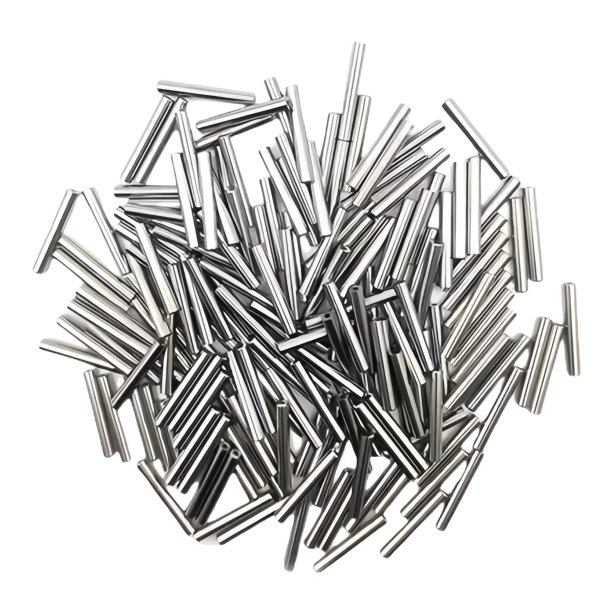
The Stainless Steel Capillary Tube Segments Bulk Supply are short lengths of fine stainless steel capillary tube, cut to size and supplied in bulk rather than as continuous stock. The shift from continuous tube to bulk cut segments moves the engineering onto the cut itself: the end condition of each segment, the consistency of length across hundreds of pieces, and the cleanliness of a fine bore that has just been cut open. A bulk supply is judged as a population – the customer needs every segment to be the same length, the same end condition and the same clear bore, because they will be used interchangeably. This page covers the cut-off, the length consistency and the cleanliness that a bulk capillary segment lives or dies by.
The cut end is the feature, and it has to be square and clean
On a bulk cut segment, the two cut ends are most of the part, and their condition is what the customer sees and uses. A capillary segment has to seat in a connector or a fitting at its end, so the end has to be square to the tube axis and free of the burr that a fine cut-off leaves. A burred or angled end does not seat, and on a fine bore the burr can also partially close the very opening the segment exists to provide. The cut is therefore a controlled operation with its own acceptance criteria, not a snip.
- Cut ends are held square to the tube axis, because the segment seats in a connector at that end.
- Burr is removed and verified, because a burr on a fine capillary both stops seating and can encroach on the bore.
- End condition is consistent across the bulk lot, because the segments are used interchangeably and one bad end is a rejected segment.
Length consistency across a bulk lot is a population requirement
When segments are supplied in bulk, the customer is buying a population of identical pieces, and the length has to be consistent across all of them, not just correct on average. A lot where most segments are the right length but a tail is short or long is a lot that jams an automated feeder or leaves a sensor at the wrong depth. Length is therefore held to a tolerance across the whole lot, and it is verified by sampling at a rate that actually represents the population rather than by checking one piece.
- Length is held to a tight tolerance across the entire lot, because the segments are used interchangeably.
- Length is verified by sampling at a rate that represents the population, not by a single measurement.
- Where the segments feed automated equipment, the length spread is checked against that equipment’s tolerance, because a wide spread jams a feeder.
Cutting fine capillary without closing the bore or leaving debris
Cutting a fine capillary tube is a small operation with an outsized failure list. The cut can push material inward and partially close the bore, it can leave a burr that sheds into that same bore, and the cutting process can introduce a particle that blocks a channel that was clear a moment earlier. The cut, the deburr and the cleaning are therefore one combined step, and the bore is verified clear after all of them, not assumed clear because the tube was clear before it was cut.
- The cut is made so it does not push material inward and partially close the fine bore.
- Deburring removes the cut burr without pushing debris into the bore, and the bore is verified clear afterward.
- Segments are cleaned and capped after cutting, because a freshly cut fine bore is the most vulnerable to a blocking particle.
Count, packing and cleanliness of a bulk supply
A bulk supply is delivered as a counted, clean quantity, and on segments too small to count individually that count is a real operation. The segments are cleaned, dried, counted – usually by weight, cross-calibrated to a parts-per-unit-mass figure – and packed so they do not abrade, nest or contaminate each other. A bulk lot that is the right length and end condition but short on count, or that arrives with debris in the bores, is a failed delivery even though every segment is individually good.
- Count is confirmed, cross-checked by weight on segments too small to count individually and re-calibrated when the stock lot changes.
- Segments are cleaned and dried as a bulk lot, because a damp fine-bore segment in a sealed bag is a corrosion and blockage risk.
- Packing keeps the segments separated and capped, so they do not abrade, nest or collect debris in transit.
How we verify a bulk capillary tube segment supply
Verification treats the lot as a population, checking the features that have to be consistent across every segment and confirming the delivery quantity and cleanliness.
- End condition: cut ends checked for squareness and burr across the lot, since the segment seats at that end.
- Length: verified by population sampling against the tolerance, and against any automated-feeding spread the customer needs.
- Bore: confirmed clear along the length and at the cut ends after deburring, on a sample that represents the lot.
- Cleanliness: segments verified clean and dry, with bores clear and ends capped.
- Count: confirmed by weight cross-check against the ordered quantity, re-calibrated when the stock lot changes.
- Material certificate and retention: stainless steel grade traceable to the lot, with retention samples drawn before the bulk supply ships.
First articles and retention samples are kept for the programme, so a repeat bulk supply is cut and verified to the same end condition, length and count. On a delivery whose value is a population of identical, clean, correctly-cut segments, holding the cut, the length spread and the count across the whole lot is what keeps a second supply dropping into the same process as the first.
Our Sensor Housings range is where this part sits. The sensor housings pages carry the process notes, common materials and inspection points behind every product in the family.
Specifications
| Item | Stainless Steel Capillary Tube Segments Bulk Supply |
|---|---|
| Brand | AUNOV |
| Designing | Share your print, or send a part to be measured, the quotation comes back with a manufacturability review attached. |
| Tooling | Dies engineered and produced in our own toolroom, with your part number on the tool record. |
| Samples | First-off samples of the tube are sent with a full dimensional report and mill certificate. |
| Materials | 304 / 316 stainless steel leads the stock list for this part, alongside carbon steel (SPCC / DC01), aluminium, brass and copper, with the final grade confirmed at the drawing review. |
| Surface finish | Zinc, nickel or chrome plating, e-coat, powder coat, anodising or passivation, fixed at the drawing review. |
| Processing | Multi-stage drawing, annealed in line where wall thinning calls for it, pierced and finish-machined on the same floor. |
| Equipment | Mechanical presses 5-250 T, hydraulic presses 250-500 T, CNC turning centres and a climate-controlled CMM room. |
| Tolerance | As-drawn tolerance +/-0.1 mm, +/-0.03 mm on machined features. |
| Delivery terms | Prices FOB, with DDP for EU and US on request, T/T and L/C accepted, D/P for established customers, scheduled call-offs welcome. |
Frequently Asked Questions
Why does the cut end count as a feature rather than as an edge?
It is the end the rest of the assembly meets. If it is out of square it will not seat in its fitting; if it carries a burr it obstructs the flow or cuts a seal; if the cut squeezed the bore closed the tube is blocked before it is used. Three failure routes, all decided by one operation.
Why is length consistency a population requirement rather than piece tolerance?
Because bulk parts are used as a batch. What matters is how the distribution behaves – whether the mean sits where it should and how wide the spread is – rather than whether every individual piece falls inside a band. Applying piece-by-piece logic here tends to produce a specification nobody can meet economically.
What does cutting fine capillary risk?
Closing or narrowing the bore, mostly. Fine tube is easy to crush in a grip and easy to leave a crescent of swarf inside, and both are invisible from outside. The cutting method and how the tube is supported during it therefore decide whether a cleaning and gauging step is needed afterwards.
Why does packing belong in a bulk specification?
Because counting and damage are the two complaints. Bulk quantities invite miscounts, and loose fine tube arrives bent. Agreeing how pieces are counted, separated, supported and identified prevents most of the problems attributed elsewhere, and costs nothing once it is part of the order.
Related Products



Request a Quote for This Part
Send a drawing or sketch — get material advice, tooling cost and a per-piece price within 24 hours (working days).