
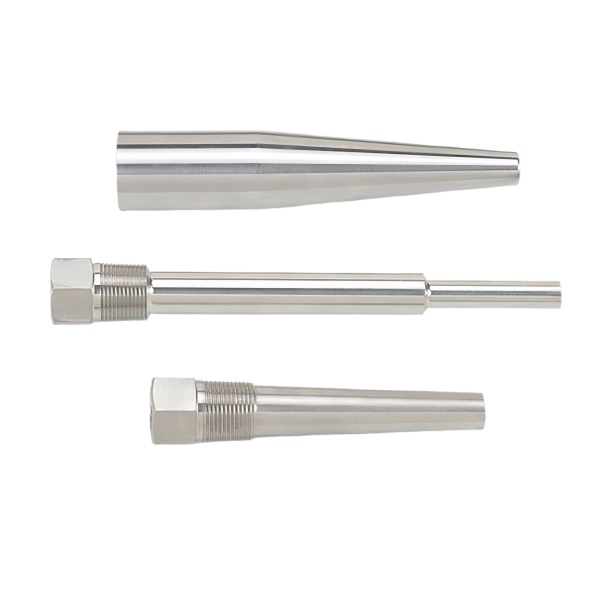
The Stainless Steel Tapered Thermowell Sleeves are protective sleeves – the tube that surrounds a sensor or a thermowell and conducts heat to it while shielding it from the process – whose bore or outer profile is tapered rather than straight. The taper is what makes the sleeve more than a plain tube: a tapered sleeve wedges into a matching tapered seat to locate positively, or presents a tapering wall that changes how it conducts and how it seals. The engineering of a tapered sleeve is about holding the taper’s angle and its concentricity to the sleeve axis, because a sleeve that is the wrong angle or off-axis neither seats nor conducts the way it is supposed to. This page covers the taper, the seating and the bore the sensor depends on.
A tapered sleeve locates by wedging, not by bottoming
A straight sleeve in a straight bore locates only by clearance – it can slide and it can rock. A tapered sleeve in a matching tapered seat wedges and locates positively, both axially and radially, and it tightens rather than loosens under load that pushes it inward. That positive location is usually the reason for the taper: the sensor inside has to sit at a known position and stay there, and a wedged sleeve holds that position in a way a straight clearance sleeve cannot.
- Taper angle is held to the mating seat’s angle, so the sleeve wedges along the intended contact band and seats at the right depth.
- The taper’s concentricity to the sleeve axis is checked, because a sleeve that is ground off-axis wedges on one side and seats crooked.
- Where the sleeve is meant to be removable, we confirm the taper angle releases cleanly rather than self-locking, so the sensor can be serviced.
The bore is the sensor’s home, and the taper complicates it
Whatever the outside taper does, the inside of the sleeve is where the sensor sits, and that bore has to be sized and finished so the sensor seats against the wall for heat transfer and runs without binding. On a tapered sleeve the bore and the outside taper interact: if the wall thickness is uniform, a tapered outside gives a tapered inside too, and a sensor that has to pass through a tapering bore has to clear the narrowest point. We control the bore as its own feature, independent of the outside taper.
- Bore diameter and finish are held to the sensor’s fit and thermal-seating requirement, measured at the critical section rather than inferred from the taper.
- Where the bore is also tapered, the sensor’s insertion path is checked at the narrowest point, so the sensor seats without binding.
- Wall thickness between the tapered outside and the bore is verified, since that web both carries load and conducts heat to the sensor.
Holding a true taper on stainless steel without drifting the bore
Machining a taper on a stainless steel sleeve means cutting a diameter that changes continuously along the part, and on a material that work-hardens as it is cut. The risk is that the taper is generated correctly but the process disturbs the bore – a thin-wall sleeve clamped or turned on the outside can go oval, and an oval outside on a tapered part usually means a distorted inside too, because they share a wall. The outside and the inside are one structure and they are controlled together.
- Thin-wall sleeves are machined over a supporting mandrel or with controlled clamping that does not squeeze them oval.
- The taper is generated rather than interpolated where accuracy matters, because a generated angle and an interpolated one leave different signatures on stainless steel.
- Finishing passes run below the work-hardened layer, so the bore and taper do not drift after machining as the stressed surface relaxes.
Concentricity between taper, bore and any mounting feature
A tapered sleeve usually has to agree with more than itself: the sensor in the bore, the tapered seat it wedges into, and often a flange or thread that mounts the whole assembly. All of those have to share one axis, or the sensor sits crooked in a sleeve that seats straight, or the sleeve seats straight and the mounting feature pulls it off. The concentricity stack across the taper, the bore and the mounting feature is the specification that ties the sleeve into the assembly.
- Runout between the tapered outside, the bore and any mounting thread or flange is measured together on the first article.
- The bore is treated as the functional datum and the outside taper and mounting feature are held concentric to it.
- Where the sensor has to read from a precise location, the whole stack is checked against that location, not just against a general tolerance.
How we verify a tapered thermowell sleeve
Verification checks the taper, the bore and the concentricity between them and any mounting feature, because a tapered sleeve only performs if they all share one axis.
- Taper: angle verified to the mating seat, and concentricity to the sleeve axis checked on the first article.
- Bore: diameter, finish and straightness confirmed at the critical section, with the sensor’s insertion path checked at the narrowest point.
- Wall thickness between taper and bore spot-checked, tracing the web that carries load and conducts heat.
- Concentricity stack: runout between taper, bore and any mounting thread or flange measured together.
- Material and passivation records per lot, confirming the stainless steel grade and that free iron was removed after machining.
- Fit check: the sleeve wedged into its gauge seat with the sensor inserted, proving seating, bore fit and concentricity together before the run.
First articles and retention samples are kept for the programme, so a repeat run of the tapered sleeve is machined and trued to the same verified taper and bore. On a part whose taper, bore and mounting all have to share one line for the sensor to seat and read correctly, that baseline is what keeps a second batch performing like the first.
Our Sensor Housings range is where this part sits. The sensor housings pages carry the process notes, common materials and inspection points behind every product in the family.
Specifications
| Item | Stainless Steel Tapered Thermowell Sleeves |
|---|---|
| Brand | AUNOV |
| Designing | Send drawings, or send a sample to be measured, our engineers reply with a manufacturability assessment and pricing. |
| Tooling | Dies engineered and produced in our own toolroom, held under your part number. |
| Samples | Pre-production samples ship with dimensional data plus material certs. |
| Materials | 304 / 316 stainless steel is the primary stock for this part, alongside carbon steel (SPCC / DC01), aluminium, brass and copper, with grade selection confirmed at drawing review. |
| Surface finish | Zinc, nickel or chrome plating, e-coat, powder coat, anodising or passivation, as called out on your print. |
| Processing | Deep drawing in stages, in-line annealing where needed, pierced and finish-machined on the same floor. |
| Equipment | Mechanical presses 5-250 T and hydraulic presses 250-500 T, CNC turning centres, climate-controlled CMM room. |
| Tolerance | Tolerances to +/-0.1 mm as drawn, +/-0.03 mm on machined features. |
| Delivery terms | Standard terms FOB, DDP offered to EU and US, T/T and L/C accepted, D/P for established customers, call-off scheduling supported. |
Related Products


Frequently Asked Questions
Why taper a sleeve instead of leaving it straight?
A tapered sleeve wedges into a matching tapered seat and locates positively, both axially and radially, tightening under inward load rather than loosening like a clearance fit.
What must the taper hold?
Its angle and concentricity to the sleeve axis, because a sleeve at the wrong angle or off-axis neither seats nor conducts as intended.
What does the sleeve do?
It surrounds and shields the sensor while conducting heat to it, so its bore is what positions the sensor.
Which stainless steel grade is used?
304 or 316, drawn then finished on the bore and the taper so the sleeve seats and conducts as specified.
Request a Quote for This Part
Send a drawing or sketch — get material advice, tooling cost and a per-piece price within 24 hours (working days).