
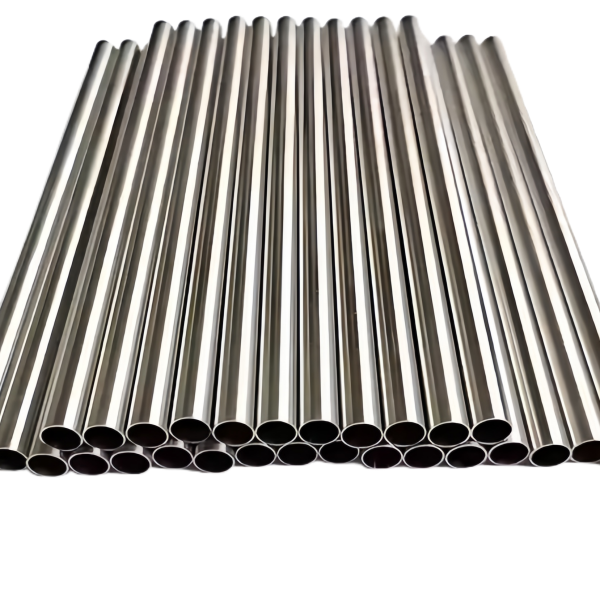
The Long Straight Stainless Steel Capillary Tubes Bundle is a set of fine stainless steel capillary tubes supplied long and, above all, straight. The defining requirement is in the name: these are long, fine-bored tubes, and long fine tubes are extraordinarily difficult to keep straight. A capillary tube that is even slightly bowed will not feed cleanly through a gland, a connector or a guide, and a bundle of them magnifies the problem because they have to stay straight and separated along their whole length. The engineering of this part is dominated by straightness – producing it, holding it through handling, and delivering it in a bundle that does not undo it. This page covers the straightness requirement, how it is produced and how the bundle protects it.
Long fine tubes are straightness problems before anything else
A short capillary tube is forgiving; a long one is not. The longer the tube, the more any small bow accumulates into a real deviation, and the more the tube’s own weight and any handling load can bend it. For a long fine stainless steel capillary, straightness over the full length is the specification that governs whether the part is usable at all, because a tube that will not pass straight through a connector is scrap regardless of its bore or its wall. Everything about making this part is subordinate to keeping it straight.
- Straightness is specified over the full length, not inferred from the ends, because a long tube can be straight at both ends and bowed in the middle.
- The straightness tolerance tightens with length, because the same absolute deviation is a far bigger deal on a long tube than a short one.
- We verify straightness on the finished bundle, because the act of bundling is itself one of the things that can bend a long fine tube.
Producing straight fine tube is a process, not a final operation
You cannot reliably straighten a long fine capillary at the end; the straightness has to be built in and protected at every step. That means supporting the tube continuously through drawing, annealing, cutting and handling, because an unsupported long fine tube deflects under its own weight and under any process load. Where a straightening step is needed, it is a controlled operation with the tube supported, not a quick manual bend-back that leaves residual stress and a tube that drifts afterward.
- The tube is supported along its length through every operation, because an unsupported long fine tube bends under its own weight.
- Any straightening is done with the tube supported and is followed by a stress relief where needed, so the tube does not spring back after it is measured.
- Annealing cycles are controlled so they do not introduce the bow that a tube picked up in a hot furnace can develop.
Bundling long tubes without bending them
Gathering several long fine tubes into a bundle is one of the operations most likely to destroy the straightness that was so hard to achieve. If the tubes are pulled tight, bent to a common radius or clamped hard to hold them together, the tubes on the outside of any bend are stretched and the bundle arrives bowed. The bundling therefore has to hold the tubes in a controlled, gentle layout that keeps them straight and separated without forcing them into a curve.
- Tubes are laid straight and held gently, because pulling a bundle tight or bending it to a radius bows the outer tubes.
- Tubes are kept separated so they do not gall or abrade each other along a long shared run.
- The bundle is supported along its full length in packing, because a long bundle that droops in the box arrives bent.
Handling and packing are where long-tube straightness is won or lost
After all the effort of making long fine tubes straight, the easiest way to ruin them is to handle them like short tubes. A long capillary that is picked up by one end, coiled too tight, or packed loose in a box will be bent before the customer ever sees it. The handling and packing are therefore designed around the length – supported coils at a controlled radius, full-length support in the box, and protection at the ends – because straightness delivered to the pack-out line is not the same as straightness delivered to the customer.
- Coiling, where the tubes are coiled, is to a radius that does not set a permanent bow in the fine tube.
- Packing supports the full length, so the bundle does not sag or bend in transit.
- Ends are protected and capped, because a kinked end on a long fine tube is a dead channel and an open fine bore collects debris.
How we verify a long straight capillary tube bundle
Verification on this part puts straightness first, because it is the requirement that governs usability, and it checks the tubes and the bundle separately.
- Per-tube straightness: each tube checked over its full length, on a straightedge or rollers, against the length-scaled tolerance.
- Individual tube features: bore, outer diameter and length verified per tube, with each bore confirmed clear along its length.
- Bundle straightness and layout: the assembled bundle checked to confirm the bundling did not bow the tubes and that they remain separated.
- End condition: tube ends inspected for kinks and burrs, and confirmed capped to keep the fine bores clear.
- Packing: the bundle confirmed supported along its full length so it does not bend in transit.
- Material certificates per lot for the tubes, traceable to the release, with a fit check at the connectors before the bundle ships.
First articles and retention samples are kept for the programme, so a repeat bundle is made and packed to the same verified straightness. On a part whose entire value is long fine tubes that arrive straight and stay straight, holding straightness through every operation and through the bundle and the box is what keeps a second delivery feeding as cleanly as the first.
This part belongs to our Sensor Housings range. The sensor housings pages collect the process notes, common materials and inspection points behind every product in the family.
Specifications
| Item | Long Straight Stainless Steel Capillary Tubes Bundle |
|---|---|
| Brand | AUNOV |
| Designing | Send drawings, or send a sample to be measured, DFM feedback is returned with the quote. |
| Tooling | Tooling designed and cut in house, held under your part number. |
| Samples | Approval samples of the tube ship with a full dimensional report and material certification. |
| Materials | Stock for this part leads with 304 / 316 stainless steel, alongside carbon steel (SPCC / DC01), aluminium, brass and copper, with grade selection confirmed at drawing review. |
| Surface finish | Zinc, nickel or chrome plating, e-coat, powder coat, anodising or passivation, per your print. |
| Processing | Deep drawing in stages, in-line annealing where needed, pierced and machined on the same floor. |
| Equipment | Our press floor runs 5-250 T mechanical and 250-500 T hydraulic presses, in-house CNC cells and a temperature-controlled inspection room. |
| Tolerance | As-drawn tolerance +/-0.1 mm, +/-0.03 mm after machining. |
| Delivery terms | FOB standard, DDP offered for EU and US, payment T/T or L/C, D/P for repeat accounts, call-off schedules and blanket orders supported. |
Frequently Asked Questions
Why is straightness the first requirement rather than a dimensional one?
Because length amplifies everything. A deviation that is unmeasurable on a short piece puts the far end of a long fine tube somewhere it cannot be threaded, or somewhere other than the point being measured. Straightness therefore decides whether the part can be installed at all, which puts it ahead of anything measured across it.
Why can straightness not simply be corrected at the end?
Correcting it introduces what you were trying to avoid. Straightening a fine tube locally works it, leaves residual stress and can oval the section, so a tube that arrives straight can distort later or lose roundness. Straightness has to be built in progressively through the process rather than imposed as a last operation.
Where is straightness most often lost?
After the process, not during it. Long fine tubes get bent being bundled, being lifted, being coiled for transit and being unpacked. Most of the straightness customers actually see is decided by how the bundle is supported and handled rather than by how accurately it was produced.
How should straightness be stated for a bundle?
Over the free length, and against a stated support. A figure quoted per unit length misses cumulative bend entirely, and a check performed unsupported measures the tube hanging rather than working. Specifying how it rests and how far along it is judged removes most of the argument.
Related Products


Request a Quote for This Part
Send a drawing or sketch — get material advice, tooling cost and a per-piece price within 24 hours (working days).