
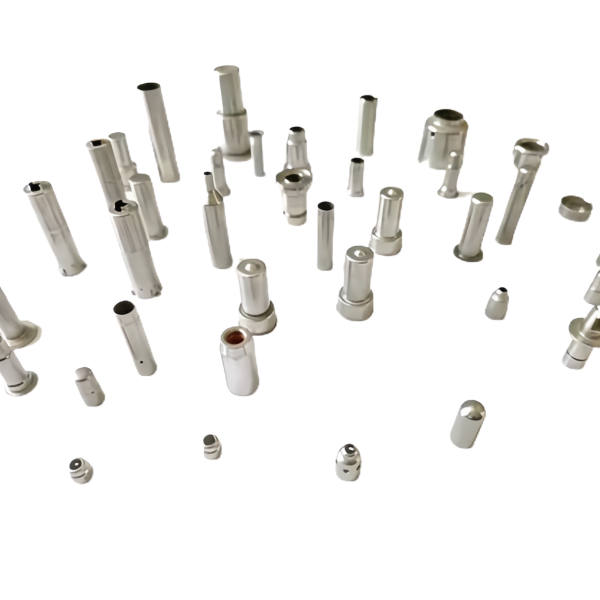
The thread on a probe housing is the feature most likely to be specified wrongly, and it is the one that is hardest to fix afterwards. This assortment covers the thread forms in common use, and the differences between them are not cosmetic: they seal differently, they are not interchangeable, and mixing them damages the port.
Taper threads and parallel threads seal differently
The important distinction is not the standard, it is whether the thread seals on the thread or on something else. A taper thread such as NPT or BSPT seals by wedging as it is tightened, which means its sealing depends on engagement depth and usually on a sealant. A parallel thread such as BSPP or a metric fine does not seal on the thread at all; it clamps a washer, an O-ring or a gasket against a face or a shoulder. Specifying one and fitting the other produces a joint that either will not seal or will not go together properly.
The thread has to match the port it is going into
NPT and BSP threads have the same nominal sizes and different thread angles, which means they will start to screw together and then bind, damaging both. This is common enough that we ask for the port standard on the drawing or at RFQ rather than inferring it. Where a customer is building new equipment, we will say which thread family suits the service; where they are replacing an existing part, the port decides and nothing else does.
Stainless Steel threads gall, and that is a specification issue
Stainless Steel threaded into stainless steel will gall and seize if it is tightened dry or too fast, and a seized probe housing is a part that has to be destroyed to be removed. Threads are cut to the correct class of fit, and for assemblies that will be opened more than once we flag it at quotation – a fitting that will see repeated service may be better in a dissimilar material or with an anti-seize specified, and either is easier to arrange before the parts are made than after they are fitted.
Thread and shoulder have to be concentric
Where the housing also seals on a shoulder or a face, the thread and that seat have to be concentric, or tightening the thread pulls the seat out of square and the joint seals on one side. The thread is cut in the same setup as the sealing feature wherever the geometry allows, which holds the relationship directly instead of relying on the tolerance of two separate operations to agree.
How the threads are checked before the part ships
Threads are gauged to the specified standard rather than test-fitted, and the sealing seat is checked concentric to the thread.
First articles and retention samples are kept for the programme, so a reorder is threaded to the same standard and the same class of fit. On a part that has to screw into a port that already exists, that is what keeps the second batch fitting like the first.
This part belongs to our Sensor Housings range. The sensor housings pages collect the process notes, common materials and inspection points behind every product in the family.
Where this part is used
Threaded-end probe housings are used wherever the housing screws into a port and the probe passes through it. Food, medical and process probes share the same interface logic: a threaded body that seals against the port, a bore that locates the sensing element, and an outside surface that has to be cleaned.
Because these ship as an assortment, the thread standard is the one thing that has to be common across the range. Where it is not, the assortment becomes several small programmes with separate tooling, and the quotation changes accordingly.
What we need to quote it
Send the thread standard and thread length per size, and tell us whether threads are rolled or cut — rolled is stronger and is what we prefer on stainless steel, but it needs the wall to allow it. Add the volume split across the assortment and whether the sizes share a die family.
Specifications
| Item | Stainless Steel Probe Housings Assortment Threaded Ends |
|---|---|
| Brand | AUNOV |
| Designing | A drawing file or a physical sample starts the review, our engineers reply with a manufacturability assessment and pricing. |
| Tooling | Tooling designed and cut in house, held under your part number. |
| Samples | Sample parts arrive with a dimensional report plus material certs. |
| Materials | Stock for this part leads with 304 / 316 stainless steel, alongside carbon steel (SPCC / DC01), aluminium, brass and copper, with the final grade confirmed at the drawing review. |
| Surface finish | Plating, e-coat, powder coating, anodising or passivation as the drawing calls out, per your print. |
| Processing | Multi-stage drawing, annealed in line where wall thinning calls for it, then pierced and machined in house. |
| Equipment | Press capacity from 5 to 500 T across mechanical and hydraulic lines, CNC cells plus a temperature-controlled CMM room. |
| Tolerance | As-drawn tolerance +/-0.1 mm, with machined features to +/-0.03 mm. |
| Delivery terms | FOB as standard, DDP available for EU and US destinations, payment T/T or L/C, D/P for repeat accounts, call-off schedules and blanket orders supported. |
Frequently Asked Questions
Why does the thread form matter more than the thread size?
Because the two common families seal in completely different places. Tapered threads seal by the interference developed along the flanks as they wind in, while parallel threads seal against a face or washer and the thread only provides clamping. Two fittings of identical nominal size built on different forms will neither seal nor interchange.
What happens when the thread does not match the port it goes into?
Rarely something obvious immediately. Usually it will not wind in to its intended depth, so the probe ends up measuring from the wrong position, or it is forced and distorts the sealing face. Both produce a joint that looks installed and behaves badly, which is why identifying the port standard belongs on the enquiry.
Why do stainless steel threads need attention on the drawing?
They gall. Similar stainless steel surfaces under thread pressure and sliding will cold-weld and seize, often during assembly rather than service, leaving a fitting that cannot be removed without destruction. It is a known behaviour with known mitigations, but only if somebody specifies them rather than leaving assembly to find out.
Why must the thread and the shoulder be concentric?
Otherwise winding in cocks the part. The seal then loads unevenly around its circumference, giving one side much more compression than the other, and the fitting never quite repeats the depth it reached last time. Concentricity between these two features does more for sealing reliability than tightening either tolerance.
Related Products



Request a Quote for This Part
Send a drawing or sketch — get material advice, tooling cost and a per-piece price within 24 hours (working days).