
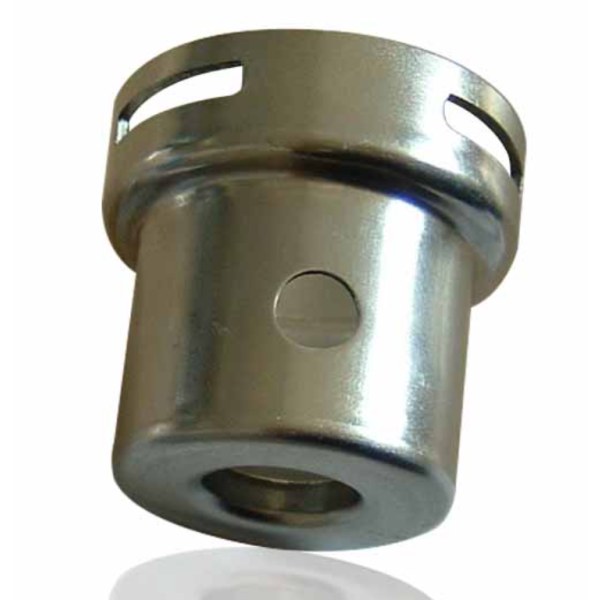
A dome plug seals by its flange, not by its dome
A deep drawn steel dome plug with a large flange looks like a cap, but the dome is mostly material that lets the flange exist. The seal happens at the wide flange, where a gasket or a face sits and where the bolts or the press-fit pull the part flat. The dome itself is under little sealing load; it is the bit of shell that had to be drawn to reach the flange. We design the plug from the flange outward, holding its flatness and its bolt circle as the functional features, and we treat the dome as the forming route that delivers them. A plug specified only by its dome shape and not by its flange flatness is a plug that will weep at the joint.
We draw these on mechanical presses in carbon steel, holding the as-drawn envelope to roughly +/-0.1 mm and any machined seal face to +/-0.03 mm. The dome is drawn in staged reductions where its depth demands it, with the large flange formed as the reference plane, and any threaded or bolted feature is placed so it loads the flange rather than the thin pole.
The dome plug is planned flange-first, and that plan is what we log against your part number. A reorder starts from recorded draw settings rather than a retune, and the flange flatness and bolt-circle position we proved first time are held on every later batch, so the plug that sealed when approved keeps sealing on the ones that follow.
The pole of the dome is the place we most watch for thinning, because it is the most stretched point of the draw and the easiest to dent. We measure pole wall thickness on the first article and we set the blank so the pole stays above the service limit, because a plug that looks fine on the flange but is thin at the top fails the first time it is handled or pressured.
A bolted dome plug spreads its seal load across a wide circle, and that is why we favour it over threading for large bores. A threaded large plug needs a heavy wall and a deep thread and is a fight to install; a flanged one is a thin drawn shell with bolts and seals better. We recommend the route from the bore size rather than from habit.
The flange flatness of a dome plug is what the gasket reads, and springback is the enemy. We over-form the flange so it relaxes flat and we lock that setting, because a flange that leaves the die flat but curls in the rack will not seal no matter how good the dome looks. We measure the flatness, we do not assume it from the die.
Drawing a hemisphere into steel: the wrinkle-and-fracture window at the pole
A dome is the hardest simple shape to draw, because the material at the pole has to stretch while the material at the rim has to flow, and the two fight. Too little hold on the rim and the dome wrinkles; too much stretch at the pole and it fractures. The window between those two failures is the draw engineer’s real problem, and it is narrower on a deep dome than on a shallow one. We set the blank holder pressure and the reduction so the pole stretches just enough and the rim feeds just enough, and we anneal between stages where the depth requires it.
- Pole stretch is the limit. The top of the dome sees the most thinning, and we measure pole wall thickness because a thin pole dents under handling or pressure.
- Rim wrinkle is the other limit, and we control it with holder pressure and draw beads rather than by over-thinning the pole.
- The large flange is the anchor that lets us pull the dome without the rim collapsing, which is why a dome plug wants a wide flange rather than a narrow one.
- Stage count follows depth, and we plan it rather than forcing a deep dome in one hit that would simply fracture.
The large flange is a gasket plane, and its flatness decides the leak
The flange on a dome plug is wide by design, and that width is what makes the seal reliable: a wide flange spreads the bolt load, stays flat under it, and gives the gasket a long, even seat. A narrow flange deflects and pinches the gasket unevenly, leaking on the light side. We keep the flange as the drawn reference plane, flatten or restrike it so it leaves the die true, and measure its flatness directly, because that single number predicts the seal better than any dome dimension.
Springback is the thing that tries to spoil this. Steel relaxes after the punch releases, and a flange that was flat in the die can curl slightly out. We compensate with an over-form that relaxes into flat, and we lock that setting from the first article so repeats stay flat. We also watch the flange edge for burr, because a burr under the gasket is a leak path the gasket cannot bridge.
We also confirm the bore size and the sealing method before fixing the flange, because the flange width and the bolt circle are set by how the plug meets its mate. A plug drawn to a flange that is too narrow for the bore will deflect and leak no matter how perfect the dome is, so the flange is sized from the seal requirement first and the dome is drawn to deliver it, not the other way round.
Threaded versus bolted dome plugs, and why the flange wins on a large bore
A dome plug can be threaded into a bore or bolted through its flange, and the choice is decided by the bore size. A small plug threads in neatly; a large-bore plug that is threaded needs a heavy wall and a deep thread and is a pain to install and remove. A large flange with bolts is simpler, seals better on a big circle, and lets the plug be a thin drawn shell rather than a chunk of machined stock. We recommend the flanged, bolted route for large bores and reserve threading for the small ones, because that is where each approach is actually better.
- Bolted flanges spread load and suit the wide seal circle a large dome needs.
- Threaded plugs need wall thickness for the thread, which fights the thin-shell economy of drawing.
- The bolt circle is concentric with the bore, confirmed so the load is even and the gasket is not starved on one side.
Wall thinning at the dome pole, and why we measure it rather than assume it
The pole of a drawn dome is the thinnest point by design, and whether that thinning is acceptable depends on what the plug has to survive: handling, a pressure differential, a bolt that loads the flange. We do not assume the blank calculation got it right; we measure pole thickness on the first article and we set the blank and reduction so the pole stays above the limit the service needs. A plug that looked fine on the outside but thinned at the pole dents the first time someone tightens the bolts or drops the part.
This is also where the stage plan pays off. A dome drawn in one aggressive hit thins the pole more than the same dome drawn in two gentle hits with an anneal, and we choose the route from the wall the pole must keep. The cost difference is a few extra press cycles; the alternative is a weak plug, and we would rather spend the cycles.
How we verify a dome plug
A dome plug is verified as a sealing component, because the flange is the whole point. The routine:
- First-article CMM report on the flange, bolt circle and any machined seal face, at the stated condition.
- Flange flatness measurement on a surface plate, because the gasket depends on it under bolt load.
- Pole wall thickness check, to confirm the draw did not thin the dome below the service limit.
- Bolt-hole position and concentricity with the bore, so the seal load is even.
- Edge and burr inspection at the flange and any threaded feature, because a burr under the gasket leaks.
- Material certificate confirming the grade the draw and the flange design assumed.
The plug ships with its dimensional report and certificate under your part number, and the draw settings are archived so a repeat order is a repeat process rather than a redevelopment of the dome.
Send the plug drawing with the flange width, the bolt circle and the bore size stated, and we return a manufacturability review with the quotation and a first article proving the flange flatness and the pole thickness. Tell us the sealing method, because that sets the flange the dome is drawn to deliver.
The engineering calls behind a part like this — draw ratio, wall thinning, radii and trim — each get worked examples in our deep drawn covers guide; the Precision Deep Drawn Parts pages gather the rest of the family.
Specifications
| Item | Steel Deep Drawn Dome Plug with Large Flange |
|---|---|
| Brand | AUNOV |
| Designing | Send us your 2D drawing, or mail a sample for measurement, you get a DFM review together with the quotation. |
| Tooling | Our own toolroom designs and builds every die, held and maintained under your part number. |
| Samples | The first-article set ships with dimensional data and material certification. |
| Materials | Stock for this part leads with carbon steel (SPCC / DC01), alongside 304 / 316 stainless steel, aluminium, brass and copper, with grade selection confirmed at drawing review. |
| Surface finish | Finishes on offer: plating, e-coat, powder coating, anodising or passivation, set by your print. |
| Processing | Multi-stage drawing, annealed in line where wall thinning calls for it, then pierced and machined in house. |
| Equipment | Our press floor runs 5-250 T mechanical and 250-500 T hydraulic presses, CNC cells plus a temperature-controlled CMM room. |
| Tolerance | +/-0.1 mm on as-drawn surfaces and +/-0.03 mm on machined surfaces. |
| Delivery terms | FOB standard, DDP offered for EU and US, payment T/T or L/C, D/P for repeat accounts, scheduled call-offs welcome. |
Frequently Asked Questions
What part of this plug actually does the sealing?
The wide flange, not the dome. The dome is substantially the material that had to be drawn in order for the flange to exist, and it carries very little sealing load. A plug ordered by its dome shape alone and not by its flange flatness is a plug that will weep at the joint.
Why does flange flatness have to be on the drawing?
Because the flange is the gasket plane, and whether it stays flat under bolt load is what decides whether the joint holds. We iron the flange toward +/-0.03 mm on a machined seal face, with the as-drawn envelope running at roughly +/-0.1 mm elsewhere.
Threaded or bolted for a plug with a large bore?
On a large bore the bolted flange usually wins. Threading loads the thin pole and the dome wall behind it, while bolting through the flange puts the load into the section that exists to carry it.
How do you keep the dome from splitting or wrinkling while it is formed?
By drawing the hemisphere in staged reductions rather than asking for it in one hit, because there is a wrinkle-and-fracture window at the pole. Wall thinning there is measured on the first article rather than assumed from the nominal.
Related Products


Request a Quote for This Part
Send a drawing or sketch — get material advice, tooling cost and a per-piece price within 24 hours (working days).