
A smoke detector cover is a fire-safety component, and it is judged by what it lets through
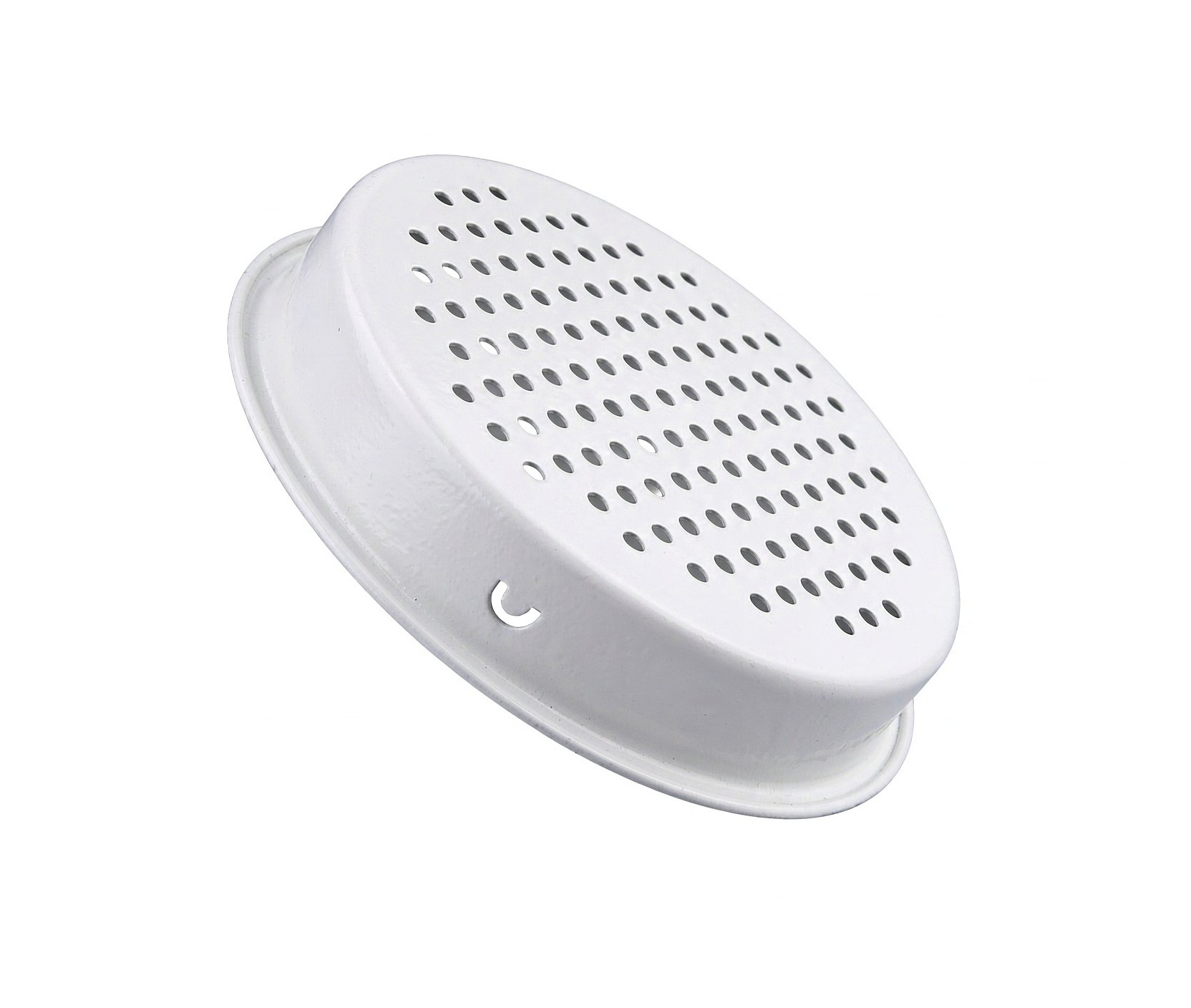
A white perforated smoke detector cover is a small white plastic-looking part with a pattern of holes, and it is part of a life-safety system. The engineering on it is unusual in this family in a specific way: the cover’s whole purpose is to let smoke in and to keep smoke out of the wrong places, and every requirement follows from those two jobs. A cover that is too closed delays the alarm. A cover that is too open lets the alarm trigger on non-smoke. Both are safety failures, and both are decided by the perforation pattern’s geometry rather than by anything a moulding engineer would think about.
We multi-stage draw with interstage annealing, then trim and pierce in following dies, and first articles verify the whole flow before the run is released, on mechanical presses 5-250 T and hydraulics 250-500 T with in-line annealing furnaces, with CNC turning centres for secondary operations and CMM inspection. Turned secondary features to +/-0.03 mm and as-drawn walls to +/-0.1 mm, and dimensional reports accompany the first article. Stock runs to carbon steel in SPCC and DC01 grades, 304 and 316 stainless steel, aluminium and brass, with grade and temper confirmed in writing before tooling. Surface treatment is matched to the duty – plating, coating or polishing – with masking and laser marking available where needed. This page is about the perforation, the airflow, and the four requirements that make this a safety part rather than a cosmetic one.
The holes are the sensor, and they have a specification
Ionisation and photoelectric smoke detectors both work by air movement, and the cover’s perforation pattern is what allows that air to move. The requirements are precise and they are not the requirements of a general perforated part:
- Open area, as a percentage of the cover’s total area. This is the primary number. Too low and the sensor’s response time suffers; too high and the cover does not exclude ambient light or air currents. It is a design calculation, not a manufacturing output.
- Total open area, and where it is distributed. A cover whose perforations are concentrated in one region does not deliver air to the whole chamber evenly, and a photoelectric detector needs light to reach its sensor from a defined direction. The distribution of the open area is a design requirement.
- Free area of each hole, and the hole’s depth. A hole in a thin wall has a free area close to its nominal diameter; a hole in a thicker wall or in a formed feature has an effective free area smaller than its nominal area because of the entry and exit effects. Where a hole is in a domed or drawn region, the actual restriction is not the hole’s diameter.
- Directionality, for a photoelectric detector. A photoelectric detector works by passing light through the chamber from a transmitter to a receiver. The cover’s perforation pattern has to support that light path – which means the cover’s design has to let light in from a defined direction and block stray light from other directions. That is a design feature, and it is why many photoelectric covers have a pattern that is not uniform around the circumference.
Light exclusion, which is the other half of the job
A photoelectric detector will be fooled by a bright light shining into the chamber. A white cover is not just a colour choice – it is part of the light-exclusion strategy, and it produces a specific set of requirements:
- Chamber geometry, not just hole size. Each hole may be a light path into the chamber, and what matters is whether the hole’s axis points toward the detector’s sensor or away from it. A pattern of holes whose axes all point at the sensor is a design error, and it is a design error rather than a manufacturing one.
- Light-absorbing baffles or offsets. Many covers use an offset or a labyrinth so that a hole’s straight-line path to the sensor is blocked. That geometry is part of the cover’s function, and it is not visible in a hole-pattern drawing – it needs a section.
- Colour, and why white. A white cover both reflects stray light away and provides a visible indication that the unit is present. On a dark cover, a light entering a hole can bounce around the chamber and reach the sensor, so the colour and the geometry work together.
- The cover’s reflection properties. Where the chamber interior is designed to reflect light, the cover’s inner surface matters as much as the holes do. A glossy interior behaves very differently from a matte one.
Airflow, and the response time it governs
The whole purpose of the cover is to let smoke reach the sensor quickly, and this is a measurable performance:
- The open area sets the airflow rate, and the airflow rate sets how quickly the chamber’s smoke concentration changes relative to the ambient.
- Bulk density and chamber geometry matter too. The obstruction presented by the cover is not just the total open area – it is the pattern of solid and open, because a cover with large open blocks can pass smoke quickly in one direction and slowly in another.
- Direction of airflow and mounting orientation. A cover designed for a ceiling mount may be optimised for smoke arriving from below. On a wall mount the same cover will be slower, and the pattern may be wrong entirely.
- Ventilation balance. A smoke detector also needs air to leave the chamber as fresh air enters. A cover that admits well but does not vent causes the chamber to stabilise and lose sensitivity. Both directions matter.
Material: this is a part where the material list is not really the point
Stock runs to carbon steel in SPCC and DC01 grades, 304 and 316 stainless steel, aluminium and brass, with grade and temper confirmed in writing before tooling, and surface treatment is matched to the duty. On a smoke detector cover the honest observation is that the material is rarely the deciding factor:
- What the cover must not do is shrink, distort, or change colour over the product’s life, because a warped cover changes the airflow and a yellowed cover changes the light exclusion. Material stability over time is the real requirement.
- Corrosion resistance matters if the cover is in a damp location, and a plated or passivated part is a reasonable route to it.
- Heat resistance matters because detectors are tested in a flame or heat test, and a cover that deforms in that test fails the certification.
- Most real smoke detector covers are moulded polymer, because a white moulded part is cheaper, lighter, insulating, and takes the perforation pattern cleanly in a single operation. A drawn metal cover is the answer where the environment is harsh, where a metal cover is required by the enclosure design, or where a drawn part is being used for a metal-bodied detector family. It is worth asking at review whether a drawn metal cover is needed, because it is a substantially more expensive way to make the same shape.
Tolerance, and where it actually has to be tight
Turned secondary features to +/-0.03 mm and as-drawn walls to +/-0.1 mm is the stated structure, and on this part the tight band belongs to:
- The mounting features, – the screw bosses or the bayonet ring – because the cover has to seat on the detector body and a warped or mislocated cover will not seal or will not twist correctly.
- The perforation’s position relative to those features, because the pattern’s relationship to the chamber is what sets the light path.
- Any sealing face, where the cover seals against the body to exclude ambient air and light from the chamber’s edge.
And on the wall: as-drawn walls at +/-0.1 mm is a general band, and for the perforation it is the hole’s own characteristics that matter more than the wall – the hole’s diameter, its free area, and whether the hole is in a flat or a formed region. A hole in a formed region may have an effective area significantly different from its nominal, and that is a design consideration rather than a tolerance.
A white cover’s uniformity across a batch is a requirement, not luck
Surface treatment is matched to the duty, with masking and laser marking available where needed. Three points specific to this part:
- Colour is a functional requirement and a white cover’s uniformity is a visual requirement across a batch. A retained colour reference sample is worth more than a colour code, and a part whose colour has drifted will be rejected by a customer’s incoming inspection even though every dimension is correct.
- Coating on the interior is a light-exclusion risk. A glossy coating on the interior will reflect stray light into the chamber, which is the opposite of what the design needs. This is one of the few cases in this family where a cosmetic finish decision can defeat the function.
- Masking the mounting features where they seal or where a dimension is critical.
A moulded cover may well be the right product
Seven things, and the first two are what turn a cover into a functional component:
- Open area, as a percentage, and the total free area of the pattern. This is the primary functional number.
- The pattern’s distribution and its relationship to the chamber – which needs a section view or a clearly stated reference to the sensor’s position, because a hole pattern without a reference to what it is admitting air and light to is not a specification.
- Hole diameter, free area, and depth, and whether each hole is in a flat or a formed region.
- Any light-exclusion geometry – offsets, baffles, or a labyrinth – stated as a feature, not as an implied consequence of the hole pattern.
- Mounting features and their tight-band tolerances, plus the sealing face if there is one.
- Colour, with a retained reference sample, and the gloss or texture if it matters.
- The mounting orientation, since a cover optimised for a ceiling mount can be wrong for a wall mount.
Is a drawn metal cover right for this product at all?
Is a drawn metal cover the right answer for this product at all? A smoke detector cover is a part where the requirements are geometric, functional, and safety-related, and where a moulded polymer part delivers the same geometry more cheaply with better colour consistency and better long-term stability. A drawn metal cover is justified where the detector family is metal-bodied, where the environment is harsh enough to need a metal cover, or where a specific thermal or EMC requirement applies. It is worth asking at enquiry, because the answer changes the whole approach to the part – and if a drawn cover is required, the perforation’s open area and the light-exclusion geometry are the two things to get onto the drawing before anything else.
Sizing the draw for a part like this — reduction per station, ironing allowance, flange width — is covered step by step in our deep drawn covers guide.
Specifications
| Item | Deep Drawn Aluminum Smoke Detector Cover |
|---|---|
| Brand | AUNOV |
| Designing | Made to your 2D/3D drawings (PDF, DWG, STEP, IGS) – DFM notes are returned before any tooling is cut; changes are priced before they are made. |
| Tooling | Our toolroom covers die design, wire-cut EDM and maintenance, so die cost stays transparent, and the die remains dedicated to your part. |
| Samples | Samples are issued for approval before the run, so the approved first article becomes the gauge reference, and the signed sample is kept for future reorders. |
| Materials | Stock runs to carbon steel, 304 / 316 stainless steel, aluminium and brass; grade and temper are confirmed in writing before tooling. |
| Surface finish | Surface treatment matched to the duty: plating, coating or polishing; masking and laser marking available where needed. |
| Processing | Multi-stage deep drawing with interstage annealing, trimmed and pierced in following dies; first articles verify the whole flow before the run is released. |
| Equipment | Mechanical presses from 5 to 250 T and hydraulic presses 250-500 T, with in-line annealing furnaces, with CNC turning centres for secondary operations and CMM inspection. |
| Tolerance | +/-0.03 mm on turned secondary features, +/-0.1 mm on as-drawn walls; dimensional reports accompany the first article. |
| Delivery terms | FOB, with DDP offered for EU and US addresses, T/T with deposit and L/C for larger runs; price breaks tie to annual volume. |
Frequently Asked Questions
What specifications do the holes on a smoke detector cover meet?
The holes are the sensor openings, so they are sized and spaced to the detection standard the product is built to, not just to look right. Hole diameter, pitch, and burr are held so airflow and light exclusion both stay in spec, and the sample is measured before the run repeats.
Why is a drawn metal cover used instead of moulded plastic?
A drawn aluminium cover gives rigidity, EMI shielding, and a stable opening pattern that moulding can struggle to hold across a batch, at the cost of a different tooling route. For a fire-safety component the metal part is often chosen where the specification demands dimensional stability over the life of the product.
Which aluminum is used for a smoke detector cover?
A formable 5xxx or 6xxx grade is specified so the cover draws cleanly and holds its openings, with the temper picked for stability after finishing. The alloy follows the draw and the finish, and the white coating that follows is held uniform across the batch.
How is batch-to-batch colour uniformity held on a white cover?
The coating is applied to a controlled process window and checked against a master so a white cover made months apart still matches. Uniformity across the batch is treated as a requirement, not luck, because a cover that changes shade between deliveries fails the product audit.
Related Products


Request a Quote for This Part
Send a drawing or sketch — get material advice, tooling cost and a per-piece price within 24 hours (working days).