
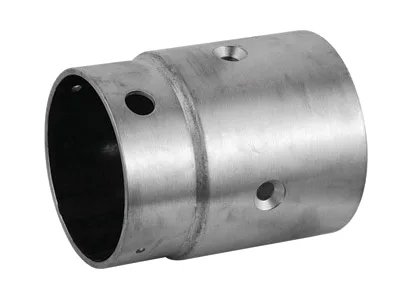
Seamless by nature: the stainless steel deep drawn pump tube
Fluid ends need tubes without seams. A welded tube carries a weld bead and a heat-affected zone that fail faster than the parent metal under pressure and corrosion, and in a pump that means leaks that no coating can fix. A stainless steel deep drawn pump tube sidesteps this entirely: drawn from a flat blank into a seamless bore with a closed or open end, it offers a continuous wall and a pressure-tight body with no weld to inspect, treat or doubt. For pumps, that seamlessness plus stainless steel’s corrosion resistance is the whole proposition. This page covers what deep drawing contributes and what it demands.
Material: which stainless steel, and why
Pump tubes usually run in the austenitic grades for corrosion and cleanliness – 304/1.4301 and 316L/1.4404 are the workhorses, with 316L preferred for chlorides, acids or medical and food contact. Austenitics draw harder than carbon steel: they work-harden quickly, need generous radii, and can require an intermediate anneal if a single draw would push work hardening past the cracking limit. That is a real cost the quote will show honestly – a two-stage draw with an anneal is not the same process as a carbon steel can, and pretending it is leads to cracked lots on the shop floor. Where corrosion demands are moderate and no chloride exposure exists, 1.4016 ferritic can substitute at lower cost and easier forming. Cleanliness also matters for pump and valve applications: we supply passivated tubes with defined surface finishes and cleaning records, because a machined burr or residual drawing lubricant inside a fluid path is a contamination risk the customer’s process may not be able to absorb.
Bore precision: where pump tubes earn their place
A pump tube’s inner bore is often a functional surface – guiding a piston, seating a seal, controlling flow. Deep drawing produces the bore as the punch sees it, which means the bore’s diameter, roundness and surface finish are set by the punch’s tooling and by the draw’s parameters. We hold bore diameters by sizing after the draw where called, keep roundness by the same restrike discipline used across our tube work, and specify surface finish (drawn, polished or roll-burnished) by the application. For tight seal fits, a sizing or ironing pass delivers the finish and diameter together. The bore’s concentricity to the outer surface also matters where the tube mounts in a housing, and we verify it on first articles with the same metrology a customer’s gauges use.
The closed end and the pressure envelope
Many pump tubes are drawn with an integral closed end, which is the part of the tube that actually holds pressure. Deep drawing forms the closed end as a continuous thickness of metal, and its integrity under pressure is a function of the wall and the corner geometry. We size the closed end and its corner radii to the pressure spec – a sharper corner concentrates stress, a generous one distributes it – and the drawn closed end’s pressure capability is verified by burst and proof testing where the application requires. For high-pressure designs the closed end is sometimes thickened locally by the blank design, since adding material where the stress concentrates is the cheapest way to buy pressure margin.
Cleanliness and finishing for fluid service
A tube destined for a pump or valve must be clean – free of drawing lubricant, metal fines and machining debris – because contamination that reaches the fluid path damages seals, valves and downstream components. Our finishing for fluid-service tubes includes degreasing, passivation in the appropriate acid solution for the grade, and a defined cleanliness check (visually and by wipe or particle test) before packaging. Packaging keeps the cleanliness: capped ends, individual bags or trays, and a marking that survives the journey. The tube’s certificate travels with it, and for regulated applications – medical, food, pharma – the cleaning record is part of the documentation rather than an afterthought.
The seam is the failure site under pressure and corrosion
The tube drawing with bore diameter and tolerance, outer diameter and wall, closed-end geometry, the pressure or vacuum spec, the material grade, the surface finish (bore and OD), the cleanliness and documentation level (industrial, food, medical), and volume. We return a draw plan (including any anneal), the finishing route, and a sample schedule – typically three to five weeks after die approval, with first articles carrying the bore metrology, burst or proof results and the cleaning record.
Why not just buy welded tube?
Why not just buy welded tube? Because the seam is the failure site under pressure and corrosion, and grinding it on a long bore is expensive and hard to verify. For seamless pressure-tight fluid paths, deep drawing is the direct route – and for closed-end tubes, the only one without a joint.
Can you match a competitor’s bore tolerance and finish? Send the tube and its print; we measure, reproduce the tooling, and confirm. If the incumbent held a tolerance our process cannot reach as drawn, we will say so and quote the sizing pass that gets there.
Do you anneal stainless steel tubes? Where the draw requires it – austenitic grades often do for deep work, ferritics rarely. The anneal specification and its own quality evidence are part of the tube’s documentation, and skipping it where it is needed is how cracks appear.
Choosing between drawing, machining and welding comes down to the shape of the part: the guide to deep drawn covers sets out where each route wins, and the overview page links through to the full Precision Deep Drawn Parts range.
Specifications
| Item | Stainless steel deep drawn pump tube |
|---|---|
| Brand | AUNOV |
| Designing | Quotation follows the print, not a catalogue – DFM notes are returned before any tooling is cut; revisions are re-quoted once rather than silently absorbed. |
| Tooling | Dies are maintained by stroke count, so tooling condition does not drift mid-order. |
| Samples | The sample you approve becomes the gauge reference for production. |
| Materials | Standard stock: carbon steel (SPCC / DC01), 304 / 316 stainless steel, aluminium, brass; the final grade is fixed with the drawing review. |
| Surface finish | Surface treatment matched to the duty: plating, coating or polishing; masking and laser marking available where needed. |
| Processing | Multi-stage deep drawing with interstage annealing, trimmed and pierced in following dies; every stage is logged against your part number. |
| Equipment | Mechanical presses from 5 to 250 T and hydraulic presses 250-500 T, with in-line annealing furnaces, backed by CNC turning centres and a climate-controlled inspection room. |
| Tolerance | +/-0.1 mm general on drawn sections, +/-0.03 mm on machined seats; critical dimensions carry CMM data with the shipment. |
| Delivery terms | Order ships FOB unless you prefer DDP; payment by T/T or L/C, freight quoted to destination. |
Frequently Asked Questions
Why does a pump tube want seamless rather than welded?
Because the weld is the weak link in exactly the two things the tube exists for. Under pressure cycling and in a corrosive fluid, the bead and its heat-affected zone go before the parent metal does, which puts a predictable failure into a part expected to last. Removing the seam removes the location rather than merely improving the average.
How is the stainless steel grade chosen for this tube?
Against the fluid rather than against habit. Chloride content, pH, temperature and what else is in the circuit all move the answer, and “stainless steel” names a family rather than a resistance. Supplying to the drawing is routine, but the drawing has to contain the grade, because the difference only appears after months of service.
Why is the bore the feature that earns these parts their place?
It is both the flow path and half of the sealing fit. Bore accuracy decides running clearance and therefore volumetric efficiency, and surface condition decides how it wears and seals. Reading the tube as a cylinder whose outside matters most misreads the part entirely – everything functional happens on the inside.
Does anything have to happen after drawing before it can go into a pump?
Usually. Ports, threads and sealing faces are rarely acceptable as drawn, so there is normally finishing on the features that have to seal or mate. Cleaning and passivation then follow, since anything left in the tube ends up circulating through the pump it is meant to protect.
Related Products


Request a Quote for This Part
Send a drawing or sketch — get material advice, tooling cost and a per-piece price within 24 hours (working days).