
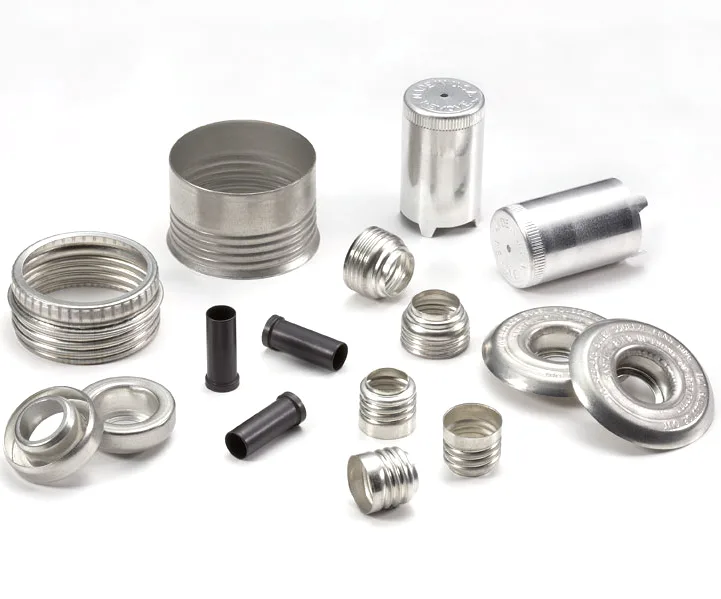
Coining is the last station, and it is the one that decides whether the part is what the drawing promised
A precision custom drawn and deep-stamped part has two different jobs done to it. Forming gives it its shape, and coining gives it its precision. The coining station is a light, sizing press operation at the end of the forming sequence, and it is what brings a formed dimension – a thickness, a flatness, a height, an angle – into a narrow band. On a part described as precision, the coining is not a finishing touch. It is usually where the precision actually comes from.
We coil-blank and progressively draw, coining on the final station where the print calls for it, and batch records are filed so a repeat order starts from approved data, on mechanical presses 5-250 T plus 250-500 T hydraulics with in-line annealing, and first articles and batch samples are checked on the CMM. Formed features to +/-0.05 mm with capability data on critical dimensions, and finer bands confirmed from capability data before quoting. Stock covers carbon steel in SPCC and DC01 grades, 304 and 316 stainless steel, aluminium and brass, with material substitutes proposed only with your written approval. Zinc, nickel or chrome plating, anodising, passivation or e-coat are available, with the finish inspected alongside the dimensional report on the first article. This page is about what coining does, what it costs, and the four things that decide whether it is worth specifying.
What coining actually does
Coining is a controlled sizing press: the part is pressed between a punch and a die in a close operation, with a small amount of material displaced. Four effects, and they are all things a formed part cannot otherwise achieve:
- Thickness control. This is the original purpose and the most valuable one. A drawn wall varies – it thins at the punch nose, it varies with the incoming material, and it varies across the part. A coining operation brings the wall into a narrow band by squeezing the material to a controlled thickness, and it does so with a repeatability that a draw alone cannot match. On a part where the wall is a functional dimension, coining is the only way to hold it.
- Flatness. A formed panel is dished or bowed from residual stress. Coining presses it to a controlled flatness, and because it is a sizing operation with a defined die, the flatness is repeatable. On a part that has to seat or seal, this is the operation that makes the seating reliable.
- Dimensional control on formed features. A formed height, angle, or step can be brought to a tighter band by a sizing operation than the forming operation can hold on its own. This is a legitimate use, though it costs tool life.
- Surface. A coined surface has a consistent texture that is a good base for a coating or for a plating’s adhesion. It is not a cosmetic benefit on its own, but it is a real one where the part is subsequently finished.
What it costs, and why it is a decision rather than a detail
Coining is not free, and the three costs are worth understanding before specifying it:
- Tool life. A coining die is squeezing material rather than cutting it, so it wears, and it wears by changing the part’s dimension. When a coining die wears, the part’s wall or flatness drifts. On a part that needs the coining to hold a tight band, the die’s maintenance interval becomes a production-planning item – and a worn coining die produces parts that are still in tolerance for a while and then suddenly are not.
- Material and the risk of cracking. Coining squeezes the material, and on a thin, hard, or previously worked material it can crack. On a part that has already been drawn – so the material is work-hardened – the coining has to be gentle enough not to crack it. This is a real constraint on how much the coining can tighten.
- An extra press station, and on a part where the coining is only sometimes needed, a process that has two variants rather than one. That is a scheduling and inventory consideration.
So the question on any part described as precision is not whether coining is available but whether this part needs it, and the answer is usually that the part needs it if the wall is functional or the flatness is functional. If neither is, the coining is a precision the part does not need and the money is better spent elsewhere.
The four questions that decide whether to coin
| Is the wall a functional dimension? | If the wall carries pressure, conducts heat, provides stiffness, or is a specified thickness, then yes – the wall’s variation from a draw is larger than most functional requirements and coining is the process that fixes it. If the wall only has to hold its shape, a draw is adequate. |
|---|---|
| Does the part have to seat or seal? | If it seats against another part or seals against a gasket, then flatness is functional and a drawn panel’s dish is a leak or a rocking fit. Coining is worth it. If it is a cover over nothing in particular, flatness is cosmetic. |
| Is a formed feature genuinely tight, or nominally tight? | A feature at a tight band that is formed can often be brought into band by coining – but only within the limits above, and at a cost in tool life. A feature that has to be really tight should be machined instead, and it is worth saying so at review rather than specifying a coining and hoping. |
| Is the material willing? | Coining works best on a ductile material in a soft condition. A hard, high-strength, or heavily work-hardened material will crack, and on a part that has already been drawn the material is work-hardened – so the coining’s severity is limited by what the part can take. |
Coining, forming, and the sequence they have to be in
On a part that is drawn and coined, the order is fixed and it matters:
- Blank, then draw. The drawing stations build the part’s shape, and the material’s ductility is consumed stage by stage.
- Interstage annealing, where the draw is deep enough to need it – and an anneal is a distortion event, so the coin comes after the last anneal.
- Coining, as the final sizing operation. It has to be after all forming and after all annealing, because anything that happens after the coining will move the dimension the coining set.
- Trim and pierce, either before or after the coining depending on whether the pierced features are in a region the coining affects. A hole in a region the coining sizes will move.
- Finishing, last – and a coating will change the dimension the coining set, which is why the drawing has to state whether the dimensions are before or after finish.
Material, and how it changes the coining decision
Stock covers carbon steel in SPCC and DC01 grades, 304 and 316 stainless steel, aluminium and brass, with material substitutes proposed only with your written approval. On a coined part:
- SPCC and DC01 carbon steel are the best case for coining. Mild steel is ductile, it takes a sizing press readily, and DC01’s tighter property specification means the incoming material is more consistent – so the coining has less to correct. Where a part is coined, DC01 is normally the better grade for that reason alone.
- Aluminium coins well and takes a good surface, and 1050 and 3003 are ductile enough for it. On a visible part the coining’s surface is a genuine aesthetic benefit, and anodising over a coined surface is a very good combination.
- 304 stainless steel is the hardest case. It work-hardens fast, so a part that has been drawn is already harder, and a coining operation on it is limited by the risk of cracking. A stainless steel part that needs tight dimensional control is often better served by machining than by a heavier coining.
- Brass coins very well and takes an excellent surface – it is probably the best-behaved material for a coining operation and it is worth considering where a part needs both precision and a fine appearance.
A coined part carries the same three finish points as everything else
Zinc, nickel or chrome plating, anodising, passivation or e-coat, with the finish inspected alongside the dimensional report on the first article. On a coined part, three points, and they are the same three that appear on every part in this family but they are sharper here because the coining set the dimension so precisely:
- A coating changes the dimension the coining set, by roughly its own thickness. On a part that was coined to hold a tight band, a coating at 60 to 120 microns is a significant fraction of that band, so whether the drawing dimensions are before or after finishing is not a detail – it is a fit question.
- Masking the functional surfaces. Sealing faces, locating features, threads, and bearing surfaces must be masked, and on a coined part these are the surfaces whose precision was the point of the coining.
- Passivation on stainless steel changes no dimension, which is the dimensionally safest route and often the right one where the coining’s precision matters and the appearance requirement is modest.
Coining is the last station and often the best one
Eight things, and the first is the one that decides the process:
- Whether the part is coined, and why – stated as a requirement rather than as a process note, with the functional dimension it serves identified.
- Wall thickness, and its tolerance, where the wall is functional – because that is what coining is for, and if it is not functional the coining may not be needed.
- Flatness, and the surface it is measured against and the support condition, where the part has to seat or seal.
- Which features are formed and which are machined, so the tolerance bands are attributed correctly and a genuinely tight feature is not left to a coining that cannot reach it.
- The position of any piercing relative to the coined region, because a hole in a region that the coining sizes will move.
- Material grade, confirmed in writing, and where the part is coined, why that material – because DC01 over SPCC and brass over mild steel are both better for a coining operation.
- Whether dimensions are before or after finishing, on every dimension the finish touches.
- Capability data on the coined dimensions, and finer bands confirmed from capability data before quoting – because on a coined dimension the process’s capability is the real constraint and it should be demonstrated rather than assumed.
Which dimension has to be tight, and is coining right?
Which dimension on this part actually has to be tight, and is coining the right way to get there? Coining is an efficient answer for a wall’s thickness and a panel’s flatness, and an inefficient answer for a tight bore, a tight hole position, or a precise feature geometry – all of which are better achieved by machining. A part that is coined to hold a flatness it does not need, and whose one genuinely tight feature is machined, has paid for a process twice: once in the coining station and once in the machining. Establishing which dimension is the real one, and matching the process to it, is the whole of the review on a part like this.
Not sure whether to draw, machine or weld this geometry? The guide to deep drawn covers compares the three routes and shows where each one wins; the full Precision Deep Drawn Parts range is linked from the overview page.
Specifications
| Item | Precision Custom Fabrication Drawn Deep Stamping Products Part Metal |
|---|---|
| Brand | AUNOV |
| Designing | Quotation follows the print, not a catalogue – samples are reverse-measured into a controlled drawing; changes are priced before they are made. |
| Tooling | Progressive and drawing dies are designed and built in house, so a die can be re-cut against the approved drawing, and first-article timing is measured from the tooling start date. |
| Samples | Samples are issued for approval before the run, so the part is proven before it is made in volume, and production starts only after your written sign-off. |
| Materials | Stock covers carbon steel (SPCC / DC01), 304 / 316 stainless steel, aluminium and brass; material substitutes are proposed only with your written approval. |
| Surface finish | Zinc, nickel or chrome plating, anodising, passivation or e-coat; the finish is inspected with the dimensional report on the first article. |
| Processing | Coil blanking and progressive drawing, coining on the final station where the print calls for it; batch records are filed so a repeat order starts from approved data. |
| Equipment | Mechanical presses 5-250 T plus 250-500 T hydraulics, with in-line annealing; first articles and batch samples are checked on the CMM. |
| Tolerance | +/-0.05 mm on formed features, with capability data on critical dimensions; finer bands confirmed from capability data before quoting. |
| Delivery terms | CIF or DDP, with FOB available, T/T or L/C, with D/P accepted on repeat business; each volume tier carries its own quoted price. |
Frequently Asked Questions
What does coining add to a deep drawn precision part?
Coining is a light sizing press operation at the end of the forming sequence that brings a formed dimension – a thickness, a flatness, a height, an angle – into a narrow band. On a part described as precision, the coining is usually where the precision actually comes from, not a finishing touch, because the draw alone leaves those features in a wider band than the print allows.
Which dimensions are worth coining on a stamped part?
Only the features the drawing calls out as critical get coined, because coining costs a station and a tool and is specified where a formed feature must hold a tight band. Features that can live in the as-drawn tolerance are left to the draw, so the coining effort goes to the dimensions that actually decide the fit.
How tight a tolerance can coining hold on a drawn part?
Formed features are held to a few hundredths of a millimetre with capability data on the critical dimensions, and finer bands are confirmed from capability before quoting. The coining station is what sets that tight band the draw cannot reach on its own, and the result is measured on the CMM at first article.
What is the minimum order for a custom coined deep drawn part?
Production runs start at 1,000 pieces, with tooling made in-house to your print rather than a catalogue shape. We return a quote within 24 hours of the drawing, and first articles are measured on the CMM before the full run begins, so the coined dimensions are proved on metal first.
Related Products


Request a Quote for This Part
Send a drawing or sketch — get material advice, tooling cost and a per-piece price within 24 hours (working days).