
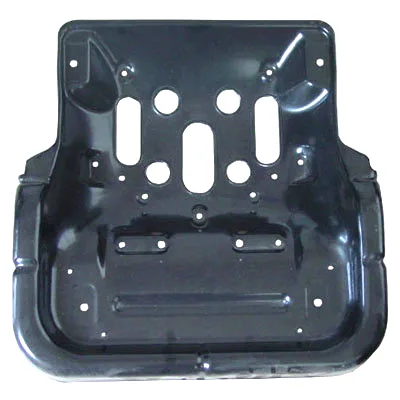
Deep drawn stampings: where deep drawing ends and stamping begins
“Deep drawn stamping” is the umbrella term for parts formed from sheet metal where the punch stroke pulls material into a die cavity deeper than the blank is wide. In practice the family covers everything from a 4 mm sensor cap drawn in a single hit to a 200 mm motor shell that travels through six redraw stations. The engineering question behind every RFQ is the same: how deep, how thin, and how tight – because those three numbers decide the number of die stations, the press size, and the unit price.
It helps to know where the boundary sits. Conventional stamping (blanking, piercing, bending, shallow forming) keeps material mostly flat and works within a draw depth of roughly half the part diameter. Once depth exceeds that, metal must flow – the blank holder grips the flange, the die radius controls how sheet streams into the cavity, and the process becomes deep drawing. The payoff for the extra tooling engineering is a part with no welds, no joined halves, and a grain structure that follows the geometry instead of cutting across it.
The decision logic we apply to every stamping RFQ
Before quoting, we walk the drawing through a fixed review – the same checklist, every time:
- Depth-to-diameter ratio. Under 0.5:1 usually draws in one station; 0.5-1.5:1 needs two or three; beyond 1.5:1 we plan redraws with intermediate annealing (for stainless steel and copper alloys) and quote the sequence explicitly so you can see what drives the price.
- Corner and wall radii. Inside corners below 2× wall thickness tear or thin out unpredictably. If your drawing calls for a 0.3 mm radius on a 1.0 mm wall, we will show you what that costs in die maintenance and scrap rate versus a 2 mm radius – and sometimes the sharp radius is worth paying for.
- Feature interaction. Holes, louvres, and embosses placed closer than 3× stock thickness to a wall or a previous form distort during drawing. Where the layout forces it, we pierce after forming – the die gets one more station, the holes stay true.
- Springback-sensitive geometry. Open-shell sections with asymmetric walls twist as they leave the die. Compensation goes into the tool steel, not into a rework bench.
This review is not a formality – on a typical week it surfaces two or three drawings where a 1 mm radius change or a moved hole saves the customer 10-20% of unit cost before we cut any steel.
Presses, tonnage and what actually sets the batch price
Deep drawn stampings run here on mechanical presses from 5 to 250 T for progressive and transfer work, and hydraulic presses of 250-500 T for large or deep shells that need slow, controlled speed through the draw. Blank holders are pressure-controlled per zone; for deep draws on 304 or aluminium we run cushion pressure profiles so the flange neither wrinkles nor galls.
Unit price at volume is dominated by three things, in this order: number of die stations, cycle time, and material utilisation. We engineer the strip layout so the offal (the scrap skeleton around the blank) is either minimised or, where the shape allows, reused for a second smaller part – on high-volume can and shell work that recovery typically moves material cost down 5-8%, and we show it in the quote breakdown rather than burying it.
Tooling life is the quiet fourth factor. Draw dies for aluminium run hundreds of thousands of strokes before maintenance; stainless steel, with its galling tendency, needs plated or coated die surfaces and a documented re-polish interval. Our toolroom holds your dies under your part number and services them on that schedule, which is why batch 400 matches batch 4,000.
Materials we draw every week
Carbon steel SPCC and DC01 for painted or plated housings; 304 and 316 stainless steel where corrosion resistance is the point; aluminium 1050, 3003 and 5052 for weight-critical and thermal parts; copper, brass and phosphor bronze for conductive and RF components. Each grade has its own draw ratio limits and lubrication regime – aluminium likes viscous lubricants and generous radii, stainless steel needs chlorinated or polymer films and slower punch speeds, copper alloys sit in between. The point of listing this: material choice is a forming decision, not just a cost line. Moving from 304 to aluminium can cut two redraw stations; moving back may be the right call anyway if your environment demands it. We quantify the trade-off in the quotation.
Tolerances across the stamping family
- As-drawn OD/ID: ±0.10 mm typical; ±0.05 mm with sizing passes.
- Depth: ±0.5 mm standard, ±0.2 mm with trim-in-die.
- Flange flatness: 0.3 mm per 100 mm as-formed; coined flanges hold 0.1 mm for gasket duty.
- Pierced holes after forming: ±0.05 mm position, burr height under 0.08 mm with die-side sharpening on schedule.
Machined features after drawing – a faced seal groove, a tapped boss – hold ±0.03 mm, done in-house on CNC centres in the same plant so the parts never leave process control between draw and machine.
Quality control and traceability
First articles ship with a full dimensional layout against your drawing. Running production is controlled by SPC on agreed key characteristics, with the charts available to you on request. Material traceability runs from coil heat number through to the EN 10204 3.1 certificate in the shipping box. For safety-relevant stampings (seat-belt components, brake hardware brackets) we run PPAP level 3 on request, including PFMEA and control plan documentation.
Typical products in this family
- Motor shells and yokes for automotive actuators, drawn and ironed for bearing-fit IDs.
- Sensor caps and covers with integral mounting tabs, drawn in 300-series stainless steel.
- Shielding cans for electronics, drawn flat-bottomed with coined flanges for lid seating.
- Aerosol and battery cans at line rates above 60 parts per minute on transfer dies.
- Deep brackets and housings that would need three welded pieces if stamped conventionally – drawn as one.
Questions we are asked about deep drawn stampings
Is deep drawing always cheaper than a welded assembly?
Not always – and we will tell you when it is not. Below roughly 2,000 pieces a year, a welded fabrication often wins because tooling dominates the drawn price. Above that, drawing wins fast: no weld consumables, no fit-up labour, and cycle times measured in seconds. We quote both routes when the crossover is close.
Can you hold drawing quality across suppliers if we dual-source?
Your dies stay under your part number in our toolroom. If you dual-source, the controlled drawings and check fixtures we build make the process portable – that is deliberate.
What drawing file format do you need?
STEP plus a PDF with tolerances and key characteristics marked. If only a sample exists, send the sample – we reverse-measure it into a controlled drawing for your approval before tooling starts.
What we need before quoting a stamping
Send the drawing, material, annual volume and target price if you have one. The quotation comes back with the die sequence and station count shown, so the cost structure is visible – you can see exactly what a radius change or a material switch saves, not just a bottom-line number.
If you are weighing drawing against machining or welding for this geometry, the guide to deep drawn covers sets out where each route wins; the full Precision Deep Drawn Parts range is linked from the overview page.
Specifications
| Item | Deep drawn stampings |
|---|---|
| Brand | AUNOV |
| Designing | Driven by your drawing or a physical sample – samples are reverse-measured into a controlled drawing; the approved drawing is kept as the controlled master. |
| Tooling | The die is dedicated to your part and maintained on a recorded schedule. |
| Samples | The sample you approve becomes the gauge reference for production. |
| Materials | Carbon steel (SPCC / DC01), 304 / 316 stainless steel, aluminium and brass are held on site; the final grade is fixed with the drawing review. |
| Surface finish | The print decides between natural, plated or coated; we log the agreed finish and check thickness and adhesion on the first article. |
| Processing | Progressive drawing through several stages, annealed between draws, then trim and pierce; batch records are filed so a repeat order starts from approved data. |
| Equipment | Press shop running 5-250 T mechanical and 250-500 T hydraulic presses, annealing ovens on site; secondary ops run on CNC turning centres, inspection on the CMM. |
| Tolerance | +/-0.1 mm general on drawn sections, +/-0.03 mm on machined seats; dimensional reports accompany the first article. |
| Delivery terms | Terms are FOB by default, with CIF and DDP quoted on request and freight priced to your door. |
Related Products



Request a Quote for This Part
Send a drawing or sketch — get material advice, tooling cost and a per-piece price within 24 hours (working days).