
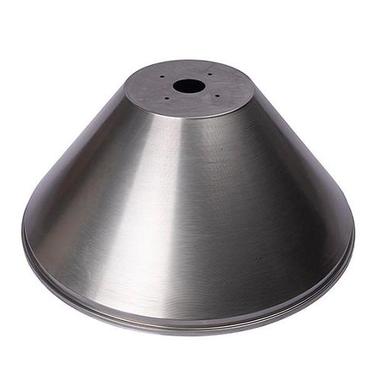
Metal spinning wins on axisymmetric parts, and loses the moment the part needs a hole
A light fabrication spun aluminium part is a family product described by its process: spun, and light. Both words are informative and both are frequently misunderstood, so it is worth establishing what spinning actually buys and what it costs before anything else is decided – because on a spun part the process sets the achievable geometry, and a design that does not respect the process’s natural boundaries ends up needing machining that was not budgeted for.
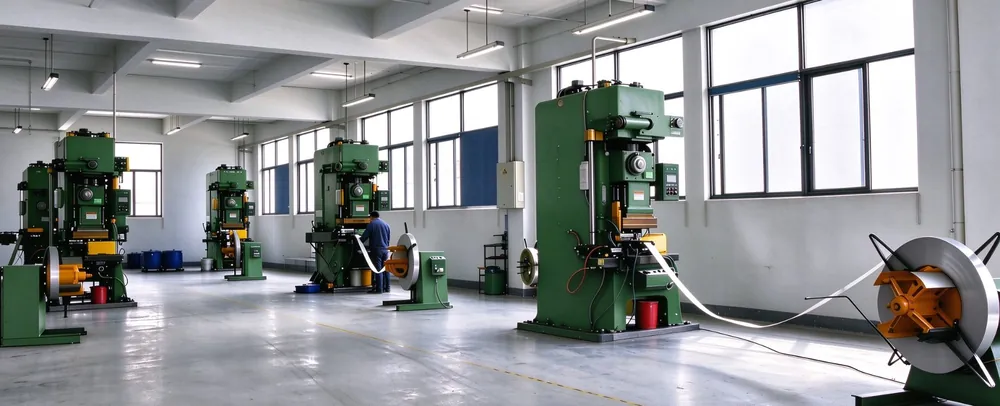
We deep draw from coil or blank with interstage annealing so walls thin evenly, and in-process checks sit between stages rather than only at the end, on mechanical presses 5-250 T and hydraulics 250-500 T with in-line annealing furnaces, with CNC turning centres for secondary operations and CMM inspection. Formed features to +/-0.05 mm with capability data on critical dimensions, and capability is checked on the first article before the run continues. Stock runs to carbon steel, 304 and 316 stainless steel, aluminium and brass, with the final grade fixed at the drawing review. Natural, plated or coated per the print, with the agreed finish logged and finish thickness and adhesion checked on the first article. This page is about where spinning’s boundary actually is, and the four requirements that follow from it.
What spinning does that nothing else does cheaply
Spinning forms a part by rotating a blank against a shaped tool, deforming the material continuously. Four capabilities, and they are real:
- Axisymmetric shapes of any complexity. Anything a lathe could produce – domes, cones, cylinders, hemispheres, and complex profiles with radii, beads, and steps – is a natural spinning shape. It is the cheapest way to make these shapes at low and medium volume.
- Seamlessness. There is no seam, because the material is never joined. On a part that is a pressure boundary, or a fluid passage, or a weldment’s component, that is a genuine advantage over a drawn or fabricated shell.
- Wall control. The wall is set by the blank’s thickness and the tool’s geometry rather than by a material flow distribution, so a spun wall is close to uniform. On a part whose wall is functional, that is worth a great deal.
- Low tooling cost for the shape. A spinning tool is a shaped mandrel, and for a complex axisymmetric shape it is far cheaper than a progressive die with the same geometry. This is the economic reason spinning is chosen at all.
Where the boundary is, and why it bites
Spinning is done on a lathe. Everything that is not a body of revolution is outside it. Four requirements that follow, and each one means a secondary operation:
| A hole not on the axis | Cannot be spun. A pierced hole off the axis of revolution has to be drilled or punched afterwards, and its position is then set by a machining operation rather than by the forming. On a part where the hole’s position matters – and it usually does, because a spun part’s hole pattern is how it mounts – this is a real cost. |
|---|---|
| A non-round outline | A square flange, a rectangular flange, or any flat on a spun part is machined after spinning. The machining is straightforward but it is an operation, and the flat’s flatness and its position relative to the axis are then machining tolerances rather than forming tolerances. |
| An off-axis feature of any kind | A boss, a tab, a pad, a bracket – all machined. And a machined feature on a spun part is a stress concentration at the point where the tool was clamped, which is worth knowing when the part is cyclicly loaded. |
| A very thin wall with a complex shape | Spinning handles thin walls well, but there is a limit where the material tears rather than flows. Complex profiles with tight radii on a thin wall are near that limit and are worth discussing before tooling. |
So the design question on any spun part is simple and worth asking early: is this part axisymmetric, and if not, how much of it is going to be machined afterwards? The answer determines the cost far more than the material or the wall does.
Springback and repeatability, the honest limitation
A spun part is not fully constrained by its tool. The material is deformed plastically and it springs back when the load is released, and on a part with a profile that has changing radii and changing wall thickness the springback is not uniform. Four consequences, stated plainly because they are the real constraint on this process:
- Dimensional repeatability across a batch is harder than a drawing’s. The part is not fully determined by the tool, so two parts from the same tool are not quite the same shape.
- Formed features to +/-0.05 mm is a real requirement to state, but where a formed feature is genuinely tight, it should be established from capability data before quoting – which the stated structure does say, and it is worth honouring.
- On a part that has to mate with something, the mating feature should be machined rather than spun. A spun rim that has to seat against another part is a source of fit variation that a machined rim would not have.
- Where a profile has a changing radius, the springback at each radius is different, so a complex profile is where the variation accumulates. A simple profile is more repeatable than a fancy one.
Aluminium, and why it is the usual choice for spinning
Stock runs to carbon steel, 304 and 316 stainless steel, aluminium and brass, with the final grade fixed at the drawing review. On a spun part the material choice is different from a drawn part in one important way: aluminium spins well, and that is why spinning is associated with it.
- 3003 and 1050 are the standard spinning grades. 3003 has a good combination of formability and strength, 1050 is the most ductile and takes the finest surface. Both form easily in a spinning operation and take a good finish.
- 5052 is stronger with better corrosion resistance and spins acceptably. Worth considering where the part is structural or in a marine environment.
- 6061 is the machinability grade, and on a spun part with significant machining – which a spun part with an off-axis feature has – it is often the right choice, because the machined features are the tight ones and 6061 machines them well.
- Carbon steel spins acceptably but is dense and is more prone to tearing on a complex profile. It is used where mass is not a concern and stiffness is.
- 304 or 316 stainless steel can be spun but is more difficult – higher tonnage, faster work-hardening, and more springback – and it is a choice made for corrosion resistance rather than for the process.
Spinning gives a profile of changing radii, and coverage follows it
Natural, plated or coated per the print, with the agreed finish logged and finish thickness and adhesion checked on the first article. On a spun part, three points:
- Coverage on a complex profile. Spinning produces a shape with changing radii, and a coating on a tight radius is thinner than on a flat or a generous radius. On a part where the finish is functional – a corrosion barrier, a ground electrical connection – the coverage on the radii is where it will fail first.
- Masking the machined features. On a spun part the features that need masking – threads, sealing faces, locating surfaces – are exactly the ones that were machined after spinning, which is convenient because they are accessible and easy to identify on the drawing.
- Coating on a rim that has to mate. The same dimensional-growth question as any part, and on a spun part where the rim is usually machined after forming, the machining can be done after the coating to give a controlled post-plate dimension.
Spinning wins on a complex axisymmetric shape
Eight things, and the first two are what make a spun part reviewable at all:
- Which surfaces are spun and which are machined, stated explicitly, and the order of the operations.
- Which dimensions are controlling – the spun profile or the machined features – and therefore which tolerances are achievable by forming and which need machining.
- Formed features at the stated band, with capability data on the critical ones, since a spun part’s repeatability is the process’s real limit.
- Wall thickness, and where the minimum is, – a spun wall is more uniform than a drawn one, which is one of the process’s advantages and should be used.
- Any off-axis feature, as a machined feature with its own tolerance, and its position relative to the spun geometry’s datum.
- Material grade and temper, confirmed at the drawing review, since the temper governs how the profile forms and how it springs back.
- Where a feature has to mate, whether it is machined. This is worth stating because a spun mating feature is the most common source of fit variation on this part type.
- Finishing, with masked areas, and whether dimensions apply before or after finish.
Is this part really better spun than drawn?
Is this part really better spun than drawn? Spinning wins on a complex axisymmetric shape at low to medium volume, on a seamless part, and on a part whose wall uniformity matters. It loses on a simple shape at high volume, where a progressive die makes the same shape far faster, and it loses on any part where the machined content is high, because then the spinning is a way of making a blank and the machining is making the part. A simple spun bowl at high volume is a case where the die-stamped version is better; a complex dome at low volume is a case where spinning is clearly right. Establishing which of those two the product is – and the volume at which it will be made – is the question that makes the process choice rather than an inherited decision.
Choosing between drawing, machining and welding comes down to the shape of the part: the guide to deep drawn covers sets out where each route wins, and the overview page links through to the full Precision Deep Drawn Parts range.
Specifications
| Item | Light Fabrication Deep Drawn Parts Metal Spinning Spun Parts Aluminum |
|---|---|
| Brand | AUNOV |
| Designing | Quotation follows the print, not a catalogue – a manufacturability review comes back with the quotation; the same drawing is used for every repeat order. |
| Tooling | Dies, fixtures and gauges are made in our own toolroom, so no tooling step is outsourced, and first-article timing is measured from the tooling start date. |
| Samples | Any sample deviation is corrected before the first production batch is released. |
| Materials | Stock runs to carbon steel, 304 / 316 stainless steel, aluminium and brass; the final grade is fixed with the drawing review. |
| Surface finish | The print decides between natural, plated or coated; we log the agreed finish and check thickness and adhesion on the first article. |
| Processing | Deep drawing from coil or blank, with in-process annealing so walls thin evenly; in-process checks sit between stages, not only at the end. |
| Equipment | Mechanical presses from 5 to 250 T and hydraulic presses 250-500 T, with in-line annealing furnaces, with CNC turning centres for secondary operations and CMM inspection. |
| Tolerance | +/-0.05 mm on formed features, with capability data on critical dimensions; capability is checked on the first article before the run continues. |
| Delivery terms | FOB Ningbo or Shanghai, payment by T/T, L/C at sight or D/P; each volume tier carries its own quoted price. |
Frequently Asked Questions
Why spin a light aluminium part instead of drawing it?
Spinning wins on axisymmetric profiles of changing radii, where it shapes the part cheaply in one setup, and it loses the moment the part needs a hole or an off-axis feature, because that pulls in machining or welding that was not budgeted. The process sets the achievable geometry, so the design has to respect the boundary.
Why is aluminium the usual choice for spinning?
Aluminium spins cleanly, takes a fine finish, and keeps the part light, which is exactly what a light fabrication wants, and the final grade is fixed at the drawing review. Where the part also has to stay light, aluminium is balanced against the wall the duty needs.
How is repeatability held on a spun aluminium part?
Springback is the honest limitation of spinning, so the process is set at first-off and re-checked at every start-up, and the profile is generated from one datum. The result is proved on the CMM at first article, and the recorded settings are re-used on re-orders.
What is the minimum order for a spun aluminium fabrication?
Runs start at 1,000 pieces, with tooling made in-house to your print. We return a quote within 24 hours of the drawing, and first articles are measured on the CMM before the full run, so the spun profile is confirmed before volume production.
Related Products


Request a Quote for This Part
Send a drawing or sketch — get material advice, tooling cost and a per-piece price within 24 hours (working days).