
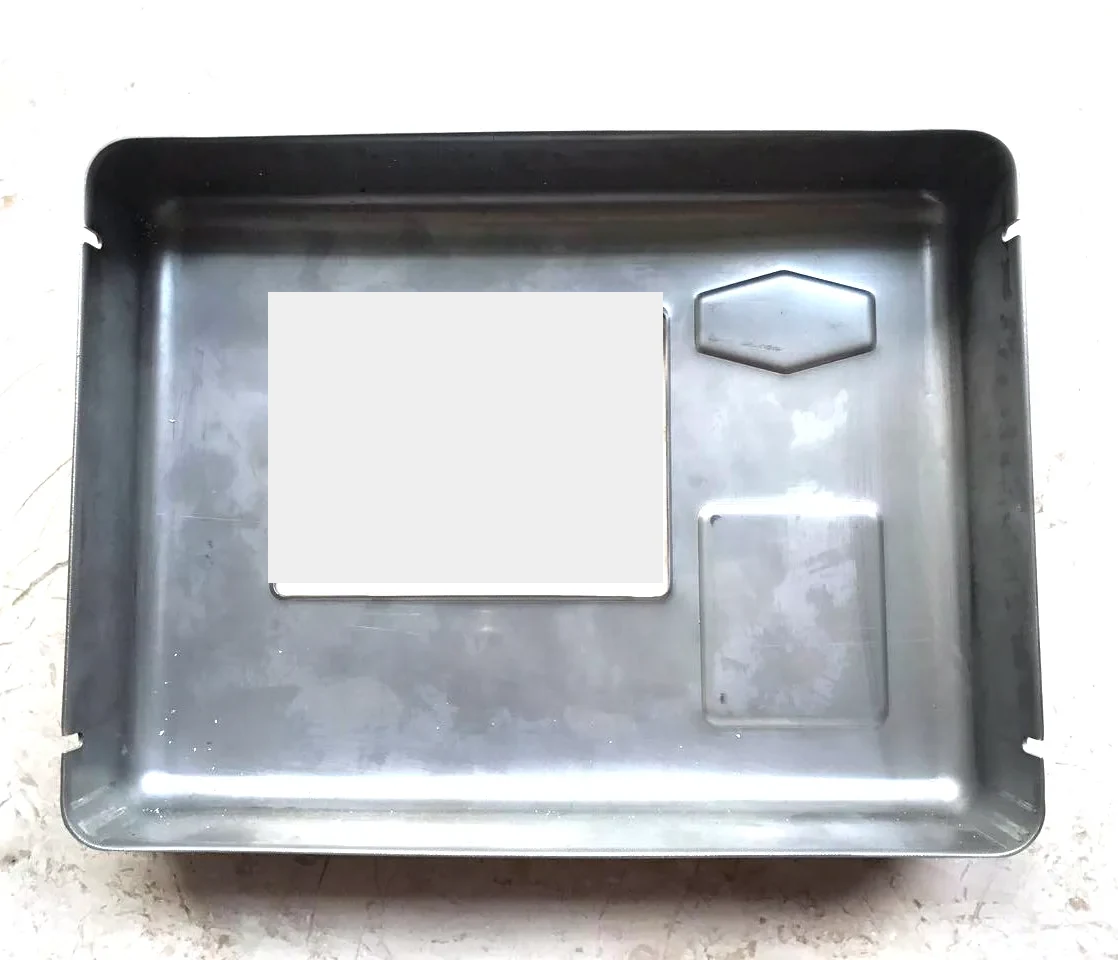
A label window is an opening in a sterile barrier, and that is the whole problem
A deep drawn instrument tray with a label window is a shallow drawn tray with a window in it – a clear or open area through which a label can be read without opening the tray. The engineering is contained in that one feature. Everything else on the tray is a normal drawn-tray requirement: a cleanable surface, a seal around its rim, a flat base. The window decides whether the tray can be sterilised in a way the label survives, and it decides whether the tray’s contents are protected.
We coil-blank and progressively draw, coining on the final station where the print calls for it, and batch records are filed so a repeat order starts from approved data, on 5-250 T mechanical presses plus 250-500 T hydraulics with in-line annealing, and first articles and batch samples checked on the CMM. Flange and rim dimensions to +/-0.05 mm with the wall controlled by the draw, and dimensional reports accompany the first article. Stock covers carbon steel in SPCC and DC01 grades, 304 and 316 stainless steel, aluminium and brass, with grade and temper confirmed in writing before tooling. Plating, powder coating, anodising or polishing per the print, with finish thickness and adhesion checked on the first article. This page is about the window, the sterilisation barrier, and the four questions that determine whether a label window is a good idea.
A window is a hole in a sterile barrier
A tray is sterilised as a system: the tray, its contents, and a wrap or pouch over it. The label is between the window and the outside. That places the label in the sterilisation zone, and every sterilisation method has a view about what it does to materials:
- Steam. Steam at 121 to 134 degrees will not survive a pressure-sensitive label or most adhesive labels – the adhesive softens, the ink runs, and the label may delaminate. Steam-compatible labels exist and are specifically qualified for the cycle, but the window is still a path for steam to reach the label directly rather than through a sealed pouch, which makes the label’s exposure more severe than a label under a wrap.
- Hydrogen peroxide plasma or vapour. More compatible with many label materials than steam, but it is a low-temperature process, and it has its own compatibility requirements.
- Ethylene oxide. Compatible with a wide range of labels, and it is a slower, more expensive process with its own aeration requirements.
- Radiation. Generally compatible with most label materials, though some inks and adhesives are affected.
So the label and the sterilisation method have to be specified together, and that is a system-level decision rather than a tray decision. It is the first question to answer on this part.
What the window does to the tray’s function
A window is an opening, and on a tray that is supposed to protect instruments, each of the following is a consequence:
- Contamination path. A window is a hole in the barrier. Air, dust, and droplets can enter through it, and on a tray that is being presented as containing sterile instruments, that is a direct contradiction. A window with a filter is a partial answer; a window that is truly open is not compatible with a sterile claim.
- Handling contact. A window in a tray is a place where a hand goes when picking the tray up, and it will be touched. A window with a sharp edge in a tray that is handled repeatedly is a laceration hazard, and this is a real consideration on a surgical instrument tray.
- Cleaning. A window’s edge is a crevice where soil collects, and on a tray that is washed between uses, an open window’s frame is a cleaning problem.
- Structural weakening. A window removes material from a wall, and if that wall is carrying load or is part of the tray’s rigidity, the window weakens the tray locally. A window near a bend or a corner is worse.
Open window, filtered window, or transparent insert
Three approaches, and they are genuinely different products:
| Open window | A cut-out in the tray wall or lid. Simple, cheap, no cleaning of a transparent film. Completely incompatible with a sterile claim and a contamination path. Used on non-sterile instrument staging, or on identification trays where the label is a handling label rather than a sterile-field label. |
|---|---|
| Filtered window | An open area covered by a membrane or a filter material – typically a PTFE or a mesh membrane, or a hydrophobic vent. This lets air equalise for packaging while excluding particles and most microorganisms, and it is a genuine sterile-barrier-compatible solution used in real sterile packaging. It has its own requirements: the material has to be sterilisation-compatible, it must be securely retained in the frame, and it has to be inspectable for damage. |
| Transparent insert | A window aperture covered by a clear polymer film, heat-sealed or bonded into the frame. This is a sealed window and it works with a sterile claim, provided the seal is intact. The requirements are that the film is sterilisation-compatible, the bond or seal is verified, and the film does not fog or become brittle with age. Fogging after steam is a common and annoying failure on exactly this feature. |
The design decision is which of these three the product needs, and it is driven entirely by whether the tray is inside a sterile field. It should be settled at enquiry because it changes the part substantially.
Geometry, and the frame around the window
Where a window has a frame – and it usually should – the frame’s geometry has four requirements:
- A flat seating land. The film, the filter, or the label sits on a flat surface, and a drawn or formed window frame is often not flat because of springback and distortion. On a window that is bonded or heat-sealed, the flatness is a seal requirement and it needs a callout.
- A retaining feature. A snap, a crimp, a lip, or a groove that holds the film. Without a positive retention the film can lift at a corner in handling and the window becomes a leak.
- Inside corner radii. A window frame’s internal corners are where a moulded or formed frame would have a radius, and they are where the film is most likely to be cut or torn during assembly. A generous radius is functional here, not cosmetic.
- The window’s position in the wall. A window in the tray’s wall is on a vertical surface, which is a hard surface to fit a flat film to. A window in a horizontal lid is much easier. Where the window is in a wall, the design has to address the fact that the film is on a curved or vertical surface and the seal has to hold in that orientation.
Flange and rim, which is where the tight band goes
Flange and rim dimensions to +/-0.05 mm is the stated structure, and on this part it belongs to:
- The tray’s sealing rim, which seals against a lid or a pouch or a gasket. Its flatness and its position relative to the tray’s base are functional and they are what makes the seal.
- The window frame’s seating land, if the film is bonded or heat-sealed, for the reason above.
- Any locating feature, where the tray registers against its lid or a rack.
And the wall is controlled by the draw, which on this part is worth understanding in one specific place: a window’s edge is where the material was cut away, and the remaining wall around the window is the thinnest and most stressed part of the tray’s wall. A window’s edge in a drawn wall will have a burr and will be a crack initiation site if the tray is flexed, and on a tray that gets handled a lot this is a fatigue consideration.
Material, and cleanability
Stock covers carbon steel in SPCC and DC01 grades, 304 and 316 stainless steel, aluminium and brass, with grade and temper confirmed in writing before tooling. For an instrument tray:
- 304 stainless steel is the standard, and it is the right answer for a surgical instrument tray: cleanable, non-shedding, sterilisation-compatible, and it does not scratch instruments.
- 316 stainless steel where the environment is saline or where the wash chemistry is aggressive.
- Aluminium is not appropriate for a tray that holds surgical instruments – it is soft, it will scratch, and it corrodes in alkaline wash chemistries.
- Carbon steel is not appropriate for a sterilised tray, for the reason covered on the sterilization tray page.
Plating, powder coating, anodising or polishing per the print, with finish thickness and adhesion checked on the first article. On this part the finish is mostly constrained by cleanability and by the window: the tray’s surfaces have to be cleanable, so a coating that is difficult to clean or that flakes is a liability, and the window’s frame has to accept a film bond, which is a surface chemistry question that a coating can break.
Eight items, and the first two are product decisions
Eight things, and the first two are the product decisions that come before any geometry:
- Whether the tray is inside a sterile field, and therefore whether the window may be open at all.
- The sterilisation method, – steam, hydrogen peroxide, ethylene oxide, radiation – and the label material that has to survive it.
- Which of the three window types this is – open, filtered, or a transparent insert – and if an insert, the film material and the seal or bond method.
- The window’s size, position, and the frame’s geometry, with the seating land’s flatness and the retention feature.
- Inside corner radii of the window frame, stated as a minimum.
- Rim flatness and position, at the tight band.
- Wall thickness, and the condition at the window’s edge including its burr state.
- Cleanability requirements, including whether the window frame is a crevice that has been designed out.
Does the label need to be visible through a window at all?
Does the label need to be visible through a window at all, or could the tray be identified another way? Many instrument trays are identified by a label on the outside of the pouch, or by a laser-marked part number on the tray, or by a coloured tape or a position in a rack. A window exists because someone wants to read a label without opening the tray, and that is a real requirement – but a laser mark or an external label satisfies the same need without putting a hole in a sterile barrier. It is worth asking, because a window is the single feature on this part that carries contamination risk, sealing risk, cleaning risk, and labelling compatibility risk, and removing it removes all four at once.
Choosing between drawing, machining and welding comes down to the shape of the part: the guide to deep drawn covers sets out where each route wins, and the overview page links through to the full Precision Deep Drawn Parts range.
Specifications
| Item | Deep Drawn Medical Tray |
|---|---|
| Brand | AUNOV |
| Designing | Quotation follows the print, not a catalogue – a manufacturability review comes back with the quotation; revisions are re-quoted once rather than silently absorbed. |
| Tooling | Tooling is built and held under your part number, so tooling lead time stays under our control, and ownership is confirmed on the quotation. |
| Samples | Sample parts are measured and reported before submission, so the part is proven before it is made in volume, and mass production is gated on that approval. |
| Materials | Stock covers carbon steel (SPCC / DC01), 304 / 316 stainless steel, aluminium and brass; grade and temper are confirmed in writing before tooling. |
| Surface finish | Plating, powder coating, anodising or polishing, per the print; finish thickness and adhesion checked on the first article. |
| Processing | Coil blanking and progressive drawing, coining on the final station where the print calls for it; batch records are filed so a repeat order starts from approved data. |
| Equipment | Mechanical presses 5-250 T plus 250-500 T hydraulics, with in-line annealing; first articles and batch samples are checked on the CMM. |
| Tolerance | +/-0.05 mm on flange and rim dimensions, wall controlled by the draw; dimensional reports accompany the first article. |
| Delivery terms | FOB Ningbo or Shanghai, payment by T/T, L/C at sight or D/P; call-off schedules are supported. |
Frequently Asked Questions
What is a label window on a deep drawn instrument tray?
A label window is a clear or open area in a shallow drawn tray through which a label can be read without opening the tray. The engineering is contained in that one feature: the tray must keep its sterile barrier while still letting the label show, and a window done wrong breaks the barrier the sterilisation depends on.
How is the window kept sterile on a medical tray?
The window is framed and sealed at its rim, with the choice between an open, a filtered, or a transparent-insert window set by the duty. The barrier integrity is designed into the frame and the seal, not assumed, because the window is an opening in a sterile boundary by definition.
Which material is used for a tray with a label window?
304 stainless steel is typical for cleanability and sterilisation, with 316 where the duty calls for more resistance, and aluminium or brass where weight or contact allows. The grade is confirmed in writing before tooling and mill certificates travel with the first article.
What traceability comes with a deep drawn medical tray?
Batch records are filed so a repeat order starts from approved data, and every stage is logged against your part number from the coil through the draw to the finish. First articles are measured on the CMM with a dimensional report, because a medical tray has to pass audit, not just function.
Related Products


Request a Quote for This Part
Send a drawing or sketch — get material advice, tooling cost and a per-piece price within 24 hours (working days).