
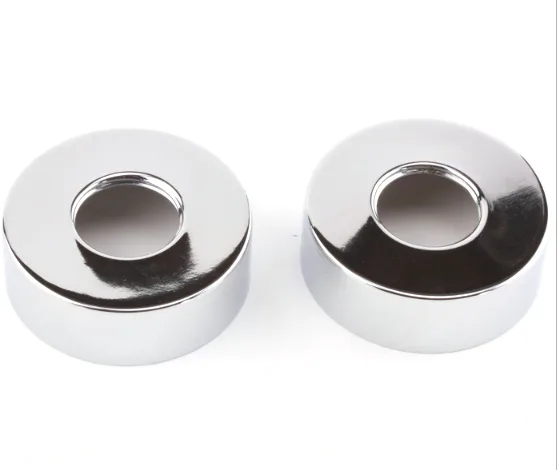
Polished stainless steel deep drawn caps: where forming quality shows
A polished cap is the most honest part in the deep drawing shop. Every die mark, every draw-ring scratch, every grain line in the metal is visible under a mirror finish – there is no paint or powder to hide behind. That is why polished stainless steel deep drawn caps are made the way they are here: the die surfaces are fine-polished, the draw lubricant is chosen to wipe clean without staining, and the polishing stages after forming are graded from levelling to final buff rather than one aggressive pass that waves the rim.
The result is a cap that is simultaneously a functional component – corrosion-resistant, seamless, press-formed strong – and a visible surface part. Sinks and cookware, marine hardware, architectural fittings, food-processing equipment, decorative trim: anywhere a cap is seen as much as it works.
Grades and what the polish demands of them
304 is the standard: it takes a bright mirror (we polish to Ra 0.05-0.2 µm on visible faces, up to a true 8K mirror on request) and resists corrosion in normal indoor and outdoor service. 316 is the choice where the cap lives near salt – coastal architecture, marine fittings, pool equipment – or under regular chemical wash-down; it polishes nearly as well and costs a little more per part. Both grades draw best from 2B mill finish sheet; the polish after drawing levels the die texture and brings the metal up to the requested gloss in stages.
One warning we give every cosmetic-cap customer: the polishing shows geometry as well as shine. A rim that is 0.2 mm out of round reads as a visible wave under mirror finish, so cosmetic caps are held to tighter roundness and rim flatness than industrial ones – and that tolerance premium is priced openly, not hidden.
Geometry range
- Diameters 10-250 mm, round dominates but oval and soft-square caps are drawn regularly.
- Depths from flat dishes to 1.5:1 depth-to-diameter in one draw for 304; deeper shapes take a redraw with bright annealing between passes so no scale stains the polished surface later.
- Walls 0.5-2.0 mm. Cosmetic caps typically sit at 0.8-1.2 mm – thick enough that polishing never thins a visible face into waviness.
- Rims: plain trimmed, curled safe-edge, or rolled bead. Curled rims are the usual choice – a polished sharp edge is a liability as well as a look.
The polishing sequence, stage by stage
Polishing a drawn cap is a process with defined stages, not a buffing wheel and hope:
Stage 1 – levelling. Abrasive 180-240 removes the draw texture and any die-ring marks on the visible dome. This stage sets flatness; run it hard and the dome thins unevenly, so it is done with tracked pressure on compliant wheels.
Stage 2 – refining. 320-400 abrasives cut the stage-1 scratches out. On satin-finish caps the sequence stops here and a directional grain is applied – the familiar brushed look, grain uniformity controlled by fixture speed.
Stage 3 – brightening. For mirror caps: 600+ plus a greaseless buffing compound brings the surface to full reflection. The cap is then degreased in an aqueous line – solvent wiping a mirror cap is how stains are born.
Stage 4 – passivation. Acid passivation to ASTM A967 restores the chromium oxide layer the abrasives disturbed. Skipped passivation is the reason “stainless steel” caps rust in the field; ours do not skip it.
Tolerances for a part people look at
- OD ±0.2 mm as-drawn (tighter than the industrial ±0.3-0.5 standard, because visible rims announce error); sizing passes hold ±0.1 mm on mid sizes.
- Rim roundness within 0.15 mm on mirror caps.
- Height ±0.4 mm.
- Surface: agreed against a physical sign-off sample – gloss level, grain direction (for satin), and a stated maximum for visible defects. The sample travels with the PO and the batch ships against it.
Verification on cosmetic work
Beyond the usual dimensions, every cosmetic batch passes a light-booth inspection against the sign-off sample under standard illuminants, film/Ra readings on the polished face, and – because caps are handled – a packing review: individual bagging or interleaved sleeves so the polish survives the box. Material certificates EN 10204 3.1 and passivation reports accompany the shipment.
Where polished drawn caps are working
- Food equipment and dairy fittings – 304 caps with curled rims, mirror ID for cleaning, satin OD.
- Marine and coastal hardware caps in 316, passivated, satin finish.
- Architectural and handrail end caps, mirror polished, sized to the tube print.
- Consumer and appliance trim caps – visible hardware where a plastic cap would read cheap.
Questions we are asked about polished stainless steel caps
Can you hold mirror finish inside and out?
Outside, yes to full mirror. Inside a deep cap, polishing access limits the finish to the stage-2 level below about 40 mm diameter – we state which faces carry which finish on the sign-off sample so nobody discovers it at incoming inspection.
Will the polish hide the weld if we ask for a welded assembly later?
Caps themselves are seam-free – that is the point of drawing. If the cap joins a tube or body by welding afterwards, the weld area is best left satin for site re-polishing; mirror-on-mirror site welds never disappear. Design note, offered free with the quotation.
What is the MOQ for a cosmetic cap?
Typically 1,000-2,000 pieces for a custom size after tooling. Small pilot runs of 100-300 are possible on soft tooling so you can show the market before committing – the polish standard is identical either way.
What we need before quoting a cap with a finish
Send the drawing (or the tube/fitting the cap must match), volume, environment, and the finish you are after – a photo of an existing part is a good start. You get the forming route, the polish specification in writing, and a sign-off sample before volume production, so what you approve is what ships.
Choosing between drawing, machining and welding comes down to the shape of the part: the guide to deep drawn covers sets out where each route wins, and the overview page links through to the full Precision Deep Drawn Parts range.
Specifications
| Item | Custom Precision Deep Drawn Stainless Steel Aluminum Stamping Deep |
|---|---|
| Brand | AUNOV |
| Designing | Drawings are reviewed for feasibility, and the agreed version is what production runs against. |
| Tooling | Our toolroom covers die design, wire-cut EDM and maintenance, so the die charge appears as its own quotation line, and the die remains dedicated to your part. |
| Samples | First-article samples ship with a dimensional report and material certificate, so the part is proven before it is made in volume, and production starts only after your written sign-off. |
| Materials | Stock covers carbon steel (SPCC / DC01), 304 / 316 stainless steel, aluminium and brass; mill certificates and heat numbers accompany the first article. |
| Surface finish | Plating, coating or polishing to suit the drawing; finish thickness and adhesion checked on the first article. |
| Processing | Multi-stage deep drawing with interstage annealing, trimmed and pierced in following dies; in-process checks sit between stages, not only at the end. |
| Equipment | Press shop running 5-250 T mechanical and 250-500 T hydraulic presses, annealing ovens on site, with in-house toolmaking to keep dies and fixtures maintained. |
| Tolerance | +/-0.03 mm on turned secondary features, +/-0.1 mm on as-drawn walls; dimensional reports accompany the first article. |
| Delivery terms | CIF or DDP, with FOB available, payment by T/T or L/C, quoted in USD or EUR; each volume tier carries its own quoted price. |
Related Products


Request a Quote for This Part
Send a drawing or sketch — get material advice, tooling cost and a per-piece price within 24 hours (working days).