
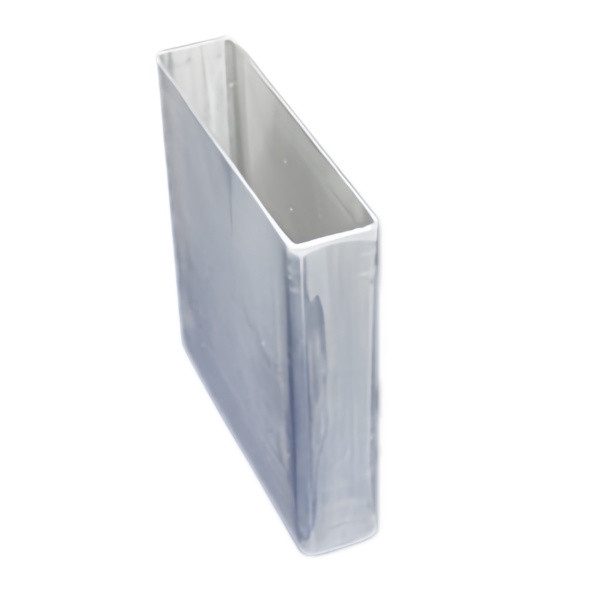
A rectangular draw springs more on the long walls than the short ones
A rectangular channel is a deep draw with corners, and the corners are what make it harder than a round shell of the same depth. Around a corner radius the material is pulled in two directions at once, and the wall that wraps the corner thins and work-hardens faster than the flat wall between corners. When the punch retracts, the flat walls spring back toward their original shape, and because a rectangle is not symmetric, the long walls spring more than the short ones. The result is a channel that is wider at the mouth than at the base on the long sides, and a shroud that no longer matches the part it was meant to clip over.
We predict the spring by the corner radius and the wall length, not by a generic “aluminium springs” rule. A long wall between two corners stores more elastic energy than a short one, so it returns more, and we compensate with an overbend built into the punch profile and, where the tolerance demands it, a restrike that re-seats the walls after the first draw has released its spring. The restrike is the operation customers do not see on the drawing but always pay for in the fit, and on a rectangular shroud it is the difference between a channel that clips on and one that has to be forced.
The other control is the corner radius itself. A tight corner draws a sharper channel but thins the wall more and springs it more; a generous corner is kinder to the wall but leaves a rounder shroud than the drawing may want. We set the corner at 2 to 4 times the wall thickness as a starting point and tune from the first article, because the rectangle does not forgive a radius chosen from a round-part habit.
The shroud must clear a harness, so the channel width is a stack not a callout
A shroud is a cover, and a cover that sits over a wiring harness or a duct has to clear it with margin, not just meet a width dimension on paper. The channel width that matters is the inside width at the closed end minus the harness diameter minus the assembly tolerance on both, and that is a stack, not a single callout. We build the width from the harness envelope the customer gives us, add the clearance we recommend, usually 1 to 2 mm per side for a flexible harness, and work backward to the blank and the draw.
The stack also includes the wall spring from the previous section, because a shroud that springs narrower at the mouth will clip the harness on insertion even if the base width is correct. We therefore verify the inside width at three heights, mouth, mid and base, and we report the minimum, because the harness meets the minimum, not the average. Where the harness is rigid, the clearance is tighter and the width tolerance is held on the machined or restruck walls rather than the as-drawn ones.
When the drawing calls a width that leaves no harness clearance after spring, the review proposes the extra width or a restrike before tooling, because forcing a harness past a too-narrow shroud damages both the harness and the shroud’s paint.
- Build the channel width from the harness envelope plus clearance, not from a standalone callout.
- Verify inside width at mouth, mid and base; the harness meets the minimum.
- Account for wall spring in the width stack, especially on the long walls.
- Move the width to a restruck or machined wall where the harness is rigid.
Aluminium work-hardens fast, and the second draw needs a different blank
The shrouds we run are aluminium, and aluminium is unforgiving about work hardening. A 3003 or 5052 shell that drew clean on the first hit is noticeably harder at the second, and the second draw needs either more tonnage or a softer starting blank, because the first draw has already eaten part of the ductility budget. If you take the same blank through two draws without accounting for the hardening, the second draw splits at the corner where the wall is thinnest and most strained.
We manage this two ways. For shallow rectangular shrouds we anneal between draws so the second hit sees soft material, which keeps the corner intact and the spring predictable. For deeper ones we start from a blank one temper softer than the finished part requires, accepting that the final temper is reached by the drawing itself. The press assignment follows: the first draw runs on a 5 to 250 ton mechanical press at speed, and any deep redraw runs where the force is controlled, because a fast mechanical ram into work-hardened aluminium is how corners split.
The annealing is in-line where the process window allows, so the shell does not sit and age between stages. Age-hardening aluminium left too long between draws gains tempers you did not plan for, and the second draw then fails on a part that drew perfectly an hour earlier.
Corner radii in a rectangle are where the wall goes thin and the crack starts
If there is one place a rectangular shroud fails, it is the corner, and if there is one dimension that decides it, it is the corner radius. At the corner the blank material is drawn around a radius in two planes, the wall stretches and thins, and the peak pressure at the radius climbs as the radius shrinks. Below about 1.5 times the wall thickness the corner is a crack waiting for the second draw; above about 4 times the wall it draws kindly but leaves a rounder shroud than the drawing may show.
We measure wall thickness through each corner on the first article, by section, because the corner is exactly where a calliper cannot reach and where the thin spot lives. The reported minimum corner wall is the number the customer’s validation should use, not the flat-wall gauge. When a corner is thin we open the radius, add an anneal, or thicken the blank locally at the corner by adjusting the blank shape, because you cannot fix a corner crack by pressing harder.
For shrouds that wrap a fragile internal part, the corner also sets the internal clearance, so a thinner corner wall that caves inward steals space the harness or duct needs. We hold the corner wall and the internal corner radius together, because they are the same feature seen from inside and out.
A shroud is a cover, so its flange must stay flat against the gasket
The function of a shroud is to cover, and a cover seals or clips on a flange, so the flange flatness is the real tolerance even when the drawing emphasises the width. A flange that waves by 0.2 mm will not seat the gasket or the clip evenly, and the shroud rattles or leaks. We hold flange flatness to 0.15 to 0.2 mm total and we win it at the trim and restrike, not at inspection.
The flatness fight on a rectangle is uneven, because the long walls spring more and pull the flange with them. We trim the flange in the die that located the shell, so the trim runs concentric with the axis, and we restrike the flange flat where the drawing needs a hard seal. A flange that is trimmed off a warped locator will read flat in the middle and curl at the ends, which is the classic rectangle defect, and it is corrected at the locator, not by a heavier press.
Where the shroud clips rather than seals, we still hold the flange straight enough that the clip engages along its length, because a flange that lifts at one corner is a clip that holds at two points and vibrates at the third.
How we verify a rectangular shroud that twists out of square
A rectangular shroud is checked for squareness as much as for size, because the failure is a twist out of square that no single dimension catches. The first article carries the checks below, and production is audited against it.
- Inside width is measured at mouth, mid and base on both long walls, and the minimum is reported against the harness envelope.
- Corner wall thickness is sectioned on the first article and the minimum recorded as a controlled characteristic.
- Flange flatness is checked on the surface plate with feeler gauges across the long and short walls.
- Squareness of the open end is measured corner to corner; a difference between the two diagonals is the twist we are catching.
- Wall spring is verified by comparing the as-drawn profile to the restruck profile where a restrike is used.
- Material temper and heat are traced to the mill certificate so the shipment documents the aluminium actually drawn.
Send the drawing or a sample shroud, and the review returns the corner radius, the width stack including harness clearance, and the restrike we recommend, so the shroud that ships clips on the first try.
Draw ratio, wall thinning, radii and trim — the design decisions behind a part like this are worked through with numbers in our deep drawn covers guide, and the Precision Deep Drawn Parts pages collect the rest of the family.
Specifications
| Item | Aluminum Deep Drawn Rectangular Channel Shroud |
|---|---|
| Brand | AUNOV |
| Designing | Share your print, or send a part to be measured, the quotation comes back with a manufacturability review attached. |
| Tooling | Every die designed and built in our toolroom, with your part number on the tool record. |
| Samples | Sample parts arrive with a dimensional report plus material certs. |
| Materials | Aluminium leads the stock list for this part, alongside carbon steel (SPCC / DC01), 304 / 316 stainless steel, brass and copper, per the drawing. |
| Surface finish | Plating, e-coat, powder coating, anodising or passivation as the drawing calls out, per the drawing. |
| Processing | Staged deep drawing with in-line annealing where needed, then pierced and machined in house. |
| Equipment | Mechanical presses 5-250 T, hydraulic presses 250-500 T, CNC turning and milling cells, a climate-controlled CMM room. |
| Tolerance | +/-0.1 mm on as-drawn features, +/-0.03 mm on machined features. |
| Delivery terms | FOB is standard; DDP offered for EU and US, T/T or L/C, with D/P for repeat business, scheduled call-offs welcome. |
Frequently Asked Questions
Why does a rectangular shroud spring more on its long walls than its short ones?
A rectangle is not symmetric, so the elastic energy released when the punch retracts is not either. A long wall between two corners stores more of that energy than a short one and therefore returns further, leaving the channel wider at the mouth than at the base on the long sides and no longer matching the part it was meant to clip over.
How do you stop a rectangular shroud twisting out of square?
We predict the spring from the corner radius and the wall length rather than from a generic rule, then compensate with an overbend built into the punch profile. Where the tolerance still demands it, a restrike re-seats the walls after the first draw has released its spring, which is usually what separates a channel that clips on from one that has to be forced.
Why is the channel width given as a stack rather than a single dimension?
Because this shroud has to clear a harness, so the figure that matters is the accumulated clearance over the bundle, not one wall-to-wall callout. Every tolerance in that chain has to be accounted for, otherwise the channel is theoretically correct and practically fouls the wiring.
Where does a rectangular shroud crack first?
At the corner radii. The material wrapping a corner is pulled in two directions at once, so that wall thins and work-hardens faster than the flat wall between corners, and it is where the crack starts once aluminium has been work-hardened past its window.
Related Products


Request a Quote for This Part
Send a drawing or sketch — get material advice, tooling cost and a per-piece price within 24 hours (working days).