
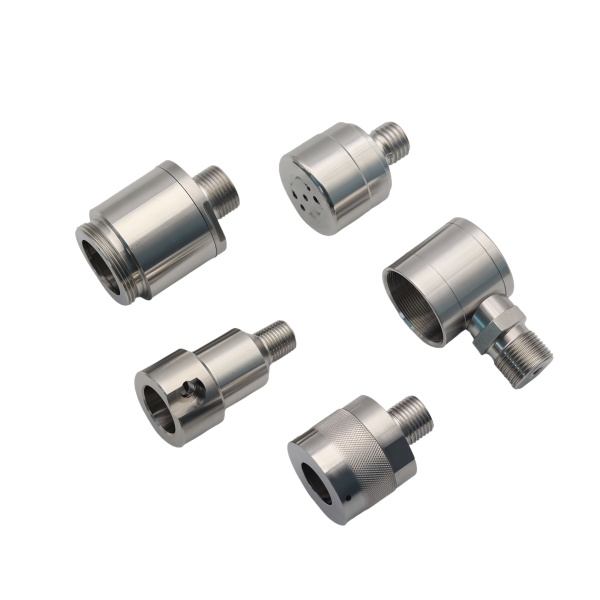
A piston seal does not measure the bore it runs in, it feels it. This cylinder body is machined so that the bore is round and straight along its whole length, not merely within its diameter tolerance, because the two are not the same requirement and only one of them governs how long the seals last.
Diameter tolerance and cylindricity are different requirements
A drawing will call up the bore in H7 or H8, and it is possible to meet that at both ends of a bore that is lobed in the middle. The seal cannot tell the difference in diameter – it sees a surface that keeps changing shape as the piston strokes, and the lip is flexed and relaxed once per cycle instead of riding a stable film. In practice that cyclic bending shortens seal life by a factor of three to five against a true cylinder. We hold cylindricity to 0.015 mm TIR as standard and to 0.008 mm where the cylinder runs above 15 MPa or above 1000 mm/s piston speed.
Roundness is measured along the bore, not at its ends
Because the failure is a mid-length one, the verification has to look for it. We take three-point internal micrometer readings at a minimum of five axial positions and at two angular orientations, and all of them have to sit inside the TIR band. Measuring only the ends passes parts that will wear seals early, which is why a bore is reported at its positions rather than at its diameter.
Surface finish is the other half of seal life
A bore that is perfectly round will still destroy a seal if it is finished wrong. Too smooth and the surface carries no oil film and the lip runs dry; too rough and it abrades. The target is a plateau finish – a surface with the peaks removed and the valleys left to hold lubricant – and it is produced by the finishing operation rather than by polishing afterwards. For a stainless steel body the finish also has to be achieved without smearing the surface, which stainless steel will do readily if the tool is allowed to rub instead of cut.
Stainless Steel changes the machining, not just the material
Austenitic stainless steel work-hardens as it is cut, so a light finishing pass that would clean up a steel bore can skate over a stainless steel one and harden the surface instead of improving it. Cuts are kept positive and deep enough to stay under the work-hardened layer, and the boring sequence is planned for the grade. The payoff is worth the extra care: a stainless steel body resists the corrosion and the chemical attack that would pit a plated steel bore and then tear the seals on the pits.
How the bore is verified before the body leaves
Each body is measured for cylindricity at its defined positions, and the finish is checked against the specified band rather than judged by eye.
First articles are retained for the programme, so a repeat order is machined to the same cylindricity and the same finish. On a body whose job is to be a running surface, that is what keeps the second batch treating its seals the same way.
This part belongs to our CNC Machining range. The CNC pages collect the process notes, tolerancing practice and inspection points behind every product in the family.
Where this part is used
Cylinder bodies with ports are the pressure-containing half of hydraulic and pneumatic actuation. We supply them into linear actuators, into pump and valve bodies where a piston seal runs in the bore, and into test and calibration equipment where the bore is the reference surface. The port positions are set by the circuit, which means the part is a machining problem wrapped around a forming problem.
Stainless steel is chosen where the fluid or the environment demands it — water-based fluids, food and pharmaceutical duty, marine and offshore. It also changes the machining: the same parameters that work on carbon steel will work-harden and gall on 304.
What we need to quote it
Send the seal type and its supplier, because the seal sets the bore specification far more tightly than the drawing usually does. Add the stroke and working pressure, the port thread standard, and tell us whether you want the body drawn and then machined or machined from solid — the first is cheaper at volume, the second is sometimes the only route for a short one-off.
Specifications
| Item | Stainless Steel CNC Machined Cylinder Bodies with Ports |
|---|---|
| Brand | AUNOV |
| Designing | Share your print, or send a part to be measured, our engineers reply with a manufacturability assessment and pricing. |
| Tooling | Tooling designed and cut in house, held and maintained under your part number. |
| Samples | Samples for approval come with a full dimensional report and material certification. |
| Materials | 304 / 316 stainless steel is the primary stock for this part, alongside carbon steel (SPCC / DC01), aluminium, brass and copper, with grade selection confirmed at drawing review. |
| Surface finish | Finish options: plating, e-coat, powder coating, anodising or passivation, per your print. |
| Processing | Staged deep drawing, with in-line annealing where the draw ratio requires, pierced and finish-machined on the same floor. |
| Equipment | Press capacity from 5 to 500 T across mechanical and hydraulic lines, CNC turning centres and a climate-controlled CMM room. |
| Tolerance | As-drawn tolerance +/-0.1 mm, with machined features to +/-0.03 mm. |
| Delivery terms | FOB is standard; DDP offered for EU and US, T/T or L/C, D/P on repeat business, scheduled call-offs welcome. |
Related Products


Request a Quote for This Part
Send a drawing or sketch — get material advice, tooling cost and a per-piece price within 24 hours (working days).