
From coil to housing: the stamping line behind a wiper motor
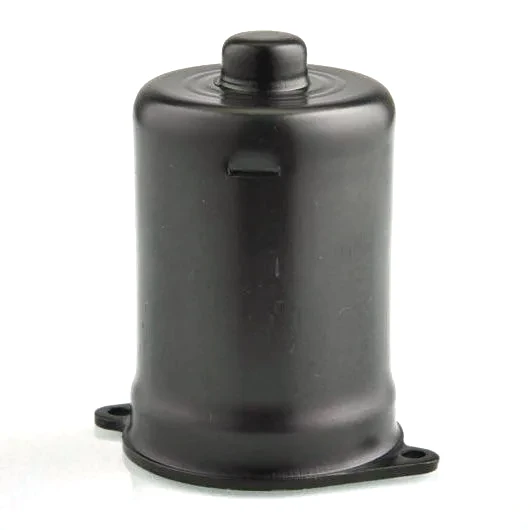
A sheet metal stamping wiper motor housing is one of those parts where the production method shapes the part more than the drawing does. On our floor it starts as a 0.9-1.5 mm coil – DC01 or SPCC for the majority of programmes, 1.4016 stainless steel where the vehicle spec calls for it – and passes through a progressive die that does in five or six stations what a job shop would spread across five machines. Blanking, drawing, restrike, piercing, trimming, all in one strip.
Why does that matter to a buyer? Because progressive-die wiper housings carry a completely different cost structure. Once the die is built (typically 4-6 weeks lead time for a housing of this class), the per-piece price collapses: no handling between operations, no re-clamping errors, and scrap rates that sit under 0.5% once the die is dialed in. At 50,000 pieces a year, the tooling pays for itself in the first production run.
The station sequence, station by station
A representative progressive die for this housing runs like this:
- Station 1 – pierce and pilot. Pilot holes are punched first; every later station registers off them. Get these wrong and nothing downstream matters.
- Station 2 – draw. The shell is drawn roughly 22-28 mm deep. Drawing ratio for a 68 mm housing blank lands around 1.7-1.8 – comfortably inside one-stroke territory with a proper draw bead.
- Station 3 – restrike and calibrate. The shell is re-seated to square up the walls and sharpen the flange radius. Skip this station and you will chase ovality all year.
- Station 4 – pierce features. The mounting ears, cable-exit slot and bearing-bore pilot are cut while the strip still holds the shell rigid – far more accurate than piercing a loose part.
- Station 5 – trim and part off. The flange OD is trimmed and the finished housing drops through, leaving the carry-over web to feed forward.
Every housing leaves the die with its features located off the same pilot system, which is why hole-to-bore true position on a progressive part routinely holds 0.10 mm where transfer-press parts drift to 0.15-0.20 mm.
Where wiper housings punish a sloppy die
Wiper motors run in the worst corner of a vehicle: water spray, road salt, stone impact, temperatures from -40°C to +90°C. The housing itself is not structural in the crash sense, but three failure modes come back to die quality:
- Flange flatness. The gasket face needs to seal against the motor end-bell. We hold flange flatness within 0.15 mm over the diameter by balancing the draw-bead restraint so the material flows evenly – an uneven bead shows up as a wavy flange that leaks.
- Bearing bore concentricity. The armature shaft runs in a sintered bushing pressed into the housing. If the bore sits more than about 0.05 mm off the OD centre, the bushing wall gets thin on one side and wears fast. That is exactly why we pierce the bore pilot in-strip rather than after part-off.
- Ear crack resistance. Mounting ears see assembly torque plus vibration. Ears formed at a draw radius that was too sharp show hairline cracks months later. We keep the radius at 2t minimum and proof-load every new die’s first article to 1.5x the specified bolt torque.
Finishing for the environment
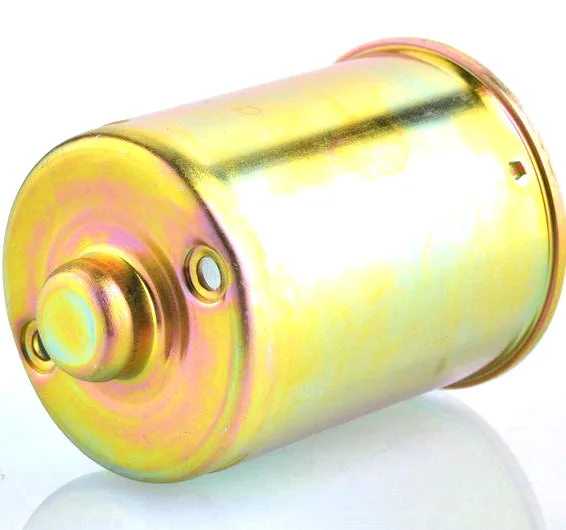
Steel housings leave the press clean but not finished. The standard route is zinc electroplating with a trivalent passivate, 5-8 μm, which clears 240-360 hours of neutral salt spray – enough for housing pockets under the cowl. Where the customer spec demands more, we go zinc-nickel alloy (12-15% Ni), which clears 720+ hours and stays ductile enough not to crack when the ears get bolted. Stainless Steel 1.4016 versions skip plating entirely and go straight to passivation; the premium is roughly 2.2x on material but zero on finishing and zero on warranty exposure in coastal markets.
Volume, application and finish – the three answers that firm a quote
A drawing is the start; three answers make the quote firm. Annual volume – because the progressive die economics hinge entirely on it. Material callout or environment class – salt-spray hours decide the plating line. And the mating interface – which faces the gasket, which carries the bushing, where the ears land – because tolerance budget belongs on those faces, not everywhere. With those three, a wiper motor housing in this class quotes in days and samples in three to four weeks after die approval.
Common questions from sourcing engineers
Can you run our housing on a progressive die if it was originally transfer-pressed?
Usually yes, if the draw depth stays under about 1.8x diameter and the flange has no deep local forms. We re-evaluate the blank development and often shave 3-5% off blank size, which is free money at volume.
What is the realistic tooling cost range?
For a single-diameter housing with ears and a cable slot, progressive die tooling typically lands in the mid four figures to low five figures depending on the number of pierce features. Multi-diameter stepped housings push higher because they need a second draw station.
How do you keep strip-to-strip consistency across steel mills?
We specify material by standard plus a mechanical-property band, not just grade, and we run first-piece layout plus a defined SPC set (bore, flange, ear position) per shift. Certificates travel with every coil lot.
This part belongs to our Automotive Motor Components range. The automotive motor components pages collect the process notes, common materials and inspection points behind every product in the family.
Specifications
| Item | Sheet metal stamping wiper motor housing |
|---|---|
| Brand | AUNOV |
| Designing | Your drawing sets the part – DFM notes are returned before any tooling is cut; the agreed version governs every later batch. |
| Tooling | Progressive and drawing dies are designed and built in house, so tooling lead time stays under our control, and the charge is refundable against agreed volumes. |
| Samples | Samples are issued for approval before the run, so the sample is retained as the master, and the signed sample is kept for future reorders. |
| Materials | Stock covers carbon steel, 304 / 316 stainless steel, aluminium and brass; the final grade is fixed with the drawing review. |
| Surface finish | Zinc or nickel plating for corrosion, plus powder coating or electrophoresis on housings; laser etching on request. |
| Processing | Coil feeding and progressive die blanking, forming, piercing or in-die tapping, deburring, then plating. |
| Equipment | Mechanical presses 5-250 T on progressive stamping lines with coil feeders and decoilers, toolroom wire-cut EDM for die maintenance. |
| Tolerance | +/-0.15 mm typical on formed parts, +/-0.3 mm on large covers; the die decides the achievable band. |
| Delivery terms | FOB, CIF or DDP per Incoterms 2020, T/T or L/C, with D/P accepted on repeat business; price breaks tie to annual volume. |
Related Products



Request a Quote for This Part
Send a drawing or sketch — get material advice, tooling cost and a per-piece price within 24 hours (working days).