
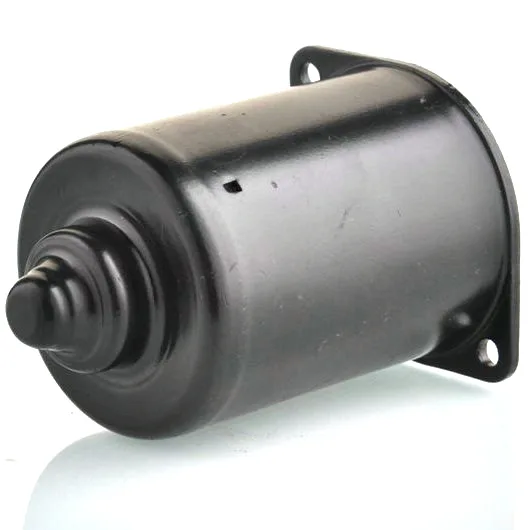
Deep canisters: drawing depth without drama
The wiper motor canister is the family’s depth champion – a cylindrical container whose length can run two or more diameters when the design stacks a motor, gearbox and electronics in one column. Depth is where deep drawing stops being a single clever stroke and becomes a planned sequence. This page explains how we build depth honestly: which ratios draw in one hit, which need a redraw, and what each choice costs in tooling and piece price.
Reading the depth budget
Every canister drawing carries an implicit depth budget: blank diameter minus punch diameter, divided by wall thickness, sets how much draw work the material must survive. Below a draw ratio of 1.9 in standard low-carbon steel, one stroke wins outright – simplest die, fastest cycle, lowest cost. Between 1.9 and 2.2, one stroke is possible but lives near the material’s limit; we will quote it only with a simulation showing thinning under 12% at the critical zone, because a canister that ships at 95% yield is not cheaper than a two-stroke canister shipping at 99.5%. Beyond 2.2, the redraw is not negotiable – and this is where suppliers promising “one-stroke anything” should be quietly deselected.
How a redraw actually works
A redraw takes the first-drawn shell, re-grips it at its base (or on a transfer finger), and pushes it through a slightly smaller die ring that walks the wall deeper while the flange region feeds in. No anneal is needed for low-carbon steel at wiper-scale reductions – the second draw absorbs its own work hardening if the first draw left enough ductility, which the simulation predicts. The redraw die adds a station and a transfer, raising piece price modestly, but it buys depth with margin and consistency. On long canisters we often split 60/40 between first draw and redraw, a proportion that simulation tunes so the critical zone’s thinning stays flat across both operations rather than spiking in either.
Internal corrosion: the problem owners forget
A canister’s inside face is its own microclimate. Sealed volumes breathe with temperature, condensation films the interior, and any chlorides introduced at assembly concentrate there. Plating the exterior does nothing for this – deposit inside a deep bore is thin, uneven and often masked by drainage during plating. Our standard answers: specify an internal-compatible finish (zinc-phosphate with oil, or an internal-rated e-coat), add a drain or breather feature where the design permits, and – for sealed designs – recommend a desiccant strategy to the motor maker. Canisters returned from wet climates with red interior dust are the most preventable failure in the family, and the fix costs a coating line choice, not a redesign.
Roundness over a long wall
The longer the wall, the more places for ovality to accumulate – coil anisotropy, bead restraint variation, and die wear each contribute a few tenths along the depth. For canisters whose internals locate against the wall (magnet rails, PCB guides), roundness at depth is a functional dimension. The restrike-with-sizing-station approach holds roundness within 0.1 mm over the full depth on our production canisters, verified by a vertical measuring machine that maps diameter at three heights per sampling plan. Customers who have fought “fits at the top, binds at the bottom” assembly issues will recognize why that map is on the certificate.
And why a 3:1 draw cannot be one stroke
Canister diameter, depth, wall, material; the internal environment spec (sealed or vented, wet or dry); whether internals locate against the wall (which sets the roundness grade); and volume. Expect the quote to state the stroke plan explicitly – depth strategy is the canister’s biggest cost lever – and first articles to follow die approval in four to five weeks given the taller tooling.
Wall thickness uniformity down a deep canister
Depth stretches the wall’s thinning story: the ironing effect of a long draw means the canister’s wall is thickest near the flange and thinnest at the critical zone, with the gradient set by the redraw split. Internals that locate along the wall care about that gradient, not just the average. We report wall thickness at three depths on first articles and keep the gradient inside the drawing’s band production-wide; when a customer’s internal rail was dimensioned to a uniform wall that physics cannot deliver, we say so at quote stage rather than letting the assembly line discover it.
Can you draw our 3:1 canister in one stroke?
Can you draw our 3:1 canister in one stroke to save tooling cost?
No, and we will not pretend otherwise – at that ratio the material fails. The two-stroke quote is the honest one; its piece price is pennies higher and its yield is dozens of points better.
Why is the inside of our current canister rusty while the outside looks new?
Interior surfaces rarely get effective coating coverage in standard plating. We can show you the deposit-thickness map from a sectioned canister – the numbers explain it – and quote an internal-rated finish.
Do you stock canisters for spares?
For qualifying programmes we retain the die and a defined safety stock; the spares economics depend on your call-off pattern, which is a conversation the quote can start.
Automotive Motor Components is the parent range for parts like this one; the overview page gathers the tooling logic, finishing options and tolerance notes that apply across the family.
Where this part is used
A wiper motor canister is the depth case in this family. Its length can run two or more diameters because the design stacks a motor, a gearbox and the electronics in a single column, and at that aspect ratio deep drawing stops being one clever stroke and becomes a planned sequence. The interesting manufacturing question on a canister is not whether it can be drawn but how many stages it takes and what that costs.
You will find these canisters wherever a wiper system has to pack a lot into a narrow column – commercial vehicles with a stowed-blade system, vehicles with a column-mounted motor, and the wiper systems on agricultural and construction machinery where the linkage geometry leaves little room. A canister also has an interior that stays wet, because a motor and a gearset live in it, and the internal corrosion that follows is the failure its owners forget about until the motor stops.
What we need to quote it
Send the can diameter, the length, the wall, and the depth-to-diameter ratio – or simply the diameter and the length, and we will work the ratio out. Tell us what lives inside it and whether it drains, because the internal condensation question changes the coating and the venting. If your drawing calls for a specific draw ratio or a specific thinning allowance, tell us the figure, because we will confirm it from simulation rather than assume it.
Specifications
| Item | Wiper motor canister |
|---|---|
| Brand | AUNOV |
| Designing | Made to your 2D/3D drawings (PDF, DWG, STEP, IGS) – unusual walls, threads or tolerances are feasibility-checked first; the same drawing is used for every repeat order. |
| Tooling | Dies, fixtures and gauges are made in our own toolroom, so a die can be re-cut against the approved drawing, and the die remains dedicated to your part. |
| Samples | Prototype and pre-production samples are provided against the drawing, so any deviation is corrected at sample stage, and production starts only after your written sign-off. |
| Materials | We hold carbon steel, 304 / 316 stainless steel, aluminium and brass, and the drawing review settles the final grade. |
| Surface finish | Adhesion comes from phosphating, followed by powder coating, e-coating or zinc plating; visible faces get chrome or nickel. |
| Processing | Deep drawing runs from coil or blank; in-process annealing keeps wall thinning even, and trim, pierce, form and finish follow. |
| Equipment | The press floor pairs 5-250 T mechanical with 250-500 T hydraulic presses; an in-line annealing furnace sits on line and CNC turning covers secondary work. |
| Tolerance | +/-0.05 mm on controlled dimensions and +/-0.1 mm on general features; capability studies supplied on request. |
| Delivery terms | FOB, with DDP offered for EU and US addresses, T/T with deposit and L/C for larger runs; call-off schedules are supported. |
Related Products

Request a Quote for This Part
Send a drawing or sketch — get material advice, tooling cost and a per-piece price within 24 hours (working days).