
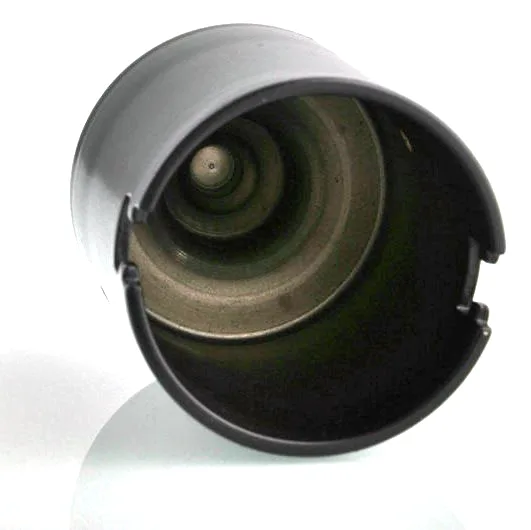
The die is the product: tooling economics for wiper motor housings
Buyers often compare deep draw wiper motor housing quotes as if the tooling were an unfortunate setup cost to be minimized. In reality, for a part family like this, the die is the product: it fixes the price curve for the next five years, the consistency of every housing you will ever receive, and how quickly a design change propagates. So it is worth understanding what you are actually buying when the tooling invoice arrives.
What a wiper housing die consists of
A complete tooling package for this part class typically includes a draw die (or a progressive die with draw, restrike and pierce stations), plus trim and pierce tooling if the process is transfer-based. The working steels matter more than most quotes admit: we build draw inserts in D2-class cold-work steel at 58-60 HRC, with the draw radii and bead surfaces polished in the direction of metal flow. A die built from commodity steel at the wrong hardness will run its first 50,000 pieces fine and then begin galling – and galling on a draw radius shows up as score marks down the housing wall and a scrap rate that creeps month by month.
Coating is the second lever. Titanium-nitride or similar PVD coatings on the draw radius extend re-polish intervals by a factor of three to five on steel housings, and more still on stainless steel, whose oxide skin is abrasive to tooling. For a customer running 1.4016 wiper housings we coat the draw inserts as standard, not as an option.
Die life in real numbers
For a wiper motor housing in DC01 at 1.0-1.2 mm, our maintenance cadence looks like this: polish the draw radius every 80,000-120,000 strokes; re-cut the trim inserts every 300,000-500,000; full insert replacement at 2-4 million strokes depending on coating and material abrasiveness. Expressed per part, die maintenance adds a fraction of a cent at volume – which is why a quote that looks 10% cheaper because the supplier skipped die-grade steel will not stay cheaper through the programme.
How tooling shapes your unit price
The amortization arithmetic is blunt. A progressive die for a single-diameter wiper housing typically runs mid four figures to low five figures. At 20,000 pieces a year that is noticeable in year one and invisible by year two. At 200,000 a year it rounds to zero. What does not round to zero is the per-piece difference between a die that runs 20,000 strokes between maintenance and one that runs 100,000 – downtime, scrap on restart, and the logistic tail of waiting for tool rooms all live in that gap. When we quote, we show the tooling and the maintenance assumptions separately so the comparison with other suppliers is honest.
Design changes: where the die architecture pays off
Wiper motor programmes evolve – a new cable-exit position, an extra earth tab, a flange hole moved 8 mm. In a progressive die, features pierced in-strip are modified by changing one insert, often within days and at insert-only cost. The same change on a transfer process can mean a new op station. This is the quiet reason we steer wiper housings toward progressive tooling whenever the geometry allows: not because it is trendy, but because year-three changes are a certainty in automotive and the change cost is a design decision you make in year zero.
What we check before cutting steel
- Draw simulation. We run the blank development and thinning prediction before ordering die steel, not after first shots. A predicted thin spot above 12% gets a radius or blank change on paper, where it costs nothing.
- Blank development. The blank outline is tuned so ears feed metal rather than starve it; 3-5% of blank area is often recoverable versus a first-guess outline, which is real money at volume.
- Feature hierarchy. We agree with the customer which faces are functional – bushing bore, gasket flange, ear holes – and design the die so every one of them is produced off a single locating system.
Volume decides whether this is a programme or a part
Drawing with material and thickness, annual volume, and any known future changes (even a rumour of a variant). The volume sets whether progressive or transfer tooling wins; the change forecast sets how much insert modularity to build in. With those, we quote tooling and piece price as separate line items, and first samples follow die approval in three to four weeks.
Who owns the die once it is paid for?
Who owns the die?
You do, once paid. It sits in our tool room under our maintenance programme, and it ships to you or a competitor on request – the standard automotive terms. We think tool lock-in is a bad deal for both sides.
Can you rebuild a die our previous supplier made?
Usually yes, after a die audit: we measure the working surfaces, re-cut or re-coat as needed, and run a first-article loop. Budget for an audit plus one corrective iteration; a tired die often needs its draw radii re-established before it produces conforming parts again.
Is a cheaper single-station draw die worth it for prototypes?
For pre-series volumes under a few thousand pieces, yes – and we say so. But do not let prototype tooling drift into production: the maintenance curve that is invisible at 2,000 pieces dominates at 200,000.
This part belongs to our Automotive Motor Components range. The automotive motor components pages collect the process notes, common materials and inspection points behind every product in the family.
Specifications
| Item | Deep Draw Wiper Motor Housing |
|---|---|
| Brand | AUNOV |
| Designing | Quotation follows the print, not a catalogue – a manufacturability review comes back with the quotation; changes are priced before they are made. |
| Tooling | Die design and toolmaking stay in house, so tooling lead time stays under our control, and ownership is confirmed on the quotation. |
| Samples | Sample parts are measured and reported before submission, so any deviation is corrected at sample stage, and mass production is gated on that approval. |
| Materials | Carbon steel (SPCC / DC01), 304 / 316 stainless steel, aluminium, brass and copper – the grade is matched to the duty of this housing. |
| Surface finish | Zinc / nickel / chrome plating or e-coat, chosen for the environment this housing sees; salt-spray tested to drawing. |
| Processing | Deep drawing runs from coil or blank; in-process annealing keeps wall thinning even, and trim, pierce, form and finish follow. |
| Equipment | 5-250 T mechanical presses and 250-500 T hydraulic presses, in-line annealing furnace, CNC turning for secondary work. |
| Tolerance | +/-0.15 mm typical on formed parts, +/-0.3 mm on large covers; the die decides the achievable band. |
| Delivery terms | FOB Ningbo or Shanghai, payment by T/T, L/C at sight or D/P; each volume tier carries its own quoted price. |
Related Products

Request a Quote for This Part
Send a drawing or sketch — get material advice, tooling cost and a per-piece price within 24 hours (working days).