
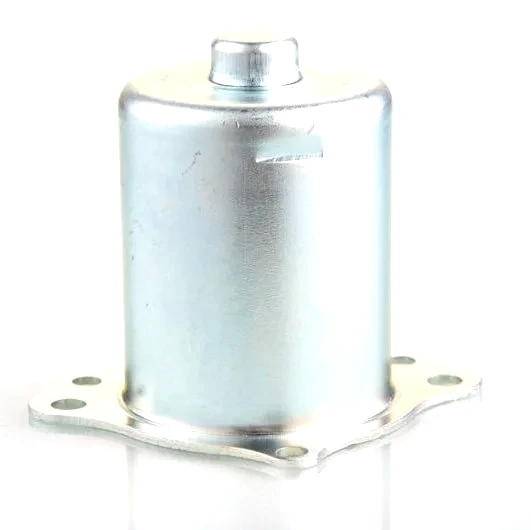
Scaling up: what changes when a wiper motor cabinet grows
Passenger-car wiper parts draw within a hand-span. The wiper motor cabinet for commercial vehicles, buses and off-highway machines does not – and the step up in size changes the engineering more than linearly. Blank diameters push past the comfortable range of single-stroke drawing, material handling stops being trivial, and the tooling itself becomes heavy industrial equipment. This page covers what buyers should expect when their wiper cabinet programme scales up.
Draw strategy at larger diameters
Above roughly 200 mm blank diameter, the arithmetic tightens. Draw ratios that were safe on a small shell strain against press tonnage and blank-holder pressure distribution – the edges of a big flange respond to clamp pressure more slowly than its centre, and wrinkles appear in a band that small parts never show. Our standard answers: two-stroke draws with a wide-radius redraw, draw beads segmented around the perimeter (full-ring beads over-restrain the corners on rectangular cabinets), and thicker sheet than the small-part intuition suggests – a 2.0 mm wall on a large cabinet draws more reliably than a 1.2 mm wall fighting the same ratio, and the mass penalty is marginal on a part this size. Simulation decides the split long before die steel; at this scale, a die revision costs weeks.
Tooling and press reality at scale
The die for a large cabinet weighs tonnes, runs in presses of 300-600 tonnes, and its maintenance cadence shifts from polish-and-recoat to insert replacement planning. Lead times lengthen correspondingly: die design, cutting, and tryout for a large cabinet run 6-8 weeks against 4-6 for small parts, and the tryout loop matters more – a large draw’s first shots are genuinely informative in a way small-draw first shots are not, because every material and lubricant variable is magnified. Buyers should budget tryout sampling into the schedule honestly rather than expecting small-part timelines at big-part scale.
Handling, distortion and transport
Thin-walled large shells are structurally shy between the press and the customer’s dock. A 300 mm shell in 1.5 mm steel will distort under its own weight if stacked carelessly, and it will oil-can if restrained while thermal-cycling through a sea shipment. Our production handling uses full-form trays that support the shell at its flange; transport packing adds flange-restraint blocks and desiccant, because a large enclosed volume breathes far more moist air across an ocean than a small one. These are the least glamorous line items in a large-cabinet quote and the ones that most often separate a clean incoming inspection from a dispute.
Where the commercial-vehicle duty cycle differs
Bus and truck wiper systems run longer duty cycles, see pressure-washing at depots, and operate across wider temperature spreads. The cabinet answers with material and coating choices rather than exotic geometry: heavier galvanizing or zinc-nickel over the standard trivalent, sealed drain strategy (a parked bus winters outdoors), and fastener features tolerant of service teams with impact drivers. We also see more stainless steel specification at this scale – 1.4016 cabinets for coastal transit fleets – and at large sizes the stainless steel premium shrinks relative to the plating-plus-warranty cost it replaces, which flips the economics that governed the small-part decision.
Within our press envelope – thickness drives it
Cabinet drawing with diameter or envelope, depth, wall and material; the vehicle duty class (passenger, commercial, off-highway); corrosion spec; volume. Expect our quote to show the stroke strategy explicitly – at this scale it is the single biggest cost driver – and expect first articles in six to eight weeks after die approval, with the tryout loop scheduled as a real step rather than compressed into it.
Assembly and service at commercial scale
Large cabinets get installed by two people and serviced by depots, not clean rooms. That shifts feature priorities: lifting or positioning features (formed notches that accept hook straps), fastener access sized for impact tools, and Identification – part number, production date and voltage-class marking stamped into a flange face where depot staff actually look. None of these appear on a passenger-car drawing, and all of them decide whether the fleet’s service records read “replaced in minutes” or “damaged during removal”. We ask about the service story at RFQ because it is cheaper to form a lifting notch than to argue with a depot manager.
Can you run a cabinet this size in stainless steel?
Can you run a cabinet this size in stainless steel?
Within our press envelope, yes – the draw behaves like a stiffer steel, and the die needs larger radii and a coating package. Simulation confirms before we commit the steel.
Why is the tooling quote 2-3x our small-part experience?
Die size, press tonnage, and the tryout loop. The piece price, once running, scales far more gently than the tooling – the amortization curve is what makes large cabinets viable at fleet volumes.
How do you prevent transit distortion?
Full-form flange trays plus restraint blocks plus desiccant, specified in the packing drawing we ship with first articles. If your dock has a preferred returnable-container system, we design to it.
This part belongs to our Automotive Motor Components range. The automotive motor components pages collect the process notes, common materials and inspection points behind every product in the family.
Where this part is used
A commercial-vehicle wiper motor cabinet is a genuinely different job from a passenger-car one. The blank diameter pushes past 200 mm, which is where single-stroke drawing stops being comfortable, the tooling weighs tonnes, and the press runs at 300 to 600 tonnes. You will find cabinets this size on buses, on refuse and haulage vehicles, on construction and agricultural machinery, and on the off-highway machines where a wiper has to sweep a windscreen a person stands in front of.
The duty cycle is also different. A commercial vehicle’s wiper runs far more hours per week than a car’s, usually in weather that is wet, salty and dirty, and the mounting is a bolted interface to a cab structure that is itself stiff and heavy. All of that shifts the questions from can the part be drawn to whether the programme can be supplied reliably for a decade.
What we need to quote it
Send the blank diameter, the wall thickness, and the flange dimensions, and tell us the material grade. Above roughly 200 mm blank diameter the draw strategy and the tooling both change materially, so we will confirm the stroke count and the die concept before quoting rather than after. Tell us the annual volume and the programme life, because at this size the die tryout cadence is part of the schedule and it is better planned in than discovered. Lead times for a large cabinet run longer than for a small part.
Specifications
| Item | Wiper motor cabinet |
|---|---|
| Brand | AUNOV |
| Designing | Your drawing sets the part – samples are reverse-measured into a controlled drawing; the agreed version governs every later batch. |
| Tooling | Die design and toolmaking stay in house, so the die charge appears as its own quotation line, and maintenance is tracked against the part number. |
| Samples | First-article samples ship with a dimensional report and material certificate, so any deviation is corrected at sample stage, and mass production is gated on that approval. |
| Materials | Carbon steel (SPCC / DC01), 304 / 316 stainless steel, aluminium, brass and copper – the grade is matched to the duty of this component. |
| Surface finish | For corrosion, zinc or nickel plating; powder coating or electrophoresis on housings; laser etching on request. |
| Processing | Coil blanking, progressive drawing through 3-5 stages with anneals between, trim and pierce, then deburr and finish. |
| Equipment | The press floor pairs 5-250 T mechanical with 250-500 T hydraulic presses; an in-line annealing furnace sits on line and CNC turning covers secondary work. |
| Tolerance | +/-0.05 mm on controlled dimensions and +/-0.1 mm on general features; capability studies supplied on request. |
| Delivery terms | FOB Ningbo or Shanghai, payment by T/T or L/C, quoted in USD or EUR; call-off schedules are supported. |
Related Products


Request a Quote for This Part
Send a drawing or sketch — get material advice, tooling cost and a per-piece price within 24 hours (working days).