
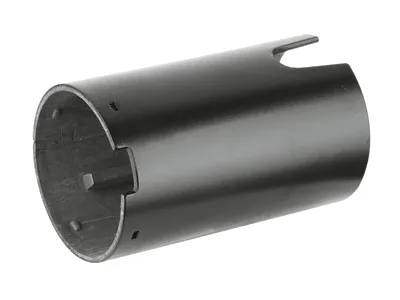
Cranking current and engine-bay heat: the starter motor housing
A starter motor deals with the harshest duty in the accessory family. It draws hundreds of amps for seconds at a time, generates cranking torque measured in newton-metres at the pinion, sits bolted to the engine block where temperatures cook every material, and must start the vehicle on the coldest morning of the year and the hottest. An auto starter motor housing has to do its mechanical job – locate the armature, carry the field, mount to the bellhousing – while surviving an environment that would destroy most drawn parts. This page covers what that demands of the shell and its tooling.
Mounting to the engine: the flange interface
The starter bolts to the engine’s bellhousing with a flange whose bolt pattern is set by the engine, not by any motor designer. This makes the housing’s flange the part where automotive mechanical interface discipline is most visible: bolt-hole position tolerance tight enough to guarantee pinion-to-flywheel alignment (typically 0.15-0.25 mm positional), flange face flatness that keeps the starter square to the block (0.1 mm preferred), and spigot or register features if the engine uses them for location. The flange also carries the starter’s reaction torque during cranking – a substantial load – so its thickness and bolt-hole margins are structural, not incidental. Our starter housings hold the flange’s key faces to tight tolerance by designing the draw so the flange is sized in a calibration station, and by piercing the bolt pattern in-strip so it registers off the same feature the pinion seat does.
Heat: the engine bay’s signature environment
Under-hood soak temperatures routinely reach 120-150°C near the block, and the starter is often the part closest to the exhaust manifold. This does three things to a housing. It thermally expands every joint, so the bearing seats and flange must keep their fits across a wide spread – press-fit bands verified at soak temperature, not just ambient. It accelerates corrosion, so the coating system must survive under-hood cyclic humidity rather than the milder door-cavity duty (zinc-nickel or e-coat, generally). And it makes the housing part of the starter’s thermal path – the field windings and brushes generate their own heat, and conduction to the block is a real cooling mechanism, which argues for a shell whose mounting flange makes solid thermal contact. We ask starter programmes for their soak temperature and the block’s material, because both change the design’s edge cases.
The shell as magnetic return
Like every DC machine, the starter’s housing closes the flux path for its field. Starter fields are strong – series-wound designs put high flux through the shell – so the housing’s wall thickness and uniformity matter to cranking torque, and saturation is a real constraint rather than a theoretical one. The material choice echoes our yoke guidance: low-carbon steel for the flux path, ferritic 1.4016 where corrosion demands stainless steel and the design can pay for the slightly stiffer draw. What differs on starters is scale: the shell diameter is larger, the wall thicker, and the draw ratios correspond to larger, heavier tooling. Simulating the draw is correspondingly more valuable – a starter shell die revision is a significant cost, so the first tryout must be right.
Bushings, spigots and the drive-end interface
The starter’s armature runs in bushings at both ends, and the drive end carries the pinion mechanism with its own bearing or spigot. The housing’s bores for these features take the pinion engagement forces – thousands of cranking cycles, each with an engagement shock. Our approach mirrors our motor-housing practice: bore features sized by coining or sizing after the draw, positions tied to the flange datum by in-strip piercing, and press-fit bands validated across the thermal range with the actual bushing material. Starter programmes reward suppliers who treat the drive-end bore as a precision feature, because a pinion that misaligns by a few hundredths destroys the flywheel’s ring gear along with its own teeth.
For replacement programmes we copy the bellhousing
The housing drawing with the bellhousing flange dimensions, spigot or register features, pinion-seat bore, the engine’s bolt pattern, soak temperature and corrosion spec, and volume. Starter volumes for a given engine family can be large, so the tooling plan will usually be progressive or transfer, with the piece price reflecting that. First articles in four to five weeks after die approval, given the shell’s size and the flange’s tolerances.
Can you match our housing as a drop-in replacement?
Can you match our existing starter housing as a drop-in replacement?
Yes – for replacement programmes we copy the bellhousing flange and bores exactly and reproduce the material and finish. The die is new, the part is a dimensional match, and we validate against your gauges before shipping.
Our starters fail at the pinion bore after high mileage – housing or mechanism?
Pinion-bore wear usually means the bore’s fit band drifted or the housing’s heat soak moved the fit beyond its validated range. Send returns; the bore’s condition tells the story, and our thermal-fit data will show whether the design’s band had margin to spare.
Do you supply the housing with bushings pressed?
On qualifying volumes, yes – the same thermal-validated press fit we build into every motor housing, delivered as a finished sub-assembly your line drops in.
Automotive Motor Components is the parent range for parts like this one; the overview page gathers the tooling logic, finishing options and tolerance notes that apply across the family.
Specifications
| Item | Auto starter motor housing |
|---|---|
| Brand | AUNOV |
| Designing | Made to your 2D/3D drawings (PDF, DWG, STEP, IGS) – samples are reverse-measured into a controlled drawing; changes are priced before they are made. |
| Tooling | Our toolroom covers die design, wire-cut EDM and maintenance, so no tooling step is outsourced, and ownership is confirmed on the quotation. |
| Samples | Samples are issued for approval before the run, so the approved first article becomes the gauge reference, and later batches are gauged back to the signed sample. |
| Materials | Carbon steel (SPCC / DC01), 304 / 316 stainless steel, aluminium, brass and copper – the grade is matched to the duty of this housing. |
| Surface finish | Zinc or nickel plating guards against corrosion; housings can take powder coating or electrophoresis, and laser etching is available on request. |
| Processing | From coil or blank, deep drawing with in-process annealing thins walls evenly; the sequence then runs trim, pierce, form and finish. |
| Equipment | 5-250 T mechanical and 250-500 T hydraulic presses, annealing ovens, and CNC turning and machining centres for secondary work. |
| Tolerance | +/-0.1 mm on formed features and +/-0.2 mm on overall lengths; tighter bands confirmed against the die before quoting. |
| Delivery terms | FOB Ningbo or Shanghai, T/T or L/C, with D/P accepted on repeat business; sea or air freight is quoted to your door. |
Related Products

Request a Quote for This Part
Send a drawing or sketch — get material advice, tooling cost and a per-piece price within 24 hours (working days).