
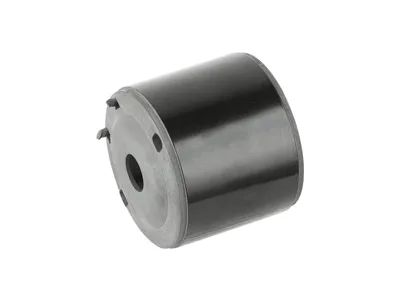
Packaging a planetary set: the starter enclosure’s internal geometry
Below the mounting flange and above the field, a gear-reduction starter’s enclosure has to do a precise job: hold a planetary reduction stage concentric to the armature, keep its lubricant where it belongs, and pass the multiplied torque out to the drive end without letting the enclosure distort. That is a different engineering brief from a wiper or window enclosure, which mainly protects rather than ensures alignment. Here, internal geometry is the point.
Concentricity: the reduction stage’s first requirement
A planetary set’s life depends on its sun, planets and ring being concentric to the armature axis. In a starter enclosure, that axis is defined by the same datum chain that locates the armature bearings, which means the enclosure’s internal features – the ring gear seat, the carrier bearing step, the alignment of the reduction housing with the motor body – must all register to one datum. Our starter enclosures carry these features formed and sized in the same die sequence, so their position relative to the armature bearing seats is fixed by tooling rather than by assembly. When a customer specifies a ring gear seat diameter and position, we treat them like a motor housing’s bushing bore: tight tolerance, in-strip forming, first-article verification. A reduction stage that runs off-centre wears its planets and, in the field, sounds like a starter that grinds.
Lubricant containment in a spinning environment
A planetary set in a starter operates briefly and brutally – a few seconds of high-speed, high-torque operation per start, thousands of times over a vehicle’s life – and its lubricant is typically grease that must stay put. The enclosure’s contribution is containment: formed features that hold the grease in the reduction chamber against the centrifugal fling of operation, a defined fill volume agreed with the gear supplier, and a joint design that resists the pumping action of repeated thermal cycling and start-stop cycling. We verify grease fill by weight on sampling and check for migration in teardowns, exactly as with the regulator body’s worm drive, because the mechanism is the same even if the loads are larger.
Torque reaction: the enclosure under magnification
The starter’s reduction multiplies armature torque severalfold into the pinion, and by reaction the enclosure carries that multiplied torque against the engine. This is the enclosure’s dominant structural load – far bigger than any vibration it sees – and it arrives as a shock on every crank. The enclosure’s response must be stiff, not merely strong: any local yielding under the reaction changes the geometry the reduction runs in, so we design the load path from the ring-gear region to the mounting flange as short and direct as the shape allows, with formed stiffening where the path bends. High-mileage starter teardowns that show a reduction housing out of round usually show a reaction path that flexed cyclically rather than failing outright – the more insidious mode.
Assembly and service
The starter enclosure assembles over the field, receives the reduction stage, and closes against the drive-end nose. Its assembly features – pilot steps, fastener bosses, locating keys – decide whether the customer’s line builds the starter quickly and whether a service team can replace a reduction on a bench. We include fastener features with lead-in forms, asymmetric locating features so the enclosure cannot be fitted rotated, and witness marks for the reduction stage’s orientation. These are the same design-for-assembly patterns used across our motor parts, applied where the customer’s build sequence has been shared with us early enough to shape the tooling.
Ring gear seat position changes the reduction
The enclosure drawing with the reduction stage’s interface dimensions (ring gear seat, carrier step, sun alignment), the grease specification and fill volume, the cranking torque reaction and volume. First articles in four to five weeks after die approval, with the internal features’ metrology and grease-fill verification included.
Starters grind at engagement – is the enclosure off?
Our starters grind at engagement – is the enclosure off?
Possibly: a ring gear seat out of position changes the reduction’s mesh. Send the enclosure and the reduction housing; our CMM comparison against print will separate a manufacturing fault from a design mismatch.
Can you form the ring gear seat to a press-fit tolerance?
Yes, by sizing after the draw, held in the same datum system as the armature bores. For very tight fits we will recommend a coining station rather than trying to hold it as-drawn.
Do you supply the enclosure with the reduction stage installed?
On qualifying volumes we can install and verify the reduction set to your print, which moves a delicate assembly step off your line. The gear set and its specification stay yours.
This part belongs to our Automotive Motor Components range. The automotive motor components pages collect the process notes, common materials and inspection points behind every product in the family.
Specifications
| Item | Auto starter motor enclosure |
|---|---|
| Brand | AUNOV |
| Designing | Your drawing sets the part – samples are reverse-measured into a controlled drawing; the same drawing is used for every repeat order. |
| Tooling | Our toolroom covers die design, wire-cut EDM and maintenance, so the die charge appears as its own quotation line, and first-article timing is measured from the tooling start date. |
| Samples | Sample parts are measured and reported before submission, so the part is proven before it is made in volume, and production starts only after your written sign-off. |
| Materials | Stock covers carbon steel, 304 / 316 stainless steel, aluminium and brass; the final grade is fixed with the drawing review. |
| Surface finish | Zinc / nickel / chrome plating or e-coat, chosen for the environment this housing sees; salt-spray tested to drawing. |
| Processing | Deep drawing runs from coil or blank; in-process annealing keeps wall thinning even, and trim, pierce, form and finish follow. |
| Equipment | Mechanical presses from 5 to 250 T, hydraulic presses 250-500 T, annealing ovens, plus CNC turning and machining centres. |
| Tolerance | +/-0.15 mm typical on formed parts, +/-0.3 mm on large covers; the die decides the achievable band. |
| Delivery terms | CIF or DDP, with FOB available, payment by T/T, L/C at sight or D/P; repeat orders reuse the approved first article. |
Related Products


Request a Quote for This Part
Send a drawing or sketch — get material advice, tooling cost and a per-piece price within 24 hours (working days).