
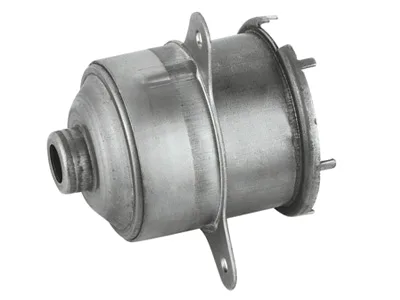
A housing that guides air: the blower motor’s structure
The electric warm wind motor – the cabin blower that pushes heated or cooled air into the vehicle – spends its life at speed, moving large volumes of air through a duct system, and its housing does something a wiper or window motor’s housing never does: it shapes the airflow. An electric warm wind motor housing is simultaneously a structural shell, a magnetic return, a bearing carrier and an aerodynamic element, and those four jobs interact. This page covers the housing as an air-handling part, which is where most of its engineering difficulty lives.
The blower’s duty cycle is nothing like a window motor’s
A window motor runs two seconds at a time; a blower motor can run continuously for hours on a summer’s drive, and its speed range spans a wide band from a whisper at low setting to several thousand rpm at full. That continuous duty changes the housing’s requirements: heat accumulates (the motor’s losses have nowhere to hide over hours of running), magnet retention must survive sustained centrifugal load, and the housing’s dimensional stability must hold across a long thermal soak. Where a window housing’s tolerances are about fit, a blower housing’s are about airflow consistency – a wall that breathes or a bore that drifts changes the fan’s clearance and therefore its noise and output. Our blower housings are designed for the continuous case: wall thickness chosen for thermal path as well as flux, magnet land held uniformly, and the bearing seats sized and coining-finished to hold the shaft’s alignment through the soak.
Housing as air guide
In many blower architectures, the housing’s inner surface forms part of the air path – a scroll or a transition that turns the fan’s discharge into the duct system. Formed sheet is a natural fit: the scroll can be shaped in the draw and trim stages, its clearance to the fan’s blade tips set by the formed geometry, and its surface smooth enough that it does not add turbulence noise. Getting that geometry right matters because tip clearance is a direct trade between fan efficiency and noise: too much clearance and the fan loses pressure and howls; too little and the blades foul the housing as the motor’s alignment shifts. We hold the scroll’s clearance band to the customer’s fan design, verify it on first articles, and treat the bearing seats and the scroll as a shared tolerance problem because the fan’s position depends on both.
Dust, leaves and the real-world air path
Cabin air carries everything: dust, pollen, leaves, and in some markets, insects. A blower housing accumulates debris in pockets and ledges, and debris that reaches the fan either unbalances it or falls into the motor. Formed housings can be designed to shed debris – avoiding flat ledges where it settles, shaping the scroll so debris migrates to a low point, and, where the architecture allows, providing a drain or a catchment that a service technician can clear. The intake path’s debris management is often an aftermarket complaint rather than a warranty one, but it shows up in service part sales and in the motor’s bearing life, so it is worth designing for at the housing level rather than leaving it to the filter.
Heat: the housing as the motor’s only thermal exit
A blower motor running for hours at high setting rejects its losses into the housing, and the housing’s job is to move that heat into the airstream. This favours a housing that presents surface area to the airflow, that couples the bearing and stator heat to that surface, and whose material and thickness conduct heat rather than trapping it. Formed steel is a decent conductor and, unlike a moulded plastic housing, it can also carry the magnetic return – which is exactly why steel blower housings persist alongside plastic ones. On programmes where the motor’s thermal margin is thin, we have bought headroom by thickening the housing’s wall in the zones that face the airflow, a change that costs grams rather than millimetres and is designed through blank development.
Debris, clearance and modes in that order
The housing drawing with the fan’s tip clearance and the scroll geometry (if the housing forms part of the air path), the bearing seat requirements, the motor’s continuous-duty thermal spec, the magnet architecture, the debris-management requirements, the corrosion spec, and volume. Blower volumes are typically high, so the tooling is progressive where the geometry allows. First articles in four to five weeks after die approval, with scroll clearance, bearing-seat metrology and thermal validation included where specified.
Blowers get noisy after a couple of years
Our blowers get noisy after a couple of years – is the housing at fault?
Sometimes: debris accumulation, a scroll clearance that drifted, or a bearing seat that relaxed with heat. Send the blowers and the fan data; our metrology and a teardown usually separate debris, wear and thermal drift within a week.
Can a steel housing be as quiet as a plastic one?
It can, with attention to the scroll’s surface and clearance and to the housing’s modal response, though the acoustic engineering differs. Where noise is the driver, we start with a modal check as we do on our other motor parts.
Do you supply housings with bearings or magnets installed?
On qualifying volumes, yes – pressed, bonded and gauged to your prints, which moves the delicate operations to the part level where they can be verified before the blower is assembled.
This part belongs to our Automotive Motor Components range. The automotive motor components pages collect the process notes, common materials and inspection points behind every product in the family.
Specifications
| Item | Electric Warm Wind Motor Housing |
|---|---|
| Brand | AUNOV |
| Designing | Made to your 2D/3D drawings (PDF, DWG, STEP, IGS) – samples are reverse-measured into a controlled drawing; the agreed version governs every later batch. |
| Tooling | Our toolroom covers die design, wire-cut EDM and maintenance, so a die can be re-cut against the approved drawing, and ownership is confirmed on the quotation. |
| Samples | Pre-production samples come with a full inspection report, so the part is proven before it is made in volume, and mass production is gated on that approval. |
| Materials | Carbon steel (SPCC / DC01), 304 / 316 stainless steel, aluminium, brass and copper – the grade is matched to the duty of this housing. |
| Surface finish | Zinc / nickel / chrome plating or e-coat, chosen for the environment this housing sees; salt-spray tested to drawing. |
| Processing | Deep drawing runs from coil or blank; in-process annealing keeps wall thinning even, and trim, pierce, form and finish follow. |
| Equipment | 5-250 T mechanical and 250-500 T hydraulic press lines, in-line annealing furnace, with CNC turning covering secondary work. |
| Tolerance | +/-0.1 mm to +/-0.2 mm general; critical features held to the drawing and verified on the first article. |
| Delivery terms | FOB, CIF or DDP per Incoterms 2020, T/T or L/C, with D/P accepted on repeat business; repeat orders reuse the approved first article. |
Related Products


Request a Quote for This Part
Send a drawing or sketch — get material advice, tooling cost and a per-piece price within 24 hours (working days).