
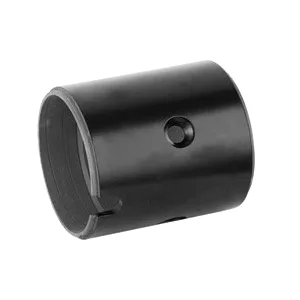
The starter can: bigger, thicker, harder
Where a window or wiper can draws at 30-45 mm, an auto starter motor can runs 60-90 mm across with walls of 1.5-2.5 mm, carrying field poles that handle cranking current in the hundreds of amperes. The physics does not change; the numbers do, and they shift the engineering far enough that a starter can programme deserves its own tooling thinking. This page covers what a larger, thicker drawn can demands – of the draw, of the material, and of the assembly steps around it.
Draw ratios at starter scale
Starter cans are typically shallower relative to diameter than window motor cans – the field length sets the depth, and it rarely exceeds a 1.5:1 aspect ratio – so draw ratios look comfortable, often 1.6-1.8. That apparent comfort conceals the real difficulty: thick sheet. Drawing 2.0 mm low-carbon steel through a can-sized die demands press tonnage and blank-holder control that a 1.0 mm shell never touches, and the thick sheet’s springback is larger in absolute terms, so the open-end flare after the punch retracts is a real dimension. Our answer at this scale is the same as everywhere – simulate before cutting steel, size the blank holder for the tonnage, and plan a sizing station for the open end rather than trusting the draw to hold it. The extra station costs less than the scrap from a marginal process.
Poles and fields: what the can carries inside
Starter field architecture varies – older designs run wound field coils around pole shoes, newer ones use permanent magnets for weight and simplicity. Either way the can is the structural host: pole shoes bolt or rivet to the can’s inner wall, magnet versions bond with the same surface-rigour as our yoke and can pages describe (cleanliness, dyne level, bond-line uniformity), and the can’s wall thickness where the field sits is part of the magnetic return path. On starter cans the wall section often carries more flux than any accessory motor, so its uniformity matters more, and the mass of the poles compounds the assembly shock loads the can must survive. We map wall thickness around the circumference on first articles as standard for this family, as we do for yoke-critical shells.
Assembly features: starters are bolted together, not just drawn
A starter can usually carries more assembly features than an accessory can: a drive-end flange or register for the nose casting, brush-holder mounting features or a locating step, and often a formed feature that positions the field poles during assembly. Every one of these is die geometry, and every one registers off the same datum system the can’s drive end does – which is why we pierce and form these features in-strip rather than adding them loose. Traceability on starter cans also tends to be tighter than accessory parts, because a cranking failure strands a vehicle: our starter can lots carry coil certificates, wall maps and piercing-position layouts in their production file.
Coating for the engine bay
A starter can lives where heat, oil mist, road spray and salt all meet. The coating system must survive cyclic under-hood conditions rather than the milder door cavity, and it must do so on a thick, formed surface where edge coverage matters (cut edges and bolt holes are the first to redden). Our standard starter routes: zinc-nickel on steel cans for the highest salt-spray demands, conventional trivalent zinc where the under-hood location is protected, and e-coat where the can also carries visible engine-adjacent surfaces. Every route is validated with a cyclic test at under-hood temperatures, not just a standard salt-spray cabinet, because the failure modes differ.
Draw ratio is the number that decides one stroke or two
The can drawing with diameter, depth, wall and material; the field architecture (wound coils or bonded magnets, with prints); the drive-end and brush-holder interfaces; the under-hood corrosion spec; and volume. Starter programmes are usually high-volume, so tooling is progressive where the strip allows, with the piece price reflecting that. First articles in four to five weeks after die approval given the shell’s size and thickness.
Can you draw a 2.5 mm wall can in one stroke?
Can you draw a 2.5 mm wall can of this diameter in one stroke?
Usually yes at the ratios starters use, provided the press has the tonnage and the blank holder is engineered for it. Simulation confirms before we commit.
Our current cans show pole-shoe looseness after high-mileage use – is the can at fault?
Possibly: pole fastening loads pass into the can wall, and a wall that flexes under cranking shock loosens its rivets. Send worn units; the wall’s condition at the rivet line usually answers the question.
Do you supply cans with fields or poles installed?
On qualifying volumes, yes – pole riveting or magnet bonding with verification, so the customer’s line receives a loaded can. The prints for the field parts stay yours; the process and its verification become ours.
This part belongs to our Automotive Motor Components range. The automotive motor components pages collect the process notes, common materials and inspection points behind every product in the family.
Where this part is used
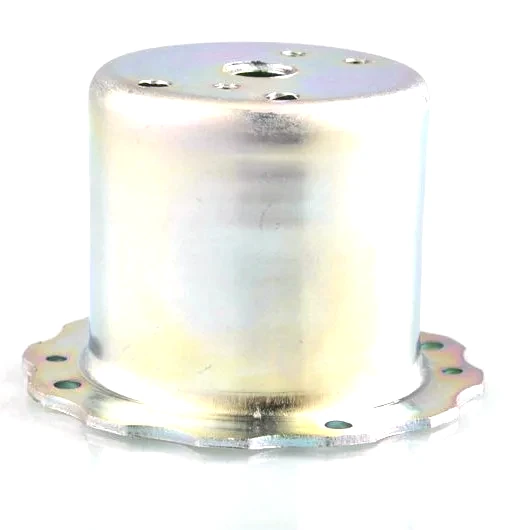
A starter motor can is the biggest drawn part on most starter programmes, and it is where the physics of drawing stops being simple. Where a window motor can draws at 30 to 45 mm, a starter can runs 60 to 90 mm across with walls of 1.5 to 2.5 mm, and it has to carry field poles handling cranking current in the hundreds of amperes. The process difficulty is not the diameter alone – it is thick sheet at that diameter.
You will find starter cans in conventional wound-field starters and in the permanent-magnet designs that have largely replaced them, where the can becomes a structural housing for bonded magnets and has to hold a bond line as carefully as a bolted pole shoe. They also appear wherever a heavy-duty engine starts – commercial vehicles, construction equipment, agricultural machinery – where the can’s duty cycle is longer and the coating spec is tougher than a passenger car’s.
What we need to quote it
Send the can diameter, the wall, and the depth, and tell us the material grade and thickness you are drawing from. The stroke count is the number that decides tooling – we will say whether one stroke or two is realistic rather than assume one. If the can carries pole shoes or bonded magnets, tell us how they attach, because the interior surface condition and the coating specification both follow from that. Add the coating requirement and the environmental duty.
Specifications
| Item | Auto starter motor can |
|---|---|
| Brand | AUNOV |
| Designing | Send drawings, or send a sample to be measured – a manufacturability review comes back with the quotation; the same drawing is used for every repeat order. |
| Tooling | Dies, fixtures and gauges are made in our own toolroom, so a die can be re-cut against the approved drawing, and first-article timing is measured from the tooling start date. |
| Samples | Prototype and pre-production samples are provided against the drawing, so the approved first article becomes the gauge reference, and mass production is gated on that approval. |
| Materials | Carbon steel (SPCC / DC01), 304 / 316 stainless steel, aluminium, brass and copper – the grade is matched to the duty of this can. |
| Surface finish | Phosphating for coating adhesion, then powder coating, e-coating or zinc plating; chrome and nickel for visible faces. |
| Processing | Deep drawing runs from coil or blank; in-process annealing keeps wall thinning even, and trim, pierce, form and finish follow. |
| Equipment | 5-250 T mechanical and 250-500 T hydraulic presses, annealing ovens, and CNC turning and machining centres for secondary work. |
| Tolerance | +/-0.15 mm typical on formed parts, +/-0.3 mm on large covers; the die decides the achievable band. |
| Delivery terms | FOB Ningbo or Shanghai, payment by T/T, L/C at sight or D/P; repeat orders reuse the approved first article. |
Related Products
Request a Quote for This Part
Send a drawing or sketch — get material advice, tooling cost and a per-piece price within 24 hours (working days).