
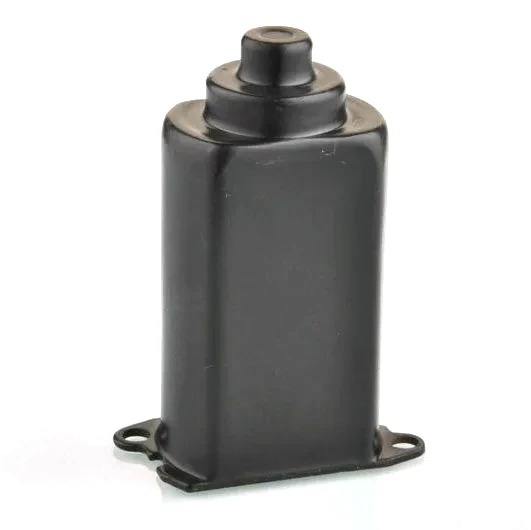
The window motor housing: small part, hard duty cycle
A wiper motor sweeps for minutes; a power window motor works in bursts of two seconds, dozens of times a day, and once a season it reverses hard against a finger or an ice-sealed glass. That duty cycle shapes every requirement on a power window regulator motor housing – high torque in a tiny package, load reversal the design must survive, and a lifetime measured in tens of thousands of short, punchy cycles. The housing carries all of it in a part that fits inside a door cavity.
Packaging: the door cavity dictates
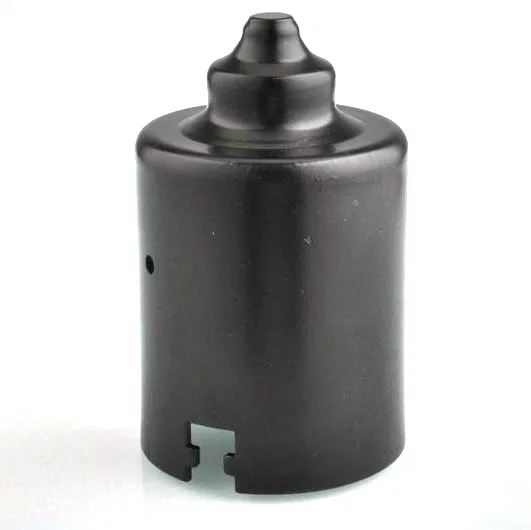
Everything about this housing begins with the space it must vanish into. Door modules allocate the motor a cylindrical volume, typically 30-45 mm across and barely wider than the gear train it drives, sharing the cavity with the speaker, the wiring harness and the crash structure. The drawn housing answers with high aspect ratio – a shell whose depth runs one and a half to two diameters – and features formed tight to its wall: flange ears that stack the bolt pattern into the regulator’s footprint, a cable-exit oriented by the harness routing, and a spigot that receives the regulator’s gear housing with zero wasted envelope. Designers new to the part often bring drawings with generous corner radii; the door cavity teaches them the honest minimums, and our simulation confirms which radii can shrink before the draw window suffers.
Load reversal: the anti-pinch legacy
Modern window systems reverse the motor when they detect a pinch, and every reversal hammers the drivetrain backwards through the housing. Mechanically that means the bearing seats and gear housing spigot must locate the armature and gear train accurately in both directions of torque – a requirement that sounds trivial until a housing’s preload strategy is built only for forward drive. Our housing designs manage it with symmetric bearing preloads, staked or clipped bushings that cannot walk under reverse load, and gear housing joints whose bolt pattern is sized for the reversal moment, not just the running torque. The failure mode this prevents is silent: a bushing that migrates a fraction of a millimetre per thousand reversals shows up a warranty-cycle later as gear noise, and by then it is a population problem, not a part problem.
Torque density: more torque per cubic centimetre
Window motors run hot magnetically – high torque from a small armature pushes flux densities toward the yoke’s saturation ceiling, as covered on our yoke page. The housing’s contribution is dimensional discipline: wall thickness uniformity where the magnets ride, roundness at the magnet land, and a bore position that keeps the armature’s air gap symmetric. Tolerances that a washing-machine motor would shrug off show up as torque spread on a window motor, and torque spread is what vehicle acousticians hear as unit-to-unit variation in window speed. Our SPC runs on exactly the features that feed the air gap, for exactly this reason.
Endurance testing that mimics the door
Window motor endurance is burst cycling – two-second runs with dwell, plus periodic stall reversals, at door-cavity temperatures that swing daily. The housing’s role in passing it: bearing seat stability across the thermal range (the press-fit band must survive -40 to +85°C without loosening or over-tightening), flange joint integrity under the vibration of a regulator cam-driven by a glass seal, and corrosion defence appropriate to a cavity that stays dry but condenses. We cycle-test housings as mounted assemblies on customer rigs and validate the press-fit band across the full temperature spread before PPAP – the test that separates housings that survive door life from housings that survive bench life.
Air gap, not the magnet, is the usual culprit
The housing drawing with the regulator interfaces identified (gear housing spigot, bearing seat, cable exit, mounting pattern), the motor’s stall torque and reversal strategy, door-cavity envelope constraints, and volume. First articles in three to four weeks after die approval, with the thermal press-fit validation included for programmes that specify it.
Window motors slow down over life – housing or magnets?
Our window motors slow down over life – housing or magnets?
Often the air gap: a housing bore that relaxes or a bushing that migrates opens the gap asymmetrically. Send us end-of-life returns; the wall-thickness and bore-position maps usually identify the mechanism within a week.
Can you form the regulator mounting ears integrally?
Yes, within the door cavity’s envelope – integral ears avoid weld distortion in a space where every tenth-millimetre of stack-up matters.
Do you support high-volume window programmes?
This family runs in the millions a year on progressive tooling; the quote will show the press class and stroke rate honestly because the piece price depends on it.
This part belongs to our Automotive Motor Components range. The automotive motor components pages collect the process notes, common materials and inspection points behind every product in the family.
Specifications
| Item | Power window regulator motor housing |
|---|---|
| Brand | AUNOV |
| Designing | Quotation follows the print, not a catalogue – DFM notes are returned before any tooling is cut; the agreed version governs every later batch. |
| Tooling | Die design and toolmaking stay in house, so tooling lead time stays under our control, and maintenance is tracked against the part number. |
| Samples | Prototype and pre-production samples are provided against the drawing, so any deviation is corrected at sample stage, and mass production is gated on that approval. |
| Materials | Carbon steel (SPCC / DC01), 304 / 316 stainless steel, aluminium, brass and copper – the grade is matched to the duty of this housing. |
| Surface finish | Zinc / nickel / chrome plating or e-coat, chosen for the environment this housing sees; salt-spray tested to drawing. |
| Processing | Coil blanking, progressive drawing through 3-5 stages with anneals between, trim and pierce, then deburr and finish. |
| Equipment | 5-250 T mechanical presses and 250-500 T hydraulic presses, in-line annealing furnace, CNC turning for secondary work. |
| Tolerance | +/-0.01 mm on turned, milled or ground features; +/-0.03 mm on formed features; critical dimensions 100% gauged. |
| Delivery terms | FOB, with DDP offered for EU and US addresses, T/T with deposit and L/C for larger runs; sea or air freight is quoted to your door. |
Related Products
Request a Quote for This Part
Send a drawing or sketch — get material advice, tooling cost and a per-piece price within 24 hours (working days).