
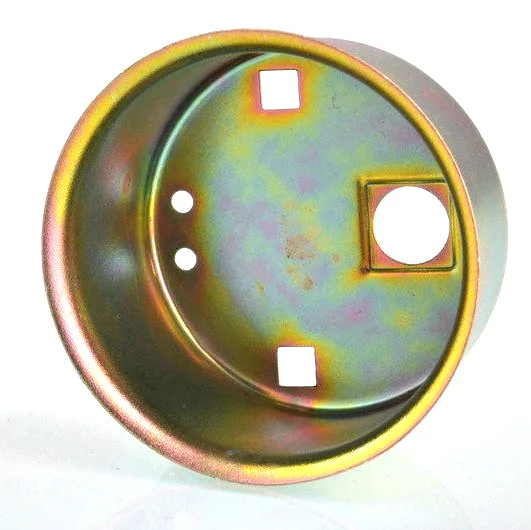
More than a box: the wiper motor enclosure as a system component
Where a case or housing protects a single motor, a wiper motor enclosure usually has to do more: carry the electronics or relay board, route the harness, mount to the vehicle through defined points, manage heat from the windings, and present a clean exterior to the cowl area. That makes it the most systems-aware part in the wiper family – and the one where a stamping supplier’s input at design stage pays back most visibly.
Integration decisions made in the die
A drawn enclosure can absorb functions that would otherwise be separate purchased parts. Mounting features – brackets, clips, slides for assembly into a plastic carrier – form from the flange material in the same stroke sequence. Cable routing features: strain-relief hooks, grommet seats with compression-sized holes, even a formed channel that keeps the harness away from the linkage’s sweep envelope. Earth terminals: a pierced tab with a stamped thread or a weld nut stake, positioned where the harness needs it rather than where a retrofit bracket would put it. Each absorbed function deletes a part number from the customer’s BOM, and unlike a plastic enclosure, the steel version carries these metal functions without inserts or ultrasonic bosses.
Heat: the enclosure as a heatsink
Wiper motors run hot at stall – a frozen blade can hold the motor at locked rotor for seconds, and the windings dump that energy as heat. A steel enclosure moves that heat better than plastic by an order of magnitude in conductivity, and its outer wall area is free radiating surface. The design levers we control: wall thickness (thicker walls spread heat to the mounting flange, which conducts it into the vehicle), flange width (a wider bolted flange is a better thermal bridge), and surface treatment (a dark powder coat radiates measurably better than bright zinc in the cowl’s radiative environment). For a customer chasing a thermal derating spec, the enclosure is often the cheapest square centimetres they can add.
Assembly sequence: designing for the motor plant’s line
Enclosures get assembled into, not just onto. The motor drops in, the end structure bolts up, the harness gets dressed, the board snaps or screws in. Every one of those operations touches the enclosure, so we review the customer’s assembly sequence at RFQ: which face sits in the fixture, where the robot gripper lands, whether the harness needs a lip to hook over or a hole to pass through. The changes that come out of that review are almost always cheap – a formed lead-in chamfer, a locaing dimple, an orientation witness mark stamped in the flange – and they save seconds per unit at line rates where seconds are budgets.
Corrosion strategy at the system level
An enclosure that bolts to painted brackets and clamps to rubber-mounted structures forms galvanic couples with its neighbours. The coating choice follows the assembly, not just the part: zinc-nickel on the enclosure when it mates with aluminium brackets, standard trivalent zinc when the neighbours are steel, and a paint system where the spec demands colour matching to the wiper linkage. We also watch the drain story at system level – an enclosure sitting in a linkage pocket needs its lowest point to either drain or seal, and the choice belongs on the drawing before tooling, not in a field fix after the first wet-climate winter.
Yes, up to a limit set by the press
The enclosure drawing plus the assembly context: what bolts to it, what drops into it, what routes through it. Add the thermal and corrosion specs if they exist, and the annual volume. We return a BOM-consolidation review – listing which separate parts the drawn enclosure could absorb – alongside the standard tooling and piece-price quote. First articles follow die approval in three to four weeks.
A note on EMC and grounding paths
Enclosures that carry relay boards or motor-control electronics inherit an EMC role. Steel is the natural choice: the enclosure becomes the shield, and its bond points to vehicle earth are what make the shield real. We form dedicated grounding tabs with bare-metal lands (masking at plating keeps them conductive), size fastener lands for the customer’s star-washer scheme, and keep the cable-exit holes sized so the harness shield can terminate 360 degrees where the spec demands it. Electronics teams usually arrive with these requirements after a lab failure; bringing them to the enclosure RFQ costs nothing and pre-empts the test-house retry.
Can you form the mounting brackets as part of the enclosure?
Can you form the mounting brackets as part of the enclosure?
Usually yes, up to brackets that carry the motor’s full reaction load – formed from the flange with embossed stiffening. Extreme bracket geometries (long cantilevers, complex 3D bends) still suit welded-on brackets better, and we will say so rather than force the process.
Our plastic enclosure warps near the motor – would steel fix it?
Almost certainly, and the steel version also buys the thermal conductivity argument above. The usual trade is fastener style and weight; the usual surprise is that the steel part costs less than expected at volume because it consolidates the metal inserts the plastic version needed.
Do you do the powder coating in-house?
We run liquid and powder through partner coaters under our quality plan – thickness, adhesion and colour verified per lot with certificates travelling with the shipment.
This part belongs to our Automotive Motor Components range. The automotive motor components pages collect the process notes, common materials and inspection points behind every product in the family.
Specifications
| Item | Wiper motor enclosure |
|---|---|
| Brand | AUNOV |
| Designing | Send drawings, or send a sample to be measured – unusual walls, threads or tolerances are feasibility-checked first; revisions are re-quoted once rather than silently absorbed. |
| Tooling | Progressive and drawing dies are designed and built in house, so tooling lead time stays under our control, and maintenance is tracked against the part number. |
| Samples | Pre-production samples come with a full inspection report, so any deviation is corrected at sample stage, and mass production is gated on that approval. |
| Materials | Carbon steel (SPCC / DC01), 304 / 316 stainless steel, aluminium, brass and copper – the grade is matched to the duty of this enclosure. |
| Surface finish | Phosphating gives coating adhesion; powder coating, e-coating or zinc plating follow, with chrome and nickel on visible faces. |
| Processing | Coil blanking, progressive drawing through 3-5 stages with anneals between, trim and pierce, then deburr and finish. |
| Equipment | Mechanical capacity 5-250 T and hydraulic 250-500 T, with annealing ovens and CNC turning and machining centres alongside. |
| Tolerance | +/-0.1 mm on formed features and +/-0.2 mm on overall lengths; tighter bands confirmed against the die before quoting. |
| Delivery terms | FOB Ningbo or Shanghai, payment by T/T or L/C, quoted in USD or EUR; sea or air freight is quoted to your door. |
Related Products


Request a Quote for This Part
Send a drawing or sketch — get material advice, tooling cost and a per-piece price within 24 hours (working days).