
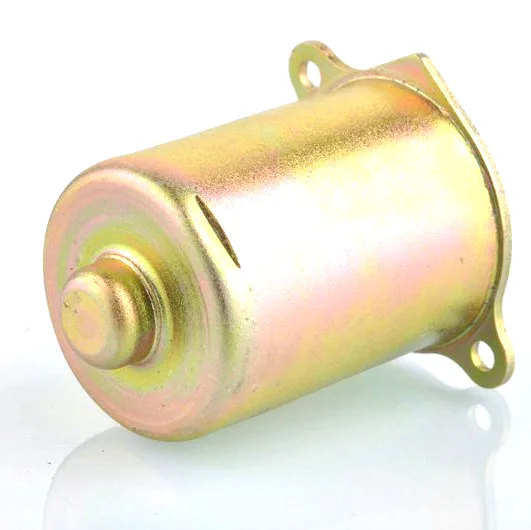
The quiet part: acoustics of a wiper motor casing
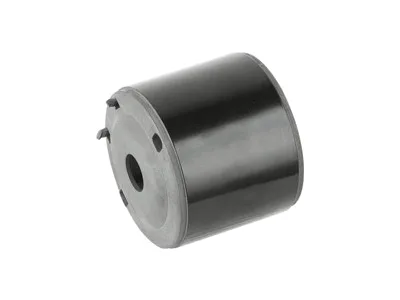
Ask a vehicle NVH engineer what they hear from a wiper system and the answer is rarely “the motor is loud” – it is “the motor buzzes at park” or “there is a whine at high sweep”. Both complaints travel through the wiper motor casing: the casing is the motor’s only radiating surface, its resonance set is the motor’s audible fingerprint, and its joint stiffness to the vehicle determines how much of that sound escapes into the cabin. Casing design is therefore acoustic design, whether or not the drawing says so.
Where the sound comes from
Three sources dominate. Electromagnetic torque ripple at slot-passing frequency puts a tonal whine into the armature, through the bearings, into the casing wall – a thin drawn cylinder radiates that efficiently at its circumferential modes. Brush-commutator friction adds broadband noise, worst at park where the brushes sit on the commutator’s wear step. And gear mesh injects impulses through the output shaft into whatever the casing bolts to. None of these can be eliminated at the casing, but all three are shaped by it: wall thickness sets the modal frequencies, joint design sets the transmission path, and damping decides how long each impulse rings.
Wall thickness as an acoustic choice
Doubling wall thickness does not halve radiation – it moves the casing’s first circumferential mode upward, typically from the 1.2 kHz region at 0.8 mm toward 2 kHz at 1.4 mm, where human hearing is less sensitive and where the torque-ripple harmonics are weaker. The catch is weight and draw depth: thicker walls draw harder and cost more material. Our usual engineering position is that the casing should be sized structurally, then acoustics managed with targeted changes – a thicker land section only where the bearings mount, damping compound where modes actually radiate, and rib-free walls (ribs on a casing raise modes into audible tonality rather than spreading them). Measured on a shaker table, a distributed damping patch of 0.5 mm bitumen can drop radiated park noise by 3-5 dB for a fraction of a gram per part – far better value than a blanket thickness increase.
The joint to the vehicle: where noise escapes
A casing that radiates into a stiff bolted flange broadcasts; the same casing on a damped rubber mount whispers. The mounting interface is shared between motor maker and vehicle maker, but the casing draws it: ear stiffness matters, because ears too compliant let the motor rock at park (a classic thump source), while ears too stiff transmit everything. The practical target is ears stiff enough to hold alignment (0.5 mm max deflection under rated torque reaction) with a defined decoupling layer – grommet or bushing – handled at assembly. We dimension ear faces and their fastener pattern to keep the motor maker’s isolation strategy honest; a casing that silently outstiffens the specified grommet is a defect the vehicle only discovers as cabin noise.
What we measure, and how findings translate to tooling
For programmes with a noise spec we run a modal tap test on first articles: tap the casing with an instrumented hammer, record the response, and compare the mode set against the target spectrum the motor maker derived from their noise budget. Modes landing inside 20% of a torque-ripple harmonic get addressed before the die is finalized – usually by shifting wall thickness locally (achievable in a drawn part through blank thickness zones, not by machining) or by adding the damping patch feature to the drawing. The test costs an afternoon and prevents the expensive version of this conversation, which happens after motors are assembled and vehicles are scheduled.
Identical outside, different inside – and that is the point
The casing drawing, the motor’s noise spec (or at least its slot-passing frequency and park strategy), the mounting interface definition, and volume. If acoustics matter, tell us at RFQ – it is cheap to design quiet and expensive to retrofit, and the drawing changes that make a casing quieter are nearly always cheaper than the ones that make it structurally identical.
Can you match our casing acoustically after switching material?
Can you make the casing identical to our current one acoustically after switching suppliers?
Yes, provided we copy geometry and thickness – steel grade shifts modes slightly, which is why we ask for your current casing as a reference and run the tap test comparison before releasing tooling.
Is aluminium quieter than steel for casings?
Its lower mass radiates more per unit force but its internal damping differs; in practice steel with a damping patch outperforms bare aluminium at equal weight, and steel keeps the flux-path benefit.
Our complaint is a park thump, not a whine – casing or motor?
Usually the brush-commutator step plus ear compliance. Send the returned motors; we measure ear deflection on our fixtures and can tell you within a week whether the casing is the transmitter or just the messenger.
Automotive Motor Components is the parent range for parts like this one; the overview page gathers the tooling logic, finishing options and tolerance notes that apply across the family.
Where this part is used
A wiper motor casing is the motor’s only radiating surface, and the complaints that reach the vehicle manufacturer are acoustic rather than mechanical: a whine at high sweep, a buzz at park. Those sounds travel through the casing wall, and the casing’s wall thickness, its joint stiffness to the vehicle and its modal behaviour decide how much of the noise gets in. In other words, the casing is an acoustic component whether or not the drawing acknowledges it.
You will find these casings on passenger-car wiper systems, on the larger systems fitted to commercial vehicles and buses, and on the heavy-duty and off-highway machines where the motor works harder for longer. The commercial and off-highway duty is where the acoustic treatment matters most, because the motor runs more hours and the cabin is quieter to begin with, so the same noise is more noticeable.
What we need to quote it
Send the casing diameter, the wall, and the length, and tell us what the motor’s excitation is – its speed range and whether there is a gear reduction, because the casing’s modes have to be kept away from the excitation frequencies rather than merely made thicker. If the current part is noisy, describe the complaint: at park, at speed, or both, because those point at different sources. A sample of the current casing with a thickness measurement is often the most useful thing you can send us.
Specifications
| Item | Wiper motor casing |
|---|---|
| Brand | AUNOV |
| Designing | Quotation follows the print, not a catalogue – a manufacturability review comes back with the quotation; the agreed version governs every later batch. |
| Tooling | Tooling is built and held under your part number, so die cost stays transparent, and the charge is refundable against agreed volumes. |
| Samples | Samples are issued for approval before the run, so the sample is retained as the master, and mass production is gated on that approval. |
| Materials | Carbon steel, 304 / 316 stainless steel, aluminium and brass are held in stock; the drawing review fixes the final grade. |
| Surface finish | Zinc or nickel plating guards against corrosion; housings can take powder coating or electrophoresis, and laser etching is available on request. |
| Processing | Coil blanking, progressive drawing through 3-5 stages with anneals between, trim and pierce, then deburr and finish. |
| Equipment | 5-250 T mechanical and 250-500 T hydraulic presses, annealing ovens, and CNC turning and machining centres for secondary work. |
| Tolerance | +/-0.03 mm on machined features, +/-0.1 mm on formed ones, with first-article inspection report. |
| Delivery terms | FOB Ningbo or Shanghai, T/T with deposit and L/C for larger runs; repeat orders reuse the approved first article. |
Related Products
Request a Quote for This Part
Send a drawing or sketch — get material advice, tooling cost and a per-piece price within 24 hours (working days).