
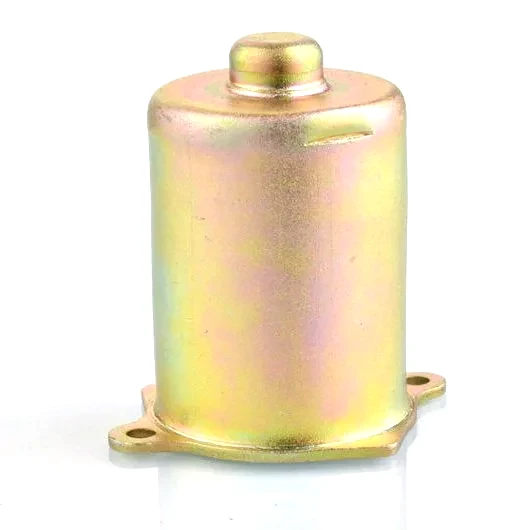
Keeping water where it belongs: sealing a wiper motor case
The wiper motor case has one job that outranks every other: keep water out. It lives directly in the spray path of its own wiper blades, cycles through car washes, freezes and thaws, and breathes – every temperature swing pulls humid air through any gap it can find. A case that seals on day one and leaks in month eighteen is a design failure, and most such failures trace to decisions made in the case’s geometry, not the gasket’s chemistry. This page covers the sealing strategy we build into drawn wiper motor cases.
Where water actually gets in
Field-teardown experience reads the same every time. Water rarely penetrates the gasket face itself – rubber against a flat flange seals well. It enters through four side doors: a flange that has bowed out of flat enough to open a capillary path; fastener bosses that distort under bolt torque and lift the gasket locally; cable grommets that were never compression-matched to their hole; and the drain path – or absence of one – that turns condensation inside the case into a standing puddle against the shaft seal. A well-designed case assumes water will eventually get everywhere outside the gasket line and gives it nowhere to sit.
Design features we build into the drawn case
- Gasket land, not gasket hope. The flange carries a raised land 3-4 mm wide, coined during restrike to within 0.1 mm flatness across its width. The rest of the flange can be whatever the drawing needs; only the land has to seal, and coining it separately is far more reliable than holding the whole flange to a sealing grade.
- Boss stiffening drawn, not welded. Fastener bosses formed from the flange material during drawing (a local stretch-and-restrike) distort far less under torque than bosses welded on afterward – a welded boss shrinks as it cools and pulls the gasket line with it.
- Grommet holes compression-sized. Every cable-exit hole is sized with the grommet supplier so the rubber sits at 20-30% compression in a defined band. undersized holes split grommets, oversized ones let them walk. The tolerance is on the pair, not the hole alone.
- Drain geometry. Where the design permits, the flange’s lowest point carries a relief notch so condensate exits rather than pools. It costs a trim-feature in the die and prevents an entire class of “mystery corrosion at the six o’clock position”.
IP ratings: what the numbers demand of the case
Wiper motor cases typically carry an IP54-to-IP67 target depending on mounting. The gap between those grades is almost entirely gasket engineering: IP54 (splash-protected) is achievable with a simple flat land; IP67 (immersion-proof) demands gasket compression control, fastener pattern spacing tight enough to keep the gasket pressure uniform, and flange stiffness high enough that bolt clamp-up does not redistribute load. Drawing the case deeper and doubling the return flange width is often what turns a marginal IP54 part into a genuine IP67 one – geometry buys sealing far cheaper than exotic gaskets do. We validate to IPX9K where specified with a test rig calibrated against the customer’s own fixture, because “tested to IP67” means nothing until both sides agree which nozzle, which pressure, and which duration.
Breathing: the paradox of a sealed case
A perfectly sealed case has a problem: it breathes anyway, thermally. Air inside expands and contracts, and if moisture is trapped it condenses on the coldest surface – usually the case wall above the windings. The fix is a breather membrane on the case where the design allows: PTFE vents that pass vapour and block liquid. We pierce and size the breather hole in the same die, and customers who add breathers report visibly drier internals at teardown. For designs without a breather, we recommend a desiccant strategy at the motor maker’s level and a drain notch at ours.
Trapped humidity, not a seal failure
Case drawing with the IP target, gasket section (or the gasket supplier’s contact), cable-exit schedule, and volume. If an IPX9K or immersion test is specified, name the standard revision – test fixtures differ. Quotes come back with the sealing features itemized separately from the shell, because when a programme changes IP grade mid-development, you want to know what that change actually costs.
Cases fog up inside – is that a sealing failure?
Our cases fog up inside – is that a sealing failure?
Usually no: it is trapped humid air condensing. Check for a breather; if there is none, the cheapest fix is a vent membrane, and we can pierce the hole on existing tooling.
Can you hold IP67 with a steel case and EPDM gasket?
Yes – that combination is industry-standard. The variables are gasket compression and flange stiffness, both geometry questions, and both answerable in the die.
Do you leak-test cases before shipping?
On programmes that specify it, yes – pressure-decay screening on the gasket land, sampling or 100% per the customer’s spec. The tester runs inline and adds seconds, not minutes.
This part belongs to our Automotive Motor Components range. The automotive motor components pages collect the process notes, common materials and inspection points behind every product in the family.
Specifications
| Item | Wiper motor case |
|---|---|
| Brand | AUNOV |
| Designing | Made to your 2D/3D drawings (PDF, DWG, STEP, IGS) – DFM notes are returned before any tooling is cut; changes are priced before they are made. |
| Tooling | Dies, fixtures and gauges are made in our own toolroom, so no tooling step is outsourced, and the charge is refundable against agreed volumes. |
| Samples | Sample parts are measured and reported before submission, so the part is proven before it is made in volume, and later batches are gauged back to the signed sample. |
| Materials | Carbon steel, 304 / 316 stainless steel, aluminium and brass are held in stock; the drawing review fixes the final grade. |
| Surface finish | Zinc / nickel / chrome plating or e-coat, chosen for the environment this housing sees; salt-spray tested to drawing. |
| Processing | From coil or blank, deep drawing with in-process annealing thins walls evenly; the sequence then runs trim, pierce, form and finish. |
| Equipment | The press floor pairs 5-250 T mechanical with 250-500 T hydraulic presses; an in-line annealing furnace sits on line and CNC turning covers secondary work. |
| Tolerance | +/-0.05 mm on controlled dimensions and +/-0.1 mm on general features; capability studies supplied on request. |
| Delivery terms | FOB Ningbo or Shanghai, T/T or L/C, with D/P accepted on repeat business; call-off schedules are supported. |
Related Products


Request a Quote for This Part
Send a drawing or sketch — get material advice, tooling cost and a per-piece price within 24 hours (working days).