
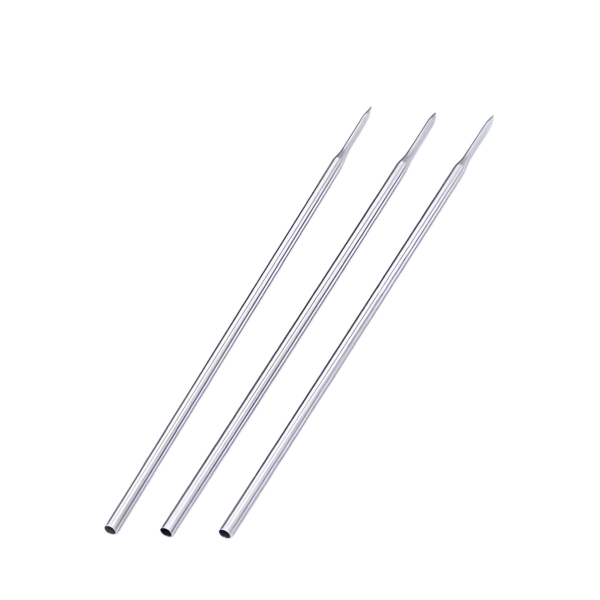
A meat thermometer needle lives a harder life than its specifications suggest. It is pushed into cold product, then into hot product, then washed down, then dropped, several hundred times a week, and the readings it gives are used to sign off batches. This page is about the working conditions rather than the dimensions.
The needle goes into cold product and into cooked product
The same probe is used to check that incoming product is cold and that cooked product reached temperature, which means it works across most of the range a food thermometer sees. It also means it is being pushed into material that varies from firm and frozen to soft and hot, and the tip has to enter both without either requiring enough force to tear the product or bending once it is inside. Insertion force is the specification that captures this, and it is the one we hold.
A thin section reads fast, and that is the whole point
In a production check, time is the constraint: the operator needs a stable reading in seconds because the product is moving. The response comes from a thin wall and a small thermal mass at the tip, so the needle is made slender by design and the tip is kept close to the sensor. The cost of that is fragility, which is handled by the material and the tip form rather than by thickening the section back up.
Washdown is a design condition, not an afterthought
Between uses the probe is washed, often with hot water and detergent and sometimes with a caustic, and then it goes back into product. That puts three requirements on the construction: it must be sealed so nothing enters the body, it must have no crevice where product can survive a wash, and its materials must tolerate the cleaning chemicals. A seamless body with a smooth finish and a sealed entry meets all three; a body with a joint or a step at the tip does not.
A bent needle reads wrong before it reads nothing
The way these fail in practice is gradual. A needle that has taken a knock is slightly bent, and a bent needle spends more of its length in the product, so the reading is taken from a different depth than the operator thinks – it still gives a number, and the number is wrong. Straightness along the stem is therefore measured on first articles and is worth checking in service, because the instrument gives no error message for it.
How the probe is checked before it ships
The tip, the stem straightness and the wall at the tip are verified on first articles, and the body is checked for the sealing that the washdown depends on.
First articles and retention samples are kept for the programme, so a reorder is made to the same tip, the same wall and the same sealing. On a probe whose readings are used to release product, that is what keeps the second batch reading like the first.
Our Sensor Housings range is where this part sits. The sensor housings pages carry the process notes, common materials and inspection points behind every product in the family.
Where this part is used
Needle probe sensors are the business end of instant-read meat and food thermometers, and they are also used in oven probe kits, catering instruments and food-safety testers. The needle has to enter the product cleanly, respond fast enough to be useful, and come out to be washed — which makes wall thickness the single most consequential dimension on the part.
Stainless steel is the default for food contact and for corrosion through repeated washing. The interesting engineering is that response time and strength pull in opposite directions, and the wall thickness is where that trade-off is settled.
What we need to quote it
Send the needle diameter and length, the handle interface, and the response-time target — that target sets the wall, and we will tell you what wall it implies. Add the food-contact certification you need, and whether the needle is a single tube or an assembly with a handle fitted.
Specifications
| Item | Stainless Steel Needle Probe Sensors for Meat Thermometers |
|---|---|
| Brand | AUNOV |
| Designing | A drawing file or a physical sample starts the review, you get a DFM review together with the quotation. |
| Tooling | Dies designed and built in our own toolroom, stored under your part number. |
| Samples | Approval samples ship with dimensional data plus material certs. |
| Materials | 304 / 316 stainless steel leads the stock list for this part, alongside carbon steel (SPCC / DC01), aluminium, brass and copper, per the drawing. |
| Surface finish | Plating, e-coat, powder coating, anodising or passivation, as called out on your print. |
| Processing | Staged deep drawing, with in-line annealing where the draw ratio requires, then pierced and machined in house. |
| Equipment | Our press floor runs 5-250 T mechanical and 250-500 T hydraulic presses, CNC turning centres, climate-controlled CMM room. |
| Tolerance | As-drawn tolerance +/-0.1 mm, +/-0.03 mm after machining. |
| Delivery terms | FOB is standard; DDP offered for EU and US, T/T or L/C, with D/P for repeat business, call-off schedules supported. |
Frequently Asked Questions
Why is a food needle probe harder than its datasheet suggests?
The cycle is what wears it out. It goes into cold product, then into hot product, then through a washdown, then occasionally onto the floor, several hundred times per shift. Individually none of those is severe, and together they ask more of the construction than the environment any one of them describes.
Why is the thin section the whole point of the part?
Speed. A thin section puts little thermal mass between the product and the sensing element, so the reading arrives while the reading is still useful to whoever is holding it. That is the feature being bought, which is why simply making the needle stouter solves one problem by creating a worse one.
Why does washdown have to be treated as a design condition?
It is the most punishing step in the cycle and it happens every day. High-temperature water and cleaning agents find their way into joints, crevices and terminations, and hygiene rules leave nowhere to hide contamination. Treating resistance to it as a finishing detail reliably produces probes that fail at their entry rather than their tip.
Why is a bent needle more worrying than one that has failed outright?
Because it still reads. A bent section can hold the sensing element away from the product it is meant to be in contact with, or change where it sits relative to the tip, so the number displayed is plausible and wrong. A probe that stops working is obvious; one that quietly misreads is the risk.
Related Products


Request a Quote for This Part
Send a drawing or sketch — get material advice, tooling cost and a per-piece price within 24 hours (working days).