
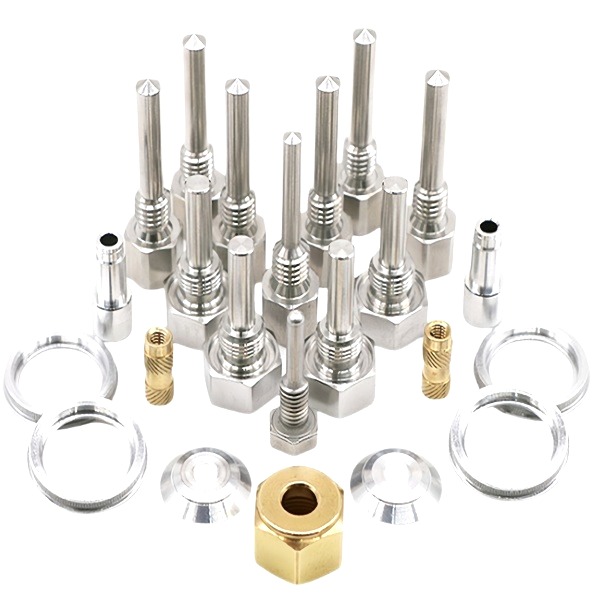
The NTC Thermistor Probe Housings with Hex Compression Fittings are housings built specifically around an NTC thermistor – a temperature-sensing resistor whose whole accuracy depends on being in intimate thermal contact with the thing it is measuring. The housing has to seat the thermistor so heat reaches it fast and without offset, protect it from the process, and let it be replaced through the hex compression fitting at the top. That makes this part different from a general thermowell: the functional requirement is not just pressure and corrosion, it is thermal contact and response, because an NTC that is seated with an air gap or a poor contact reads low and slow even though the housing is mechanically perfect. This page covers the thermistor seating, the compression fitting and the response that ties them together.
An NTC reads through thermal contact, so seating is the specification
Unlike a sensor that generates its own signal, an NTC thermistor is a resistor whose value changes with its own temperature, which means it has to actually reach the temperature of the thing being measured. That happens only if it is in good thermal contact with the housing wall, which is in contact with the process. Any air gap, any poor contact, any offset between the thermistor and the metal adds a thermal error and a response lag. The seating of the thermistor is therefore the primary functional feature of this housing, ahead of almost anything else.
- The thermistor seat is designed for contact – a snug fit, a thermally conductive fill or a pressed interface – not just a cavity the part drops into.
- Seating depth is held so the thermistor sits at the point the housing conducts heat best, which is against the thin wall at the sensing end.
- Response is verified, not just dimensions, because a housing that measures correct but responds slowly fails the NTC’s purpose.
Thermally conductive fill: the contact that a mechanical fit cannot make
Even a snug mechanical fit leaves microscopic gaps, and those gaps are thermal resistance. On an NTC housing the standard answer is a thermally conductive fill – a compound or epoxy that is poured or injected around the thermistor to eliminate the air gap and lock the part in place both thermally and mechanically. The fill is a functional material, not a potting afterthought: it sets both the thermal contact and the vibration resistance of the sensor.
- Fill material is chosen for thermal conductivity and for the temperature range, because a fill that degrades or cracks loses the contact.
- Fill volume and placement are controlled so the thermistor is fully surrounded, with no void at the critical contact face.
- Where the assembly sees vibration, the fill also has to hold the thermistor against fatigue, so its mechanical stability matters as much as its conductivity.
The hex compression fitting makes the thermistor replaceable
The compression fitting at the top is what lets the thermistor be removed and replaced without scrapping the housing, and it has to seal the housing while releasing the sensor on demand. That means the ferrule and the cone have to make a reliable seal under process conditions and still break free when the sensor is swapped. The hex is what the installer turns to set that seal, and it has to transmit a controlled torque without distorting the housing the thermistor is seated in.
- The compression cone and ferrule are held so the seal is reliable at the specified torque and still releases cleanly for service.
- Hex across-flats and depth are sized for the assembly torque, and the hex is checked to tighten square to the housing axis.
- Torque is specified as a window, because over-tightening distorts the housing and can disturb the thermistor seating the fill created.
Response time is the acceptance test that matters most
Because the whole point of an NTC housing is a fast, accurate temperature reading, the acceptance test that matters most is not a dimension – it is response. We verify that a thermistor seated in the housing reaches the process temperature quickly and without offset, because that is what the customer’s measurement depends on. A housing that passes every dimensional check and responds slowly is a failed part for this application, and only a thermal test catches it.
- Response is verified on the first article by stepping the housing between two temperatures and timing how fast the thermistor follows.
- Offset is checked against a reference, because a seating error shows up as a consistent temperature error, not as a dimensional one.
- Where the customer has a response spec, we verify against it directly, rather than assuming a good mechanical fit gives a good thermal one.
How we verify an NTC thermistor probe housing
Verification on this part puts the thermal checks ahead of the dimensional ones, because the thermistor’s reading is the function.
- Thermistor seating: seat geometry and depth verified, and the fill confirmed to surround the thermistor with no void at the contact face.
- Response and offset: the assembled housing stepped between temperatures, with response time and offset measured against the customer’s spec.
- Compression fitting: cone angle and thread verified, with the hex checked for across-flats, depth and squareness to the axis.
- Seal and service check: the fitting torqued to the specified window and leak-tested, then loosened and re-tightened to prove the thermistor is replaceable.
- Material and fill records per lot, with the fill material and the housing grade traceable to the release.
- Fit check: the production thermistor inserted, filled and seated, proving the whole assembly reads correctly before the run.
First articles and retention samples are kept for the programme, and the verified response baseline travels with them, so a repeat housing seats and responds the same way. On a part whose entire value is an NTC reaching process temperature quickly and without offset, holding the seating and the fill to that thermal baseline is what keeps a second batch reading as accurately as the first.
Sensor Housings is the range this part sits under; the overview page pulls together the tooling logic, finishing options and tolerance notes that apply across the family.
Specifications
| Item | NTC Thermistor Probe Housings with Hex Compression Fittings |
|---|---|
| Brand | AUNOV |
| Designing | Share your print, or send a part to be measured, you get a DFM review together with the quotation. |
| Tooling | Our own toolroom designs and builds every die, held and maintained under your part number. |
| Samples | First articles go out with a full dimensional report and material certification. |
| Materials | Held stock: carbon steel (SPCC / DC01), 304 / 316 stainless steel, aluminium, brass and copper, per the drawing. |
| Surface finish | Zinc, nickel or chrome plating, e-coat, powder coat, anodising or passivation, per the drawing. |
| Processing | Staged deep drawing with in-line annealing where needed, then pierced and CNC-machined in house. |
| Equipment | Our press floor runs 5-250 T mechanical and 250-500 T hydraulic presses, CNC turning centres and a climate-controlled CMM room. |
| Tolerance | As-drawn tolerance +/-0.1 mm, +/-0.03 mm after machining. |
| Delivery terms | FOB as standard, DDP available for EU and US destinations, payment T/T or L/C, D/P for repeat accounts, call-off schedules and blanket orders supported. |
Frequently Asked Questions
Why does seating decide the reading rather than just accuracy?
Because a thermistor measures its own temperature. Whatever separates it from the process – a gap, a surface that is not really touching, a position slightly off – becomes part of what it reads. Two installations of the same part can differ noticeably for that reason alone, which is why seating is a specification rather than an assembly detail.
Why can a close mechanical fit not do this on its own?
Contact is worse than it looks. However well two surfaces fit, the real contact area is a small fraction of the apparent one, and the rest is gas – which is among the worst conductors available. A thermally conductive compound fills those voids and does work that tightening alone cannot, however carefully it is done.
What does the hex compression fitting actually buy?
Replaceability. It lets the sensing element be withdrawn and refitted without disturbing the housing or the process connection, so a failed thermistor costs a consumable rather than an installation visit. Over a working life that is usually worth considerably more than the fitting costs.
Why is response time the acceptance worth writing down?
It is the only single number that reflects everything the assembly has to get right. Fit, compound, wall and seating quality all influence how quickly the reading follows the process, so a response criterion captures deficiencies that individual dimensions cannot separate. It is also the acceptance that corresponds to what the user actually wanted.
Related Products


Request a Quote for This Part
Send a drawing or sketch — get material advice, tooling cost and a per-piece price within 24 hours (working days).