
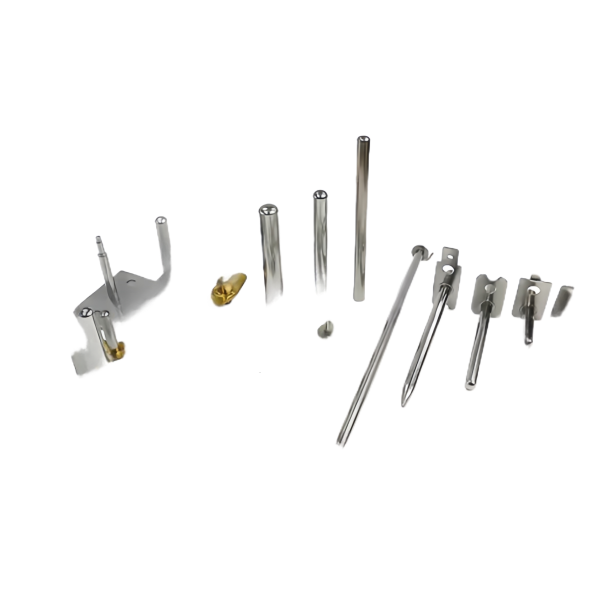
The Assorted Temperature Sensor Probe Parts and Fittings family gathers the mixed components that make up temperature-sensing probes – wells, fittings, ferrules, end pieces and sleeves – supplied together as one release. An assorted sensing release is a different engineering problem from a single part, because the parts are related but not identical: they share material, process and often a function, but each has its own drawing and its own acceptance criteria. The risk in a mixed release is not that any one part is hard to make, but that the parts blur together – a part number gets substituted, a feature that should differ between two similar parts ends up the same, or a problem on one component is not isolated from the rest. This page is about running a mixed sensing release as a controlled family rather than as a bag of similar parts.
An assortment is a family with a shared spec and per-part exceptions
The efficiency of an assorted release comes from doing once what all the parts share – one material lot, one plating batch, one inspection routine – while keeping the control points that are genuinely part-specific. The discipline is knowing which is which. The thread class, the material and the finish are usually shared; the sizes, the seat depths and the seal geometry are usually not. Collapsing the whole assortment into one generic spec is how a part that needs a tighter seat or a different thread slips through, and splitting everything into per-part specials throws away the efficiency the assortment was ordered for.
- Material, finish and passivation are managed as one lot or one verified process across the family, saving cost without blurring per-part checks.
- Size, seat and seal features keep per-part control points, because these are the features that differ and that the assembly depends on.
- The control plan names which checks are shared and which are per-part, so the shop does not have to guess at a mixed release.
Similar parts are the trap: what looks the same often is not
In a sensing assortment the most dangerous parts are the ones that look almost identical but serve different functions – two fittings the same size but with different threads, two wells the same length but with different tip geometry, two ferrules that differ only in bore. These near-identical parts are where a wrong-part error happens, both on the shop floor and at final pack-out, and a wrong-part error in a sensing assembly is a functional failure even though every dimension is in tolerance. We make the differences visible and verify them explicitly.
- Near-identical parts are segregated in the process flow, so a similar part is not sitting next to the one it could be confused with.
- The distinguishing feature between look-alike parts is called out and checked specifically, rather than assumed from the part number.
- Pack-out is verified per part number, because a mixed kit with two look-alike parts swapped is a failed delivery.
Traceability has to survive the mixing
In a single-part release, traceability is straightforward: one lot, one certificate, one release. In an assorted release the parts may come from different lots, different operations and different times, and the traceability has to keep them straight. A problem found on one component has to be traceable to that component’s lot without quarantining components that are fine. If the traceability collapses at the mixing point, a single bad lot contaminates the whole release or, worse, goes uncaught.
- Each part number keeps its own lot traceability, so a problem on one component is isolated to that component.
- Material and process records are filed per part number, not per release, so the mixed kit can be reconstructed if needed.
- Retention samples are drawn per part number, so a field issue on one component can be investigated against a known-good sample.
The seal and seat features carry the function, and they vary most
Across a sensing assortment the features that vary the most are exactly the ones that carry the function: the sealing land, the sensor seat depth and the thread that has to hold pressure. These are the features that differ between two similar-looking parts because they are matched to different sensors or different ports. They are also the features that are hardest to inspect on small parts and easiest to get wrong when a family spec is applied too loosely. We verify the functional features per part, every time.
- Sealing lands and sensor seats are verified per part number against that part’s sensor and port, not against a family average.
- Threads are gauged per part, because two parts in the same assortment can legitimately have different thread requirements.
- Where a functional feature cannot be gauged in production, it is sectioned on the first article so the dimension is proven even if it is not checked every time.
How we verify an assorted sensing parts and fittings release
Verification on a mixed release runs the shared routine and the per-part checks together, so the family is consistent and every component is proven.
- Shared features: material, finish and passivation verified across the family, against one lot or verified process.
- Per-part functional features: each part number’s seal land, sensor seat and thread verified against its own sensor and port.
- Look-alike segregation: the distinguishing feature between near-identical parts confirmed and checked, and pack-out verified per part number.
- Traceability: material and process records filed per part number, with the mixed release reconstructable.
- Count and completeness confirmed per part number, cross-checked by weight on parts too small to count.
- Fit and retention: a fit check per part number against its mating sensor or port, with retention samples from each before the kit is boxed.
First articles and retention samples are kept per part number for the programme, so a repeat assortment is built to the same verified components. On a family whose value is a complete, consistent set of related but non-identical sensing parts, keeping the shared spec shared and the per-part features per-part is what stops a mixed release from becoming a box of parts that almost fit.
This part belongs to our Sensor Housings range. The sensor housings pages collect the process notes, common materials and inspection points behind every product in the family.
Specifications
| Item | Assorted Temperature Sensor Probe Parts and Fittings |
|---|---|
| Brand | AUNOV |
| Designing | Send drawings, or send a sample to be measured, DFM feedback is returned with the quote. |
| Tooling | Our own toolroom designs and builds every die, held under your part number. |
| Samples | The first-article set ships with a dimensional report and material certification. |
| Materials | Carbon steel (SPCC / DC01), 304 / 316 stainless steel, aluminium, brass and copper, with the final grade confirmed at the drawing review. |
| Surface finish | Plating, e-coat, powder coating, anodising or passivation, as called out on your print. |
| Processing | Staged deep drawing with in-line annealing where needed, pierced and finish-machined on the same floor. |
| Equipment | Our press floor runs 5-250 T mechanical and 250-500 T hydraulic presses, CNC turning and milling cells, a climate-controlled CMM room. |
| Tolerance | +/-0.1 mm on as-drawn features, machined features held to +/-0.03 mm. |
| Delivery terms | FOB is standard; DDP offered for EU and US, T/T and L/C accepted, D/P for established customers, call-off schedules and blanket orders supported. |
Frequently Asked Questions
How should a mixed family be specified – one shared spec, or one per part?
A shared specification with named exceptions. Without an overarching sheet, ten components arrive with ten interpretations of finish and tolerance; without exceptions, each part loses whatever is unusual about it. Writing the set as one document that lists per-member differences is what lets receiver and maker agree on what “correct” means.
Which features carry the function in this family?
The seal and seat features. Threads, taper faces and shoulders are what make the assembly work, and they are also the features that vary most between members that otherwise look interchangeable. Everything else can be visually identical, which is exactly why these get insufficient attention on drawings.
Why are the nearest-looking members the ones that go wrong?
Because nothing distinguishes them at goods inwards. Two parts differing only in thread form or seat angle will pass every visual check and fail at installation, usually after someone has spent an hour getting access. Separating, labelling and gauging the look-alikes is therefore a specification item rather than a packing preference.
How should evidence be organised for a mixed release?
Per member, with the set identified as one batch. Dimensional data and material certification belong against the component they prove, while the delivery itself needs one record tying the members together. Evidence that is accurate but not attributable is the common failure here, and it costs the most when something is later questioned.
Related Products


Request a Quote for This Part
Send a drawing or sketch — get material advice, tooling cost and a per-piece price within 24 hours (working days).