
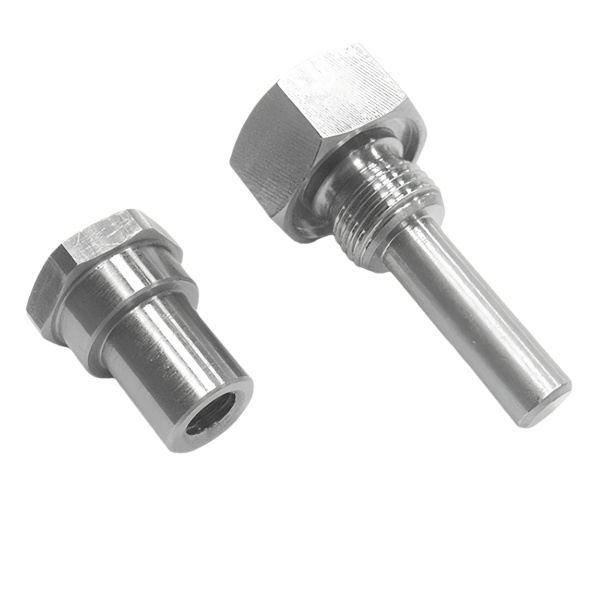
The Stainless Steel Hex Head Thermowell Fittings are threaded thermowell fittings whose driving feature is an integral hex head – a hexagonal section formed or machined directly into the body of the fitting, rather than a separate nut that runs on a thread. That distinction matters. An integral hex head is one piece with the fitting, so there is no nut to gall, no nut to loosen under vibration and no separate thread for the nut to ride on; but it also means the head is part of the pressure-carrying body, and the whole fitting has to be turned by that head without distorting the threaded section or the seal. This page covers the integral head, what it gains over a separate nut and the strength and seating it has to deliver.
An integral head is one piece, and that removes a failure mode
A nut-on-thread fitting has a joint between the nut and the body, and that joint can gall, can loosen under vibration and can be a leak path. An integral hex head has none of those: the head is machined or formed from the same bar as the fitting, so there is nothing to come loose and nothing to gall except the port thread itself. For a thermowell that has to hold pressure and stay put for years, removing that extra joint is a real reliability gain, and it is the main reason to choose an integral head over a separate nut.
- There is no nut-to-body thread to gall, which matters on stainless steel where a separate nut is a classic galling and seizure risk.
- There is no nut to vibrate loose, so the fitting stays at its assembled torque without a locking feature.
- The head is part of the pressure boundary, so it is finished and inspected as structural material, not as a loose accessory.
The head has to transmit torque without distorting the thread or seal
Because the head is integral, all the assembly torque goes straight into the fitting body, and that body carries the thread that seals and the seat that locates. If the head is too shallow, too thin or too soft, the torque that is supposed to engage the port thread instead distorts the fitting – it bells the thread, cock the sealing shoulder, or twists the body out of true. The head is therefore sized not just to turn the fitting, but to turn it without the body feeling it.
- Head across-flats and depth are sized for the assembly torque, with enough section behind the head that torque goes into the port thread and not into distorting the body.
- The head is checked to stay square to the fitting axis after tightening, because a head that cocks under torque seats the whole fitting crooked.
- Thread and seal geometry are verified after a representative tightening load, since on an integral-head fitting the wrenching is transmitted directly into the features that seal.
The thread and the seat do the real work, and the head just holds them
Everything the head does is in service of getting the thread engaged and the seat sealed, and those two features are where the fitting actually performs. The thread has to engage enough to hold against the pressure trying to push the well out, and the seat or seal land has to close off the port. On an integral-head fitting these are cut into the same body the head turns, so their geometry and the head’s strength are one design, not two.
- Thread engagement is set against the internal pressure load, and the thread form is held so the engaged bites carry load evenly.
- The sealing shoulder or land is checked for squareness to the axis, because the head is what drives it onto the seat and a cocked shoulder seals unevenly.
- Where the seal is on the thread rather than a face, the thread class is held to that sealing duty rather than to a general retention class.
Stainless Steel integral heads: forming or machining, and the galling that remains
An integral hex head on a stainless steel fitting is either machined from bar or formed, and either way the stainless steel governs the process. Machining a hex from bar is straightforward but wasteful of material and time; forming a hex is faster but works the metal and has to leave a head strong enough for the torque. And although the integral head removes the nut-to-body galling risk, the port thread is still stainless steel-against-stainless steel (or stainless steel-against-the-port-material), so anti-gale provision at the port thread is still required.
- The head is machined or formed to full corner strength, because a formed hex that is not fully developed rounds off under torque.
- An anti-gale lubricant or coating is still specified on the port thread, since the integral head does nothing about the galling risk there.
- Passivation after all machining and forming removes the free iron that both operations leave, and is verified per lot rather than assumed.
How we verify a stainless steel hex-head thermowell fitting
Verification checks the head, the thread and the seat together, and re-checks the thread and seat after a representative tightening load because the head drives them directly.
- Head: across-flats, depth and corner strength verified against the assembly torque, with the head checked for squareness to the fitting axis.
- Thread: form and class gauged to the seal or retention duty, with the crest inspected for galling or build-up.
- Seat or seal land: squareness and finish confirmed, since the head drives it onto the port.
- Post-torque check on the first article: thread and seat re-measured after a representative tightening load, to confirm the integral head did not distort the body.
- Material and passivation records per lot, confirming the stainless steel grade and that free iron was removed, with the anti-gale provision noted.
- Fit and pressure check: the fitting threaded into a gauge port, torqued, and pressure-tested to confirm it holds before the run.
First articles and retention samples are kept for the programme, so a repeat run of the integral-head fitting is machined and verified to the same head, thread and seat. On a part whose whole advantage is having no separate joint to fail, holding the head strong enough to seat the thread and seal without distorting them is what keeps a second batch performing like the first.
Sensor Housings is the range this part sits under; the overview page pulls together the tooling logic, finishing options and tolerance notes that apply across the family.
Specifications
| Item | Stainless Steel Hex Head Thermowell Fittings |
|---|---|
| Brand | AUNOV |
| Designing | A drawing file or a physical sample starts the review, our engineers reply with a manufacturability assessment and pricing. |
| Tooling | Dies engineered and produced in our own toolroom, held under your part number. |
| Samples | Pre-production samples ship with a full dimensional report and material certification. |
| Materials | Stock for this part leads with 304 / 316 stainless steel, alongside carbon steel (SPCC / DC01), aluminium, brass and copper, and the grade is fixed at the drawing review. |
| Surface finish | Plating, e-coat, powder coating, anodising or passivation as the drawing calls out, fixed at the drawing review. |
| Processing | Deep drawing in stages, in-line annealing where needed, then pierced and machined in house. |
| Equipment | Our press floor runs 5-250 T mechanical and 250-500 T hydraulic presses, in-house CNC cells and a temperature-controlled inspection room. |
| Tolerance | Tolerances to +/-0.1 mm as drawn, machined features held to +/-0.03 mm. |
| Delivery terms | Prices FOB, with DDP for EU and US on request, payment T/T or L/C, D/P for repeat accounts, call-off scheduling supported. |
Related Products


Frequently Asked Questions
Why an integral hex head instead of a nut?
An integral head is one piece with the fitting, so there is no nut to gall, no nut to loosen under vibration and no separate thread for it to ride on.
What does the integral head gain in reliability?
For a fitting that holds pressure and stays put for years, removing the nut joint is a real reliability gain against galling and loosening.
How is the head formed?
Machined or formed from the same bar as the fitting, so the head turns the body without distorting the threaded section or the seal.
Which stainless steel grade is used?
304 or 316, chosen for the process, with the hex and thread held concentric so the fitting seats true.
Request a Quote for This Part
Send a drawing or sketch — get material advice, tooling cost and a per-piece price within 24 hours (working days).