
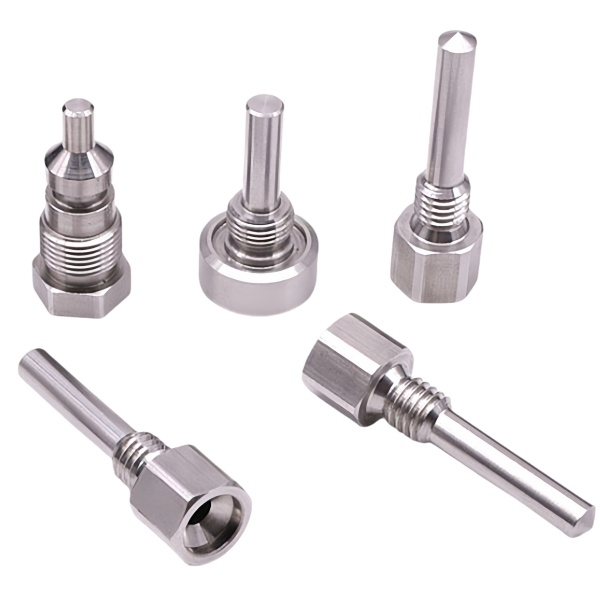
A stepped thermowell changes diameter along its length instead of being one diameter from tip to thread. The steps are not decoration: each one does a job, and a stepped design is chosen when a straight tube cannot do those jobs or when it would have to be made heavier to do them.
A step is a stop, a guide or a reinforcement
Every diameter change on this part is there for a reason. A shoulder can be a stop that fixes immersion depth when the probe is screwed home, so the tip lands at a known position every time. A larger section near the fitting can reinforce the part exactly where the thread and the bending load are. A smaller tip section can be the part that has to fit a bore or a guide. A straight tube has to compromise between all three; a stepped one can satisfy all three at once.
Steps concentrate stiffness where it is needed
The load on a thermowell is worst at its root, where it leaves the fitting and the flow tries to bend it. A stepped design puts metal there and takes it away toward the tip, which is both lighter and faster – a slim tip responds quicker, a heavy root resists vibration. On a straight tube, root strength and tip response pull against each other, and the compromise usually favours one at the expense of the other.
Each transition is a place to be careful
The cost of stepping is that every diameter change is a stress concentrator, and in a part that sees vibration and thermal cycling the transitions are where cracks start. Radii at the shoulders are specified as functional features rather than left to whatever the tool produces, and they are among the dimensions we inspect. A sharp shoulder on a vibrating thermowell is a fatigue crack that has not happened yet.
The hex fitting and the step are one assembly
The hex that screws this into the port has to work with the step behind it, not just with the thread. The step that reinforces the root is also the feature that bears on the port face or the shoulder, so its position and its diameter set how much of the probe stands into the process. That relationship – hex, shoulder, tip position – is held as one stack, because each one alone can be right while the assembled probe sits at the wrong depth.
How the steps are checked before the part ships
The diameters, the shoulder positions and the radii between them are measured together, because a stepped part is defined by its transitions as much as by its sizes.
First articles and retention samples are kept for the programme, so a reorder is made to the same steps and the same radii. On a part whose strength and response both come from its profile, that is what keeps the second batch behaving like the first.
You will find this part in our Sensor Housings range. Process notes, common materials and inspection points for every product in the family are collected across the sensor housings pages.
Where this part is used
Stepped thermowells with hex fittings serve sensors that need two things at once: a reduced tip for faster response and a larger body for strength and thread engagement. Process piping, engine and rig test work, and compressed-air and hydraulic circuits all use them where a single-diameter well would either respond too slowly or be too weak to install.
The step is where the part is most often mis-specified. If the drawing calls the reduced section a sealing land and we treat it as a diameter change, or the other way round, the part is made correctly to the wrong requirement.
What we need to quote it
Send both step diameters with the transition length, the hex across-flats, and say explicitly whether the step is a sealing land or only a diameter change. Add the process temperature, which sets the material, and whether the well is installed by spanner or by torque wrench — that decides how much hex we leave.
Specifications
| Item | Stainless Steel Stepped Thermowells with Hex Fittings |
|---|---|
| Brand | AUNOV |
| Designing | Send drawings, or send a sample to be measured, you get a DFM review together with the quotation. |
| Tooling | Every die designed and built in our toolroom, held and maintained under your part number. |
| Samples | Sample parts arrive with a full dimensional report and mill certificate. |
| Materials | Stock for this part leads with 304 / 316 stainless steel, alongside carbon steel (SPCC / DC01), aluminium, brass and copper, with grade selection confirmed at drawing review. |
| Surface finish | Plating, e-coat, powder coating, anodising or passivation, as called out on your print. |
| Processing | Deep drawing in stages, in-line annealing where needed, pierced and finish-machined on the same floor. |
| Equipment | Mechanical presses 5-250 T, hydraulic presses 250-500 T, in-house CNC cells and a temperature-controlled inspection room. |
| Tolerance | As-drawn tolerance +/-0.1 mm, +/-0.03 mm on machined surfaces. |
| Delivery terms | FOB standard, DDP offered for EU and US, T/T or L/C, with D/P for repeat business, scheduled call-offs welcome. |
Related Products

Frequently Asked Questions
What job does each step on a stepped thermowell do?
A step is a stop, a guide or a reinforcement, and every diameter change is there for a reason. A larger section near the fitting reinforces exactly where the thread and the bending load are, while a smaller tip section fits a bore or a guide. A stepped design is chosen when a straight tube cannot do those jobs, or would have to be made heavier to do them.
Why step the tube instead of leaving it straight?
A straight tube has to compromise between a slim tip for fast response and a heavy root for strength, but a stepped one satisfies both at once. The load is worst at the root where the probe leaves the fitting and the flow tries to bend it, so metal is put there and taken away toward the tip. A slim tip responds quicker and a heavy root resists vibration, which is both lighter and faster.
What is the cost of stepping the diameter?
Every diameter change is a stress concentrator, and on a part that sees vibration and thermal cycling the transitions are where cracks start. A sharp shoulder on a vibrating thermowell is a fatigue crack that has not happened yet. The hex that screws it into the port also has to work with the step behind it, not just with the thread.
How are the steps checked before the part ships?
The diameters, the shoulder positions and the radii between them are measured together, because a stepped part is defined by its transitions as much as by its sizes. The step that reinforces the root also bears on the port face or shoulder, so its position and diameter set how far the probe stands into the process. Stepped thermowells with hex fittings serve sensors needing a reduced tip and a larger body at the same time.
Request a Quote for This Part
Send a drawing or sketch — get material advice, tooling cost and a per-piece price within 24 hours (working days).