
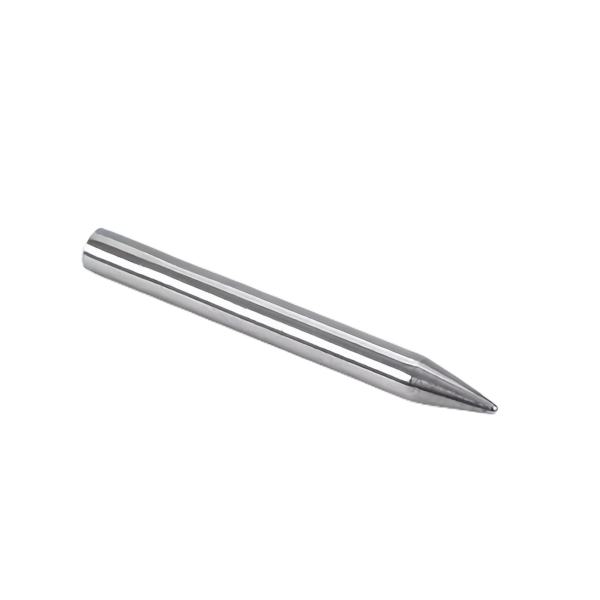
A pointed tip is a compromise between two requirements that move in opposite directions. To go into material the point has to be slender and sharp. To survive doing it the section behind the point has to be thick enough not to buckle. Everything about this tip is a decision about where on that line the part sits.
The cone angle sets both the effort and the strength
A narrow cone enters with less force and leaves a smaller hole, which is what makes it right for dense or firm material. It is also easier to bend, because there is less metal behind the point. A blunter cone is stronger and enters with more effort. The angle is specified from what the probe is going into, and it is held as a formed feature rather than left to whatever the grinding leaves.
The point is formed, then finished by grinding
The tip is produced in the forming so the wall stays continuous over the nose, and then it is finished by grinding to the final angle. Grinding stainless steel is its own problem: it work-hardens, it discolours if it is allowed to get hot, and a tip that has been overheated has lost the corrosion resistance that made stainless steel the right choice. We grind with the heat controlled and passivate afterwards, so the finished point is stainless steel at the surface and not just in the certificate.
Wall thickness behind the point is what stops it buckling
A point is only as good as the section behind it. Push a slender tip into something firm and the load goes back into the tube, and if the wall is thin there the tube takes a permanent set instead of returning. This is the failure that does not show up as a break – the probe still works and it is now bent, and a bent probe measures at a different depth. The wall behind the point is specified with that load in mind, not with the pressure rating alone.
Cleanability: there is nowhere for product to lodge
Where the probe goes into food or pharmaceutical material, the absence of a crevice is a functional requirement. A tip formed from the same piece of metal as the tube has no seam and no step, so there is nowhere for product to be left by a wash. That is the reason to form the tip rather than to close the tube and shape the end afterwards, and the finish is specified so the surface releases product instead of holding it.
How the tip is checked before it ships
The cone angle, the wall behind the point and the surface condition are measured on first articles, and the tip is inspected for the continuity that the cleaning requirement depends on.
First articles and retention samples are kept for the programme, so a reorder is formed and ground to the same angle and the same wall. On a tip whose whole job is to enter material and come back straight, that is what keeps the second batch behaving like the first.
This part belongs to our Sensor Housings range. The sensor housings pages collect the process notes, common materials and inspection points behind every product in the family.
Where this part is used
Pointed-tip temperature probe tubes are used wherever the probe has to enter a semi-solid medium rather than a liquid: meat and poultry, dairy and cheese, frozen product, soil and compost, and packaged goods where the probe is pushed through the film. The point exists so the tube parts the material instead of displacing it, which is the difference between a clean insertion and a torn one.
Because these tubes are cleaned and often chemically sanitised, the tip has to survive that cleaning and stay smooth. A ground tip leaves a surface that holds residue; a formed tip does not.
What we need to quote it
Send the tip angle and diameter, the insertion depth, and whether the tip should be formed or ground — formed is what we prefer on stainless steel for cleanability. Add the cleaning regime, since that decides the surface finish we hold and whether the tube needs electropolishing.
Specifications
| Item | Stainless Steel Pointed-Tip Temperature Probe Tube |
|---|---|
| Brand | AUNOV |
| Designing | Share your print, or send a part to be measured, the quotation comes back with a manufacturability review attached. |
| Tooling | Dies engineered and produced in our own toolroom, held under your part number. |
| Samples | First-off samples are sent with dimensional data and material certs. |
| Materials | Stock for this part leads with 304 / 316 stainless steel, alongside carbon steel (SPCC / DC01), aluminium, brass and copper, with the final grade confirmed at the drawing review. |
| Surface finish | Finish options: plating, e-coat, powder coating, anodising or passivation, fixed at the drawing review. |
| Processing | Progressive deep draw stages with in-line annealing as the draw ratio demands, then pierced and CNC-machined in house. |
| Equipment | 5-250 T mechanical presses plus 250-500 T hydraulic presses, CNC cells plus a temperature-controlled CMM room. |
| Tolerance | As-drawn tolerance +/-0.1 mm, with machined features to +/-0.03 mm. |
| Delivery terms | Standard terms FOB, DDP offered to EU and US, payment T/T or L/C, D/P for repeat accounts, call-off scheduling supported. |
Related Products



Frequently Asked Questions
Why is a pointed tip a compromise?
To go into material the point has to be slender and sharp, but to survive doing it the section behind the point has to be thick enough not to buckle. Everything about the tip is a decision about where on that line the part sits. The cone angle sets both the effort needed to push it in and the strength of the point that does the pushing.
How is the point made and finished?
The point is formed, then finished by grinding, and the wall thickness behind it is what stops it buckling. Grinding stainless steel is its own problem: it work-hardens, it discolours if allowed to get hot, and an overheated tip has lost the corrosion resistance that made the alloy the right choice. We grind with the heat controlled and passivate afterwards, so the finished point is stainless steel at the surface, not just in the certificate.
Why does cleanability matter on a pointed probe?
The design leaves nowhere for product to lodge, which matters when the probe enters food or soil and is cleaned between uses. Pointed-tip tubes are used wherever the medium is semi-solid rather than liquid: meat and poultry, dairy and cheese, frozen product, soil and compost, and packaged goods where the probe is pushed through the film. Formed tips are preferred on stainless steel for cleanability.
What should you send to quote a pointed-tip probe?
Send the tip angle and diameter, the insertion depth, and whether the tip should be formed or ground. Add the cleaning regime, since that decides the surface finish we hold and whether the tube needs electropolishing. The tip is checked before it ships so the point, the wall behind it and the finish all match the drawing.
Request a Quote for This Part
Send a drawing or sketch — get material advice, tooling cost and a per-piece price within 24 hours (working days).