
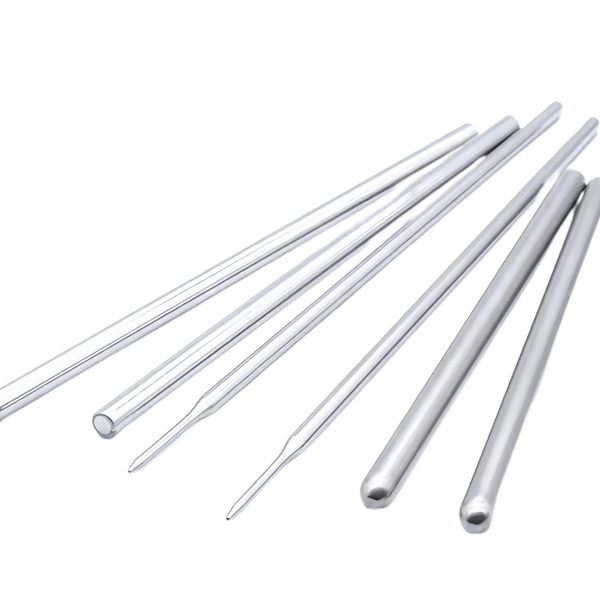
The Stainless Steel Thermowell Sleeves and Needle Probes Set is a mixed set that puts two different probe geometries in one delivery: thermowell sleeves, which are closed-end tubes that protect a sensor in a fixed installation, and needle probes, which are slender pointed probes pushed into material to take a reading. The two are related by material and function but not by shape – a sleeve is a robust, sealed pressure boundary, a needle is a fast, fragile insertion tool – and managing them as one set is the engineering challenge. The risk in a mixed set is that the two geometries get treated as one product, and a control that is right for the sleeve is wrong for the needle, or a needle gets released against a sleeve’s criteria. This page covers the two geometries and the discipline of controlling them as one family.
Two geometries, two sets of requirements, one delivery
The sleeve and the needle in this set look like relatives, but they are optimized for opposite things. The thermowell sleeve is built to hold pressure, seal a process out and protect a sensor for years, so its priorities are wall thickness, a leak-tight closed end and corrosion resistance. The needle probe is built to insert easily and respond instantly, so its priorities are a sharp point, a thin wall and a clean surface. Putting them in one set does not merge those requirements – it means the set has to deliver both, each to its own standard, from one release.
- The sleeve is verified against pressure, leak-tightness and corrosion, because that is what a fixed thermowell has to do.
- The needle is verified against insertion force, response and cleanability, because that is what an insertion probe has to do.
- The shared material and finish are held consistently, so both members of the set corrode and clean the same way.
The trap of one control plan for two different parts
The most common way a mixed set fails is that a single control plan gets written for “the set” and applied to both geometries. A wall-thickness check that is the key spec on the sleeve is almost irrelevant on a needle that is thin by design; an insertion-force check that is the key spec on the needle makes no sense on a sleeve that is never pushed into anything. The control plan therefore has to carry two sets of criteria and record which applies to which member, so neither part is judged against the other’s standard.
- The control plan names which checks apply to the sleeve and which to the needle, so neither is judged by the other’s criteria.
- Wall and leak checks are applied to the sleeve; point, insertion and response checks to the needle.
- Shared checks – material, finish, cleanliness – are applied to both, because those requirements really are common.
Look-alike confusion is the delivery risk in a mixed set
Within a set that contains both sleeves and needles, there is a real risk of the two being confused at pack-out, especially where a short sleeve and a needle are similar in length and diameter. A needle packed where a sleeve was expected is a functional failure even though both parts are individually good, because the customer installs the wrong one. The two geometries are kept visually and procedurally distinct through the process and the pack-out, and the set contents are verified per part number.
- Sleeves and needles are segregated in the process flow and at pack-out, so a similar-length part is not packed in the wrong slot.
- The distinguishing feature between a sleeve and a needle is called out, so a mix-up is caught before the set ships.
- Set contents are verified per part number, because a mixed set with the wrong member is a failed delivery.
Consistency of the shared material and finish across both geometries
What genuinely is shared across the set – the stainless steel grade, the finish and the passivation – has to be consistent, because the customer bought a set that will corrode and clean uniformly. A sleeve and a needle from the same set that have different finishes, or that were passivated differently, is a set the customer will notice, because one part stains or cleans differently from the other. We hold the shared material and finish to one specification across both geometries and verify it across the set.
- Stainless Steel grade is one lot or one verified process across both the sleeves and the needles.
- Finish and passivation are verified across the set, so both geometries corrode and clean the same way.
- Where the food-contact duty applies to the needle, the cleanability spec is confirmed on both geometries where both see food.
How we verify a thermowell sleeve and needle probe set
Verification runs two criteria sets on the one delivery, applying the right checks to each geometry and the shared checks to both.
- Sleeves: wall thickness, closed-end leak-tightness and corrosion-relevant finish verified, against the fixed-thermowell standard.
- Needles: point geometry, insertion force, response and cleanability verified, against the insertion-probe standard.
- Shared material and finish: stainless steel grade, finish and passivation confirmed consistent across both geometries.
- Look-alike segregation: the sleeve-versus-needle distinction confirmed and pack-out verified per part number.
- Traceability: material and process records filed per part number, so the set is reconstructable.
- Set fit and retention: a fit check per geometry against its mating sensor or material, with retention samples from each before the set is boxed.
First articles and retention samples are kept per part number for the programme, so a repeat set is made to the same two verified geometries. On a delivery whose value is two very different probes supplied as one consistent family, holding each to its own standard and the shared material to one spec is what keeps the whole set performing the way the customer expects.
Sensor Housings is the range this part sits under; the overview page pulls together the tooling logic, finishing options and tolerance notes that apply across the family.
Specifications
| Item | Stainless Steel Thermowell Sleeves and Needle Probes Set |
|---|---|
| Brand | AUNOV |
| Designing | A drawing file or a physical sample starts the review, you get a DFM review together with the quotation. |
| Tooling | Our own toolroom designs and builds every die, held under your part number. |
| Samples | Approval samples ship with dimensional data plus material certs. |
| Materials | 304 / 316 stainless steel is the primary stock for this part, alongside carbon steel (SPCC / DC01), aluminium, brass and copper, per the drawing. |
| Surface finish | Plating, e-coat, powder coating, anodising or passivation, fixed at the drawing review. |
| Processing | Progressive deep draw stages with in-line annealing as the draw ratio demands, pierced and finish-machined on the same floor. |
| Equipment | Our press floor runs 5-250 T mechanical and 250-500 T hydraulic presses, CNC turning centres and a climate-controlled CMM room. |
| Tolerance | +/-0.1 mm on as-drawn features, with machined features to +/-0.03 mm. |
| Delivery terms | Standard terms FOB, DDP offered to EU and US, T/T and L/C; D/P on repeat accounts, call-off schedules supported. |
Frequently Asked Questions
Why is one control plan the trap in a mixed set?
Because the two members fail differently. A closed-end sleeve is judged by pressure containment and tip thickness; a needle is judged by diameter, straightness and how it survives washing. One plan must either over-control one member or under-control the other, and both outcomes cost more than writing two.
What should stay shared across the two geometries?
Material and finish, because they sit in the same process and the same cleaning regime. Consistency there is what makes the set behave as one purchase. Everything about acceptance should be treated as separate, since it is the differences in duty that make it worth having two shapes at all.
Where does the risk actually sit in a mixed delivery?
In confusion between look-alikes. Members of a family often differ in ways nobody can see, so the failure happens at installation rather than at inspection, usually after somebody has spent time getting access. Separation and labelling are therefore requirements of the set rather than courtesies of the packer.
Why buy them together if they need separate treatment?
Because they serve one line, one medium and one maintenance cycle. One qualification exercise and one purchase decision covers both, which is worth more than the small inconvenience of two acceptance records. The saving is administrative and practical, even though the engineering stays distinct.
Related Products

Request a Quote for This Part
Send a drawing or sketch — get material advice, tooling cost and a per-piece price within 24 hours (working days).