
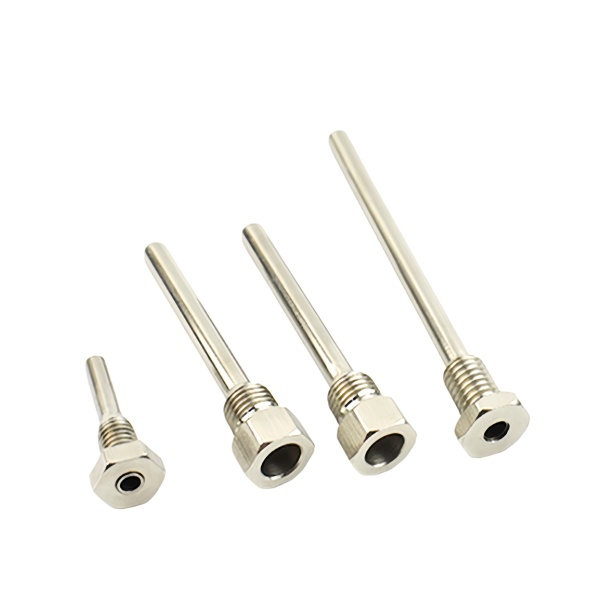
These probes are mounted through a flange rather than screwed into a port, which moves the sealing job from a thread to a flat face. The flange is the pressure boundary and the locating feature at the same time, and on a brass flange those two jobs pull against each other: the bolt load that compresses the gasket is the same load that can dish the face doing the compressing.
A face seal is only as good as the face under load
A threaded thermowell seals along a thread or a tapered seat, both of which are forgiving of a few hundredths. A flanged thermowell seals across a gasket, and a gasket needs even compression all the way round. That makes flatness a loaded condition, not a free-state one: a flange that measures flat on a surface plate can still dish between bolts once it is clamped, and then it seals at the bolts and weeps between them. We hold the flange flat as it will be clamped, which is why the thickness and the bolt circle are specified together rather than independently.
Brass makes the seal easy and the over-tightening easy too
Brass is specified here because it machines cleanly, it seats against a gasket at modest bolt torque, and it conducts heat well enough to serve the thermowell. The other side of soft is that it keeps deforming. The torque that reaches a good seal on a steel flange will keep pulling a brass one past flat, and the result looks like a sealed joint at the bolt holes and leaks along the arc between them. The specified bolt torque is a window, not a target, and it is passed on with the parts because an installer working to steel habits will exceed it.
The bolt circle clamps the gasket and locates the probe
The bolt circle does two things at once, and they can conflict. It has to clamp the gasket evenly, which argues for more bolts on a tight circle. It also fixes the probe’s position in the port, which argues for hole positions held to the mating flange’s pattern. We hold the holes to the mating pattern and size the circle for even clamping; a flange that binds on a bolt never seats flat, and a flange that never seats flat leaks regardless of the gasket.
The probe has to stand square on the face that locates it
Because the flange both mounts and locates the probe, the relationship between the probe axis and the flange face is a functional stack rather than two independent features. A probe that leans relative to its base bolts down perfectly and still puts its tip off the centreline, or fouls the bore it was meant to reach into. That squareness is held through the joint between probe and base, not corrected by the installer pulling the bolts unevenly – which is the field fix that dishes the flange.
How a flanged base is checked before it ships
Flange flatness, the bolt pattern and the probe’s squareness to the face are inspected together, because they are what the gasket and the tip position both depend on.
First articles and retention samples are kept for the programme, so a reorder reproduces the same flatness, the same pattern and the same torque window. On a joint that has to seal across a face, that is what keeps the second batch sealing like the first.
This part belongs to our Sensor Housings range. The sensor housings pages collect the process notes, common materials and inspection points behind every product in the family.
Where this part is used
Flanged-base thermowells bolt to a nozzle rather than threading into one, which makes them the choice where a vessel wall is too thin to hold a thread or where the thermowell has to come off without disturbing the port. Water and wastewater plants, food and dairy vessels, and light chemical duty are the common users.
The flange is the whole mounting and sealing interface, so it has to be flat and true after the tube is drawn and welded to it. A flange that seals on the bench and rocks on the vessel is the failure we design against.
What we need to quote it
Send the flange standard with its facing type and bolt pattern, the immersion depth, and whether the flange is a sealing face or only a mounting face. Tell us if the assembly is welded or gasketed downstream, and whether the thermowell is removed in service — a removable one needs the bolt pattern to clear the nozzle every time.
Specifications
| Item | Brass Thermowell Probes with Flanged Bases |
|---|---|
| Brand | AUNOV |
| Designing | A drawing file or a physical sample starts the review, DFM feedback is returned with the quote. |
| Tooling | Dies engineered and produced in our own toolroom, each die held against your part number. |
| Samples | Pre-production samples ship with dimensional data and material certification. |
| Materials | Brass is the primary stock for this part, alongside carbon steel (SPCC / DC01), 304 / 316 stainless steel, aluminium and copper, per the drawing. |
| Surface finish | Surface treatment per the drawing: plating, e-coat, powder coating, anodising, passivation, per your print. |
| Processing | Deep drawing in stages, in-line annealing where needed, pierced and finish-machined on the same floor. |
| Equipment | Press capacity from 5 to 500 T across mechanical and hydraulic lines, CNC cells plus a temperature-controlled CMM room. |
| Tolerance | Drawn tolerances held to +/-0.1 mm, +/-0.03 mm on machined features. |
| Delivery terms | FOB as standard, DDP available for EU and US destinations, T/T and L/C; D/P on repeat accounts, call-off scheduling supported. |
Related Products


Frequently Asked Questions
Why mount through a flange instead of a thread?
It moves the seal from a thread to a flat face, so the flange is both the pressure boundary and the locating feature at the same time.
Why is flange flatness a loaded condition?
A flange that measures flat can still dish between bolts once clamped and then seal at the bolts but weep between them, so flatness is held as it will be clamped.
How is the gasket sealed?
Even compression all the way round is required, so thickness and bolt circle are specified together rather than independently.
Why brass for the flange?
Brass machines to a clean sealing face with light force and conducts heat well, which suits a flanged thermowell base.
Request a Quote for This Part
Send a drawing or sketch — get material advice, tooling cost and a per-piece price within 24 hours (working days).