
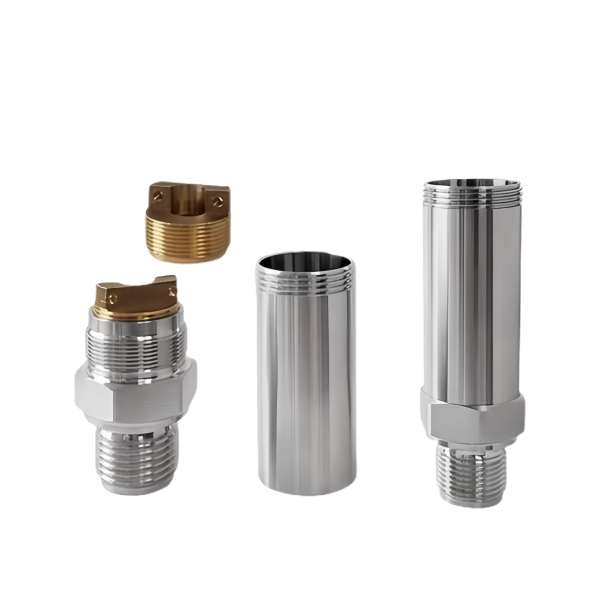
The Brass and Nickel Plated Sensor Sleeve Housings are cylindrical sleeves that hold a sensor and sit inside a bore, made of brass and finished with a nickel plate. The sleeve is a precision bore part – the sensor has to seat inside it and the sleeve has to fit inside the housing – so the inside diameter and its finish are the features that matter, and the nickel plating is applied for conductivity, corrosion resistance and a clean, solderable or wear surface. The central tension on this part is that the plating is applied to both the inside and the outside of the sleeve, and plating build-up inside the bore changes the very dimension the sensor depends on. This page covers the bore, the plating and how the two are reconciled.
The inside diameter is the datum, and everything serves it
A sensor sleeve is specified by its bore, because the bore is what the sensor seats in and what positions it. The outside diameter matters only insofar as it has to fit the housing it slides into. That ordering is the opposite of how a shaft is specified, and it changes how the part is machined and measured: the bore is finished and verified first as the functional datum, and the outside is then held concentric to it, rather than the other way round.
- Bore diameter and roundness are the primary checks, because a sensor that seats in a lobed or undersized bore reads or positions wrong.
- Bore surface finish is controlled where the sensor seals or slides against it, since finish affects both seating and friction.
- The outside diameter is held concentric to the bore, so the sleeve runs true on the feature the sensor actually uses.
Nickel plating grows the bore, and the sensor feels it
This is the defining issue on a plated sleeve: nickel deposits on every exposed surface, including the bore wall, and that deposit makes the bore smaller by roughly twice the coating thickness across the diameter. A sleeve that is bored to the sensor’s fit dimension and then plated will be tight or interfered, because the plating ate into the clearance. The bore therefore has to be machined to a pre-plate size that accounts for the build-up, so that after plating the bore lands where the sensor needs it.
- We machine the bore to a calculated pre-plate size that leaves the correct post-plate dimension, rather than boring to the final size and hoping.
- Post-plate bore is the deliverable, and we verify it in the plated condition, because that is the dimension the sensor actually meets.
- Where the fit is tight, we discuss whether the bore should be bored or reamed after plating to remove the build-up and guarantee the dimension.
Plating a bore is harder than plating an outside surface
Getting an even nickel deposit inside a small bore is genuinely harder than plating the outside of the same part. Current and solution have to reach the inside of the bore, and on a deep or small-diameter sleeve the deposit is naturally thinner at the bottom of the bore than at the mouth – a throwing-power problem that leaves the bore with a taper in its coating. That taper becomes a taper in the finished bore dimension, which a close-fitting sensor will feel as a position or a drag difference along its length.
- We control bore plating with attention to throwing power, using anode placement and bath conditions that reach into the bore rather than just coating the mouth.
- Where the fit demands it, we verify coating thickness at the bottom of the bore, not only at the mouth, because the mouth is where plating is always easiest.
- For a very tight bore fit we discuss post-plate boring or honing as the reliable route to a uniform, guaranteed dimension.
Brass substrate plus nickel: what the combination is for
The pairing of a brass substrate with a nickel plate is a deliberate combination of properties. Brass gives a body that machines cleanly and conducts well; nickel gives a hard, corrosion-resistant, clean surface that also conducts and solders reliably. The result is a sleeve that seats a sensor, sits in a housing and connects electrically or thermally without corroding. The limitation is that the nickel is a thin barrier, and once it is scratched through, the brass underneath is exposed and the protection at that spot is gone.
- Nickel thickness is specified against the environment and the wear the sleeve sees, since a thin plate wears through at contact points.
- Handling after plating avoids scratching the bore, because the sensor-seating surface is also the protected surface.
- Where the assembly is electrical, we confirm the nickel is acceptable for the contact, since nickel’s own surface oxide is a consideration in some connections.
How we verify a brass and nickel-plated sensor sleeve
Verification on this part concentrates on the bore, because the bore is the function, and it is checked in the finished, plated condition.
- Post-plate bore: diameter and roundness measured in the plated condition, since that is the dimension the sensor meets, not the pre-plate bore.
- Bore along its length: diameter checked near the mouth and near the bottom, to catch the throwing-power taper that uneven bore plating leaves.
- Bore finish confirmed against the seating or sliding requirement.
- Outside diameter and concentricity to the bore verified, so the sleeve runs true in its housing.
- Plating record: nickel thickness attached, with a check that the deposit reached the bore and not only the outside.
- Fit check on the first article: the sensor the sleeve is built around is inserted and seated, proving the post-plate bore fits before the run.
First articles and retention samples are kept for the programme, so a repeat run of the plated sleeve is bored, plated and verified to the same post-plate bore. On a part whose entire value is a bore that a sensor fits after a coating has shrunk it, that verified post-plate dimension is the only baseline that matters.
Our Sensor Housings range is where this part sits. The sensor housings pages carry the process notes, common materials and inspection points behind every product in the family.
Specifications
| Item | Brass and Nickel Plated Sensor Sleeve Housings |
|---|---|
| Brand | AUNOV |
| Designing | Send us your 2D drawing, or mail a sample for measurement, a manufacturability review comes back with the quotation. |
| Tooling | Dies designed and built in our own toolroom, stored under your part number. |
| Samples | First articles go out with a dimensional report and material certificate. |
| Materials | Brass is the primary stock for this part, alongside carbon steel (SPCC / DC01), 304 / 316 stainless steel, aluminium and copper, and the grade is fixed at the drawing review. |
| Surface finish | Surface treatment per the drawing: plating, e-coat, powder coating, anodising, passivation, fixed at the drawing review. |
| Processing | Deep drawing in stages, in-line annealing where needed, then pierced and CNC-machined in house. |
| Equipment | Mechanical and hydraulic press lines cover 5-500 T; CNC turning and milling cells and a climate-controlled CMM room support them. |
| Tolerance | +/-0.1 mm as-drawn, machined features held to +/-0.03 mm. |
| Delivery terms | Prices FOB, with DDP for EU and US on request, T/T or L/C, D/P on repeat business, call-off scheduling supported. |
Related Products


Frequently Asked Questions
Why does plating inside the bore matter?
The plating builds up on the bore’s inside diameter, and that build-up changes the very dimension the sensor seats on, so the bore is finished and verified first as the functional datum.
How is the bore specified?
By its inside diameter, opposite to a shaft: the bore is finished and verified first and the outside is held concentric to it.
Why nickel plate a brass sleeve?
Nickel adds a hard, corrosion-resistant, conductive and solderable surface on both the inside and the outside of the sleeve.
How is the plating thickness controlled?
Coating thickness is checked at the bore and the outside so the plated sleeve still meets the sensor’s seat dimension.
Request a Quote for This Part
Send a drawing or sketch — get material advice, tooling cost and a per-piece price within 24 hours (working days).