
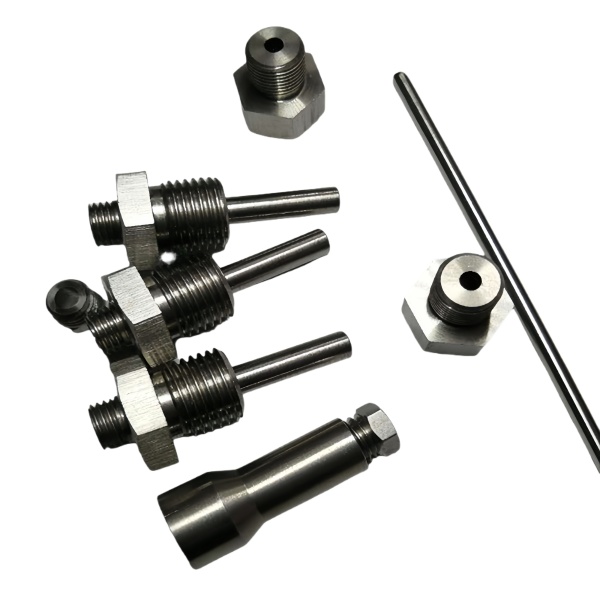
The Steel Thermowell Fittings with Hex Nuts Assortment is a mixed release of threaded thermowell fittings – steel bodies that screw into a port and hold a well or sensor – each with a hex nut or hex section that gives the installer something to turn. The hex is a small feature that carries a lot of responsibility: it is the surface every bit of assembly torque is transmitted through, it is what gets rounded off if the wrong wrench is used, and on a fitting that has to seal it is the difference between a controlled tightening and a distorted one. This assortment also runs several sizes together, so the hex, the thread and the well all have to be managed as a family rather than as one part.
The hex is a torque interface, and it is specified for the wrench
A hex on a fitting is not decoration; it is the interface that turns a wrench’s torque into thread engagement and seal compression. That means the hex’s across-flats dimension, its depth and the sharpness of its corners are all functional. A hex that is undersized rounds off under torque; a hex that is too shallow strips before the seal is made; and a hex with rolled or soft corners concentrates stress and can crack. We treat the hex geometry as a functional spec and hold it to the assembly torque the fitting will actually see.
- Across-flats is held to the standard wrench size, with enough corner strength to take the assembly torque without rounding.
- Hex depth is sufficient that the wrench fully engages before torque climbs, because a partially-engaged wrench loads only the top corners.
- Corner condition is controlled – sharp, not rolled – because a rounded hex corner is where a wrench slips and a fitting gets gouged.
Wrenching distorts a small fitting, and the seal feels it
Everything that makes a hex useful for tightening also makes it a source of distortion. When torque is applied to the hex, the fitting body is loaded in torsion and the round sections – the thread and the well bore – can be pulled slightly out of round by the same force. On a small fitting this distortion is small but it lands exactly where the seal and the sensor are, so a fitting that sealed before wrenching can leak or bind a sensor after. We design and verify with the wrenching load in mind, not just the static geometry.
- Thread and bore roundness are checked after a representative wrenching load on the first article, not only on the unmachined part.
- Where the seal is on a face or a cone, we confirm the wrenching torque does not bell or flatten the sealing land.
- The hex is positioned and sized so the tightening force goes into the thread engagement and not into distorting the well or the sensor seat.
Running an assortment: shared process, separate control points
An assortment of fittings shares the steel, the threading process and the plating line, but each size has its own hex, its own thread and its own well geometry, and they do not all fail the same way. The discipline on a mixed release is to run them as a family where it saves cost – one material lot, one plating batch, one inspection routine – while keeping the control points that are genuinely size-specific. Collapsing the whole assortment into a single generic control plan is how a size that needs a tighter hex or a deeper thread slips through.
- Material and plating are managed as one lot where the sizes share grade and finish, saving cost without blurring the per-size checks.
- Each size keeps its own thread gauge, its own hex check and its own well-bore check, because these are the features that differ and that the assembly depends on.
- Lot traceability is per size, so a problem found on one size can be isolated without quarantining the whole assortment.
Steel, plating and the environment the fitting lives in
These are steel fittings, so their corrosion performance is set by the plating or coating and by how well that coating covers the features that matter – the threads, the hex corners and the well bore. A thermowell fitting screws into a port and often sees a wet or humid environment, so the coating has to survive assembly as well as service. Coating build-up on the thread is a specific concern, because a plated thread that was gauged before coating can be a different fit after.
- Thread and hex are gauged in the condition the customer receives them – plated where plated – so the fit is proven after coating, not before.
- Coating coverage inside the well bore and on the hex corners is checked, because these recessed and edged features are where coating is thinnest.
- Where the fitting sees a corrosive environment, we confirm the coating class against that environment rather than defaulting to a general-purpose zinc.
How we verify an assortment of steel thermowell fittings
Verification runs per size against a shared routine, so the family is checked consistently without losing the size-specific control points.
- Thread: class and form gauged per size in the as-coated condition, with the fit confirmed after plating.
- Hex: across-flats, depth and corner condition checked per size against the wrench and torque the fitting will see.
- Post-wrenching check on the first article of each size: thread and bore roundness re-measured after a representative tightening load.
- Well bore and seat: diameter, finish and depth confirmed, since the sensor seats there.
- Material and coating certificates per lot, traceable per size, with coating thickness attached.
- Fit and seal check: each size torqued into a gauge port at its specified torque and seal-tested before the assortment ships.
First articles and retention samples are kept per size for the programme, so a repeat assortment is made to the same verified hex, thread and well. On a family where a whole release shares one plating batch and one inspection routine, those per-size baselines are what keep a mixed box of fittings all sealing and all turning with the same wrench.
Our Sensor Housings range is where this part sits. The sensor housings pages carry the process notes, common materials and inspection points behind every product in the family.
Specifications
| Item | Steel Thermowell Fittings with Hex Nuts Assortment |
|---|---|
| Brand | AUNOV |
| Designing | Send drawings, or send a sample to be measured, our engineers reply with a manufacturability assessment and pricing. |
| Tooling | Dies engineered and produced in our own toolroom, each die held against your part number. |
| Samples | First-off samples are sent with a dimensional report and material certification. |
| Materials | Carbon steel (SPCC / DC01) is the primary stock for this part, alongside 304 / 316 stainless steel, aluminium, brass and copper, and the grade is fixed at the drawing review. |
| Surface finish | Plating, e-coat, powder coating, anodising or passivation, exactly as your print calls for. |
| Processing | Staged deep drawing, with in-line annealing where the draw ratio requires, pierced and machined on the same floor. |
| Equipment | Mechanical presses 5-250 T, hydraulic presses 250-500 T, CNC cells plus a temperature-controlled CMM room. |
| Tolerance | Drawn tolerances held to +/-0.1 mm, +/-0.03 mm on machined features. |
| Delivery terms | Prices FOB, with DDP for EU and US on request, T/T and L/C accepted, D/P for established customers, scheduled call-offs welcome. |
Related Products



Frequently Asked Questions
Why is the hex more than a place to put a wrench?
A hex on a fitting is the interface that turns a wrench’s torque into thread engagement and seal compression, not decoration. It is the surface every bit of assembly torque passes through, and it is what gets rounded off if the wrong wrench is used. On a fitting that has to seal, that difference is between a controlled tightening and a distorted one.
How does wrenching a small fitting distort the seal?
When torque is applied to the hex, the fitting body is loaded in torsion, and the round sections, the thread and the well bore, can be pulled slightly out of round by the same force. The seal then feels a distortion the drawing never called out. Keeping the wrench interface matched to the size is what protects the round features.
What does running several sizes as one assortment require?
An assortment shares the steel, the threading process and the plating line, but each size has its own hex, thread and well geometry, and they do not all fail the same way. The discipline is to run them as a family where that saves cost, one material lot, one plating batch, one inspection routine, while keeping the control points that are genuinely size-specific. Folding the whole release into a single generic control plan is how a size needing a tighter hex or a deeper thread slips through.
How does plating affect a steel fitting and its threads?
These are steel fittings, so their corrosion performance is set by the plating or coating and by how well it covers the threads, the hex corners and the well bore. A fitting that screws into a port often sees a wet or humid environment, so the coating has to survive assembly as well as service. Coating build-up on the thread is a specific concern, because a thread gauged before coating can be a different fit afterwards.
Request a Quote for This Part
Send a drawing or sketch — get material advice, tooling cost and a per-piece price within 24 hours (working days).