
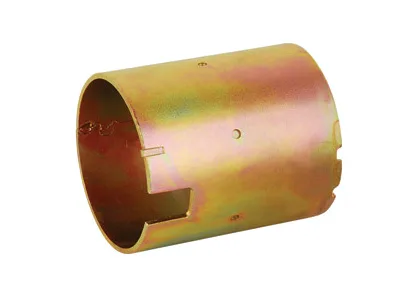
The starter motor cover closes the drive end of an automotive starter — the end where the solenoid shift lever and the drive pinion come out. It is a small part with a hard brief: align the pinion with the ring gear, keep the elements and road spray out of the windings, survive under-hood heat and salt for the life of the vehicle, and do all of it at automotive volumes and prices. Aunov Tech draws these covers to print in steel or stainless steel, with pilot and flange features machined to ±0.03 mm in-house.
What the cover actually does in a starter
A starter’s drive end is a busy place: the pinion must slide along its helix, engage the ring gear, and carry torque through the cranking pulse — hundreds of amps and a real shock load, repeated for years. The drawn cover is not decoration here:
- It sets the pinion’s axis. The cover’s pilot spigot locates it on the housing; bore-to-pilot concentricity is what keeps the pinion gear meshing true instead of wearing the ring gear. That concentricity is measured on the CMM at first article — it is the named critical dimension on this part.
- It closes the drivetrain end against spray. Road salt, water and dust enter low-mounted components first. A one-piece drawn shell has no corner seams for them, which is why drawn covers outlast folded-and-welded alternatives in this position.
- It carries the mounting interface. Bolt circles and flange faces are formed and machined so the starter bolts to the engine as designed — flange flatness is gauged on every run, not just at approval.
The surrounding system — solenoid, armature, drive — is explained in plain language in What is an auto starter? Components explained.
Under-hood environment: material and finish choices
The cover lives with heat cycling, salt spray and stone impact, so the material-and-finish pairing is a duty decision:
- Carbon steel (SPCC / DC01) + zinc plating or e-coat — the volume route. E-coat reaches drawn corners uniformly; zinc with passivation handles salt exposure. This is the standard for high-volume starter programmes.
- 304 stainless steel, natural — for premium or exposed-duty variants where paint chips are unacceptable; higher material and forming cost, zero coating maintenance.
- Masking and marking. Contact faces and grounding points are masked before coating; laser marking carries the part number where traceability requires it.
The finish is agreed in the drawing review and travels with the part number — repeat orders do not reopen the question.
Production at automotive rhythm
Automotive supply is less about making a good sample and more about making ten thousand identical ones, so the process is built for drift control:
- One locked route. Drawing runs from flat blank to finished envelope in one controlled sequence; flanges and rims are formed in the same line, then trimmed. Drift is corrected at the machine — not sorted out at final inspection.
- Gauging to the signed first article. Production batches are gauged back to the approved first article, not to a memory of it. Any drawing change is re-approved and re-verified before production continues.
- Die upkeep by stroke count. Maintenance is triggered by a schedule, which is how piece 50,000 holds the concentricity piece 500 did.
- Call-off supply. Orders ship against call-off schedules, quoted FOB as standard with DDP on request.
The automotive product family this part belongs to — wiper motor housings, blower shells, drive-end covers — is indexed on automotive motor components.
Tolerances we hold
| Feature | Control | Note |
|---|---|---|
| Bore-to-pilot concentricity | CMM at first article | The named critical dimension on starter covers |
| Flange flatness | Gauged every run | Sealing and mounting both depend on it |
| Turned secondary features | ±0.03 mm | Pilots, bores, machined seats |
| As-drawn surfaces | ±0.1 mm | Finer bands confirmed from capability data before quoting |
| Wall thickness | Held to print | Thinning at radii monitored per run |
Samples and programme start
Pre-production samples come with a full inspection report, so the part is proven before volume, and the signed sample is kept for future reorders. Tooling is designed and built in-house — tooling lead time stays under our control and the die remains dedicated to your part. Unusual walls, threads or tolerances are feasibility-checked before the price is issued; changes are priced before they are made. Toolroom detail is on tool & die design, the quality system on quality control.
Requesting a quotation
Send the drawing (or a sample), the annual volume and the vehicle-environment requirements — under-hood position, salt exposure, any OEM coating specification. The reply confirms material and finish options, tolerance bands and tooling cost, via the quote request page.
Frequently asked questions
Can you match a cover to an existing starter design?
Yes — send the drawing or a sample. It is reverse-measured into a controlled drawing, bore-to-pilot concentricity is verified on the CMM, and a first article is approved before volume. The replacement repeats a defined process, not a guess.
What volumes justify a drawn cover over a machined or welded one?
The die is the fixed cost; above a few thousand pieces a year the draw usually wins on unit price and on field durability (no seams). Below that, ask about the stamping routes on custom metal stamping — the quotation will say which route the volumes support.
Is salt-spray validation possible on the finish?
Coating systems can be selected and tested to the OEM specification you name at RFQ — the test requirement is written into the quality plan with the rest of the named checks.
| Item | Car starter electric motor cover |
|---|---|
| Brand | AUNOV |
| Designing | Driven by your drawing or a physical sample; feasibility-checked before pricing; changes priced before they are made. |
| Tooling | In-house die design and toolmaking; tooling lead time under our control; die dedicated to your part. |
| Samples | Pre-production samples with full inspection report; signed sample kept for reorders. |
| Materials | Carbon steel, 304 / 316 stainless steel, aluminium, brass; special grades sourced to drawing when volumes justify. |
| Surface finish | Zinc / nickel / chrome plating, e-coat, anodising, passivation; masking and laser marking available. |
| Processing | Progressive drawing through several stages, annealed between draws, trim and pierce; batches gauged to the signed first article. |
| Equipment | Mechanical presses 5–250 T and hydraulic presses 250–500 T with in-line annealing; CMM inspection. |
| Tolerance | ±0.03 mm on turned secondary features, ±0.1 mm on as-drawn walls; finer bands from capability data. |
| Named checks | Bore-to-pilot concentricity (CMM, first article); flange flatness (gauged every run). |
| Delivery terms | FOB standard, DDP on request; sea and air priced with the order; call-off schedules supported. |
Related Products


Request a Quote for This Part
Send a drawing or sketch — get material advice, tooling cost and a per-piece price within 24 hours (working days).