
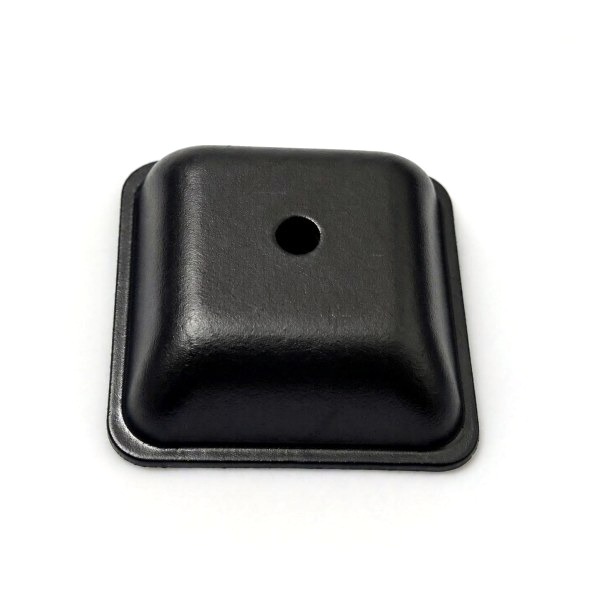
A sump cover shell is an oil seal before it is a cover
A deep drawn sump cover shell, the kind that closes an oil pan or a fluid reservoir, has one non-negotiable function: it has to hold oil in and dirt out at a bolted flange, often while the engine or machine around it vibrates and heats. The “shell” is shallow, but shallow is exactly where the sealing difficulty lives, because a shallow draw has little material to relax into a flat flange and the bolt circle has to pull that flange flat against a gasket every time. We treat the flange face and the bolt pattern as the functional features and the dome as the material that carries them, and we plan the draw so the flange wins.
We draw these in black steel on mechanical presses, holding the as-drawn envelope to roughly +/-0.1 mm and any machined seal face to +/-0.03 mm. The “black” finish is specified against duty, and the pierced features for drain, breather and bolt holes are placed so none of them breaches the seal land that the gasket depends on.
The sump cover is planned as an oil seal from the first station, and that is what we record against your part number. A reorder starts from the recorded draw and finish settings rather than a retune, and the flange flatness and bolt-circle position we proved on the first article are the ones held on every later batch, so the cover keeps sealing the way it did when it was approved.
The oil drain and breather features on a sump cover are where we spend the most care, because they sit near the seal land and near the bolt circle at once. A drain boss that is just pierced thin shell will strip its thread; we form a local boss so there is material for the thread and the wrench. A breather that breaches the seal land becomes a leak, so we keep it clear and we verify the distance on the first article.
Black oxide, where it is the chosen finish, needs a top oil or a lacquer to actually protect in an oily environment, because bare black oxide is mostly cosmetic and will red-rust where it is scratched. We state the post-treatment on the drawing and we confirm it, because a sump cover that rusts at the first oil change is a finish failure, not a steel failure.
The flange stiffness versus bolt torque trade is the sump cover’s core cost. A wider, stiffer flange uses more material and a bigger press but seals reliably under the torque the assembly needs; a narrow one saves steel and weeps. We size the flange from the bolt torque, not from the drawing’s default, and we tell you when the default is too thin to seal.
Black finish on steel: what “black” means and why it is not a coating
“Black steel” on a sump cover usually means one of two things, and the difference matters. It can mean black oxide, a thin conversion finish that looks black and gives mild corrosion resistance and a clean non-reflective surface, but protects almost nothing in a wet oil environment. Or it can simply mean unfinished dark steel that will be painted or plated downstream. We confirm which is meant, because specifying “black” and assuming corrosion protection is a common error that leads to a rusting cover in service.
- Black oxide is a appearance and light-corrosion finish, not a barrier against oil and road splash; where the sump lives exposed we recommend a real coating over it.
- A painted or powder black is a different system with its own thickness and adhesion rules, and it has to be planned around the flange so the gasket still seats.
- We state the finish on the drawing rather than leaving “black” to interpretation, because the same word covers finishes with completely different service lives.
Drawing a shallow shell that stays flat under bolt torque
A shallow sump cover is pulled flat by the bolt circle every time it is installed, and if the flange is not already flat and rigid the bolts simply bend it into shape and the gasket takes the strain. That is the route to a slow weep. We design the draw so the flange has enough section to stay put, we restrike or flatten it so it leaves the die true, and we set the bolt torque expectation from the flange stiffness rather than from a generic figure.
- Flange width is the lever. A wide, stiff flange resists the bolt pull and spreads the load; a narrow one deflects and weeps.
- Springback is predicted and compensated, because a flange that relaxes out of flat after the punch releases is a flange that will not seal.
- The dome is kept shallow on purpose, so the flange stays dominant and the cover behaves like a stiff plate, not a flexible cap.
The bolt circle is a reacted moment, not just a ring of holes
The bolt circle on a sump cover is where the assembly’s internal pressure and the bracket loads get reacted into the block or pan. It is not a decoration of evenly spaced holes; it is a load path, and the holes have to be positioned so the load is shared, not concentrated at one fastener. We hold bolt-hole position to a tight band and we confirm the pattern is concentric with the seal land, because a bolt circle that is off-centre loads the gasket unevenly and leaks on the light side.
We also watch the hole edge at the bolt circle. A burr or a ragged pierced edge under a bolt head or washer simply compresses into the gasket and defeats the seal at that point, so we deburr or coin those holes and we inspect them on the first article. The bolt holes are functional, and we treat them as such.
We also confirm the service side of the cover early, because a sump that lives above a hot engine and one that lives on a cold hydraulic tank want different materials and finishes even though the shape is the same. Stating the duty on the drawing lets us pick the steel grade and the real barrier coating rather than the black-oxide look, and it is the single input that most changes whether the cover lasts.
Drain and breather features, and where piercing compromises the seal
A sump cover often carries a drain boss or a breather, and both are pierced or formed features that sit close to the seal land. The risk is that a piercing near the flange thins the material exactly where the gasket needs full section, or leaves a burr that the gasket cannot bridge. We place these features with clearance from the seal land and we form a localized boss where a threaded drain needs wall thickness, rather than piercing thin shell and hoping the thread holds.
- A breather needs a clean pierced hole that does not become a leak path through a thin section.
- A drain boss is formed, not just pierced, so there is material for the thread and for the wrench load.
- Neither feature may breach the seal land, and we verify their distance from the gasket plane on the first article.
How we verify a sump cover shell
A sump cover is verified as a sealing component, because that is the property the assembly cannot compromise. The routine:
- First-article CMM report on the flange, bolt circle and any machined seal face, at the stated condition.
- Flange flatness measurement on a surface plate, because the gasket depends on it under bolt torque.
- Bolt-hole position and concentricity with the seal land, confirmed so the load is shared and the gasket is even.
- Burr inspection at every pierced feature, especially at the bolt circle and any drain or breather.
- Finish confirmation that “black” means what the drawing intends, with a real barrier coating where the duty needs it.
- Seal-land clearance check for drain and breather features, so no piercing compromises the gasket plane.
The cover ships with its dimensional report and material certificate under your part number, and the draw and finish settings are archived so a repeat order is a repeat process rather than a redevelopment of the flange.
Send the cover drawing with the finish specified as what it actually is, not just “black”, and with the flange flatness and bolt circle stated. We return a manufacturability review with the quotation and a first article proving the seal face, and we will tell you plainly if the duty needs a real barrier coating over the black finish.
If you are comparing this part with a machined or welded alternative, the guide to deep drawn covers lays out where drawing wins, where it loses, and what it costs either way.
Specifications
| Item | Black Steel Deep Drawn Sump Cover Shell |
|---|---|
| Brand | AUNOV |
| Designing | Send the drawing, or a shell sample we can measure, the quotation comes back with a manufacturability review attached. |
| Tooling | Dies engineered and produced in our own toolroom, each die held against your part number. |
| Samples | Approval samples ship with a dimensional report plus material certs. |
| Materials | Carbon steel (SPCC / DC01) leads the stock list for this part, alongside 304 / 316 stainless steel, aluminium, brass and copper, and the grade is fixed at the drawing review. |
| Surface finish | Plating, e-coat, powder coating, anodising or passivation as the drawing calls out, fixed at the drawing review. |
| Processing | Staged deep drawing, with in-line annealing where the draw ratio requires, pierced and machined on the same floor. |
| Equipment | Mechanical presses 5-250 T and hydraulic presses 250-500 T, CNC cells plus a temperature-controlled CMM room. |
| Tolerance | As-drawn tolerance +/-0.1 mm, with machined features to +/-0.03 mm. |
| Delivery terms | FOB is standard; DDP offered for EU and US, payment T/T or L/C, D/P for repeat accounts, blanket orders and call-offs supported. |
Frequently Asked Questions
Why is a sump cover shell specified by sealing rather than by its shape?
Its one non-negotiable function is holding oil in and dirt out at a bolted flange while the machine around it vibrates and heats. Shallow is exactly where the difficulty lives, because a shallow draw has little material to relax into a flat flange, and the bolt circle still has to pull that flange flat against a gasket every time.
Is the black finish on this steel a coating?
No, and treating it as one is the usual procurement mistake. “Black” here is a conversion finish specified against duty, not a layer of applied thickness, so it does not build dimension onto the sealing faces and it does not behave like paint at the gasket line.
Why is the bolt circle described as a reacted moment rather than a ring of holes?
Each bolt delivers a clamping load, and the flange has to distribute those individual loads into continuous compression along the whole seal land. Reading the circle as a set of holes predicts nothing about whether the gasket sees even pressure between bolts, which is where a sump cover weeps.
Where can piercing compromise the seal?
At any feature that breaches the seal land the gasket depends on. Drain, breather and bolt piercings are placed so none of them cut into that land, and we hold the as-drawn envelope while bringing any machined seal face to a finer band so the joint closes where it is meant to.
Related Products


Request a Quote for This Part
Send a drawing or sketch — get material advice, tooling cost and a per-piece price within 24 hours (working days).