
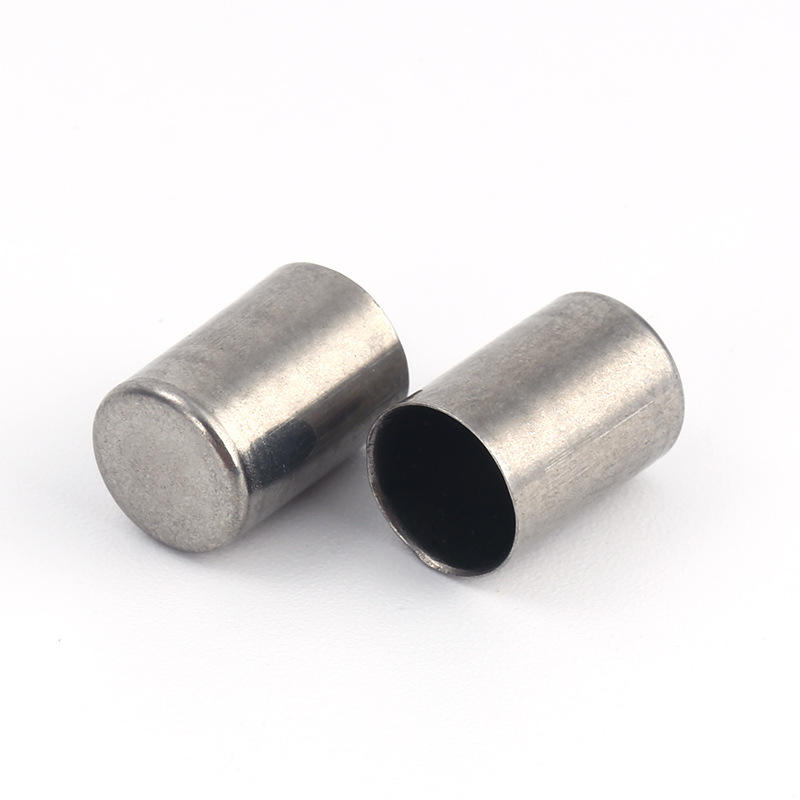
The Steel Deep Drawn Cups Closed and Open End are two cup styles that share a draw route but diverge at the base: a closed-end cup is a seamless cap with a formed bottom, while an open-end cup is a tube with a controlled wall taper and no base. Because they are quoted together, the engineering below covers drawing the closed base without pinching it and drawing the open wall to a taper that still holds a bore.
Drawing a closed-end cup without pinching the base
A closed-end cup is drawn from a flat blank in two or three stages until the base closes, and the failure that defines it is the base pinch – the centre of the bottom thinning to a knife edge as the last stage tries to flatten it. For a 50 mm outside-diameter cup from 1.0 mm DC01 we blank at about 82 mm and draw in two stages to set the wall at 0.95 mm, then a light restrike that sets the base without over-flattering it. The base is allowed to finish at 1.0 mm, the stock thickness, because a closed base should not be thinner than the wall or it becomes the weak point.
The punch that forms the base has a 5 mm corner radius at the wall-to-base junction, because that is where the steel must flow to close the bottom. Closing the radius to gain a flatter base is exactly what pinches the centre, so we hold the radius and accept a slightly crowned base rather than a thin one.
- 50 mm OD, 1.0 mm DC01; two draw stages to 0.95 mm wall, base kept at stock.
- Base corner radius 5 mm; never close it to flatten the bottom.
- Restrike sets the base without over-flattering and pinching the centre.
The blank size for the closed cup is set 4 mm larger than the simple area calculation suggests, because the base needs material to flow into the corner radius and a blank cut to theory starves the centre and pinches it. We also anneal between the two draw stages when the first stage reduction passes 40 percent, because DC01 that is drawn twice without relief cracks at the base corner on the second hit. A closed cup is judged finished only when the ultrasonic base map shows the centre at or above the 1.0 mm minimum across the whole bottom.
Forming an open-end cup to a controlled wall taper
An open-end cup is drawn to a wall that tapers from thick at the mouth to slightly thinner at the closed tail, or vice versa, depending on which end locates. We draw it in two stages and iron the wall on the second so the taper is set by the die, not by luck. For a 50 mm OD, 70 mm long open cup the wall is held at 1.0 mm at the mouth and 0.9 mm at the tail, a 0.1 mm taper that the assembly uses to locate without a separate shoulder.
The mouth is trimmed square to +/-0.1 mm and the tail is trimmed or left as drawn depending on the print; we trim both ends so the cup references a known axis for the bore machining that usually follows. An open cup that is not trimmed square reads as out of round even when the wall is fine.
- Draw in two stages; iron the wall on the second to set the taper by the die.
- Trim both ends square to +/-0.1 mm to reference the bore axis.
- Hold the taper to 0.1 mm so the cup locates without a separate shoulder.
Steel grade and coating for closed and open cups
DC01 is the default for both cup styles because it draws the base or the taper cleanly and takes zinc or e-coat without prep drama. Where the cup holds a fluid or sees weather we use a zinc-coated base (Z140) so the drawn wall edge is protected, since a plated-only cup rusts first at the trim edge. We use 304 stainless steel for cups that must be cleaned to a food or medical standard, because stainless steel draws in two stages at the same reduction as DC01 and needs no coating.
Coating thickness is reconciled to the cup’s tight feature. A closed-end cup with a press-fit base gets the base masked during e-coat so the fit is not lost; an open-end cup with a tight bore gets the bore masked for the same reason. We cap the coat at 12 microns on cups with slots or tight holes so they do not close.
- DC01 default; Z140 base or 304 stainless steel where fluid or hygiene demands it.
- Mask the base or bore during coating when they are press fits.
- Cap coating at 12 microns on cups with slots or tight holes.
Holding base thickness and mouth roundness per type
The closed-end cup is judged on base thickness and mouth roundness: the base is mapped to 1.0 mm minimum at the centre, and the mouth is held round within 0.05 mm TIR and to +/-0.03 mm on diameter because the mouth is usually the locating or sealing face. The open-end cup is judged on bore roundness and wall taper: the bore is machined after drawing to +/-0.03 mm and round 0.03 mm TIR, and the taper is held to 0.1 mm over the length.
We measure the closed-base thickness with an ultrasonic gauge on first article and sample it, because a base that thinned to 0.7 mm at the centre is the cup that bursts under pressure test. The open cup’s bore is air-gauged in production because a bore that goes out of round at the tail is the hidden cause of a piston that binds.
- Closed cup: base 1.0 mm min at centre, mouth round 0.05 mm TIR, dia +/-0.03 mm.
- Open cup: bore +/-0.03 mm, round 0.03 mm TIR, taper 0.1 mm over length.
- Ultrasonic the closed base; air-gauge the open bore every run.
The two cups are drawn on the same press family but never in the same die, because the closed base needs a punch that forms a bottom and the open cup needs a punch that stops short. We keep the tooling separate and labelled per type so a setup error cannot put an open-cup punch into a closed-cup die and vice versa. The shared part of the route is the blank and the first draw; everything after the first stage is type-specific, and that is where the inspection plan forks between base thickness and bore roundness.
Why closed-end cups fold at the bottom and how we stop it
A closed-end cup folds at the bottom when the last draw stage tries to flatten a base that still has material to move, and the excess doubles up into a wrinkle at the centre. We stop it two ways: by keeping the base corner radius open so the material flows rather than folds, and by limiting the final reduction so the base sets without surplus. A fold shows as a ridge on the inside of the base and is caught by the base-thickness map and a visual on first article.
The second failure is a base that splits instead of folding, which happens when the radius is too tight and the centre is starved. We keep the blank large enough to feed the base and the radius open, and we anneal between stages when the cumulative reduction passes 20 percent so the DC01 does not work-harden into a split.
- Keep the base corner radius open so material flows, not folds.
- Limit the final reduction so the base sets without surplus material.
- Anneal between stages past 20 percent reduction to avoid a centre split.
How we verify closed and open end cups together
Because the two cup styles share a draw route, they are verified together at first article and then gauged by their individual critical feature in production – base thickness for the closed cup, bore for the open one.
- First article: CMM on mouth and bore roundness and diameter for both, ultrasonic base-thickness map for the closed cup, wall-taper check for the open cup, plus a material certificate.
- Production: ring gauge on mouth roundness every run, ultrasonic spot on the closed base, air gauge on the open bore, and a visual on the base for folds on the first and last part.
- Shipment file: dimensional report, base and bore records, coating thickness, and material cert travel under your part number.
The draw dies for both styles are built and held in our own toolroom against your part number, with the base radius and wall-taper archived so a reorder reproduces the form. A reorder is a draw run and a gauge pass, not a new development.
Our deep drawn covers guide puts numbers to the design decisions behind a part like this — draw ratio, wall thinning, radii and trim; the Precision Deep Drawn Parts pages collect the rest of the family.
Specifications
| Item | Steel Deep Drawn Cups Closed and Open End |
|---|---|
| Brand | AUNOV |
| Designing | A drawing file or a physical sample starts the review, our engineers reply with a manufacturability assessment and pricing. |
| Tooling | Our own toolroom designs and builds every die, held under your part number. |
| Samples | Approval samples of the cup ship with a dimensional report and material certificate. |
| Materials | Stock for this part leads with carbon steel (SPCC / DC01), alongside 304 / 316 stainless steel, aluminium, brass and copper, with the final grade confirmed at the drawing review. |
| Surface finish | Plating, e-coat, powder coating, anodising or passivation as the drawing calls out, fixed at the drawing review. |
| Processing | Progressive deep draw stages with in-line annealing as the draw ratio demands, pierced and machined on the same floor. |
| Equipment | Press capacity from 5 to 500 T across mechanical and hydraulic lines, CNC cells plus a temperature-controlled CMM room. |
| Tolerance | +/-0.1 mm on as-drawn surfaces and +/-0.03 mm on machined surfaces. |
| Delivery terms | FOB as standard, DDP available for EU and US destinations, payment T/T or L/C, D/P for repeat accounts, call-off scheduling supported. |
Frequently Asked Questions
What failure mode defines a closed-end cup?
The base pinch. It is the centre of the bottom thinning toward a knife edge as the last stage tries to flatten it, and it is what the whole stage plan is built to avoid.
Why do you accept a slightly crowned base rather than a flat one?
Because chasing perfect flatness means closing the corner radius where the steel has to flow, and that is exactly what pinches the centre. We hold a generous radius at the wall-to-base junction and take the crown, which is the difference between a base that is slightly domed and one that is thin enough to fail.
Is the base meant to end up the same thickness as the wall?
It should not end up thinner. The base stays at around stock thickness because it is not thinned by the draw, and allowing it to become the thinnest part of the cup would make it the weak point rather than the strongest.
What changes for the open-end version?
The priorities swap. Open-end cups are formed to a controlled wall taper and are judged on mouth roundness, while the closed version is judged on base thickness and freedom from folds at the bottom. Both are verified together because they share the same tooling family.
Related Products


Request a Quote for This Part
Send a drawing or sketch — get material advice, tooling cost and a per-piece price within 24 hours (working days).