
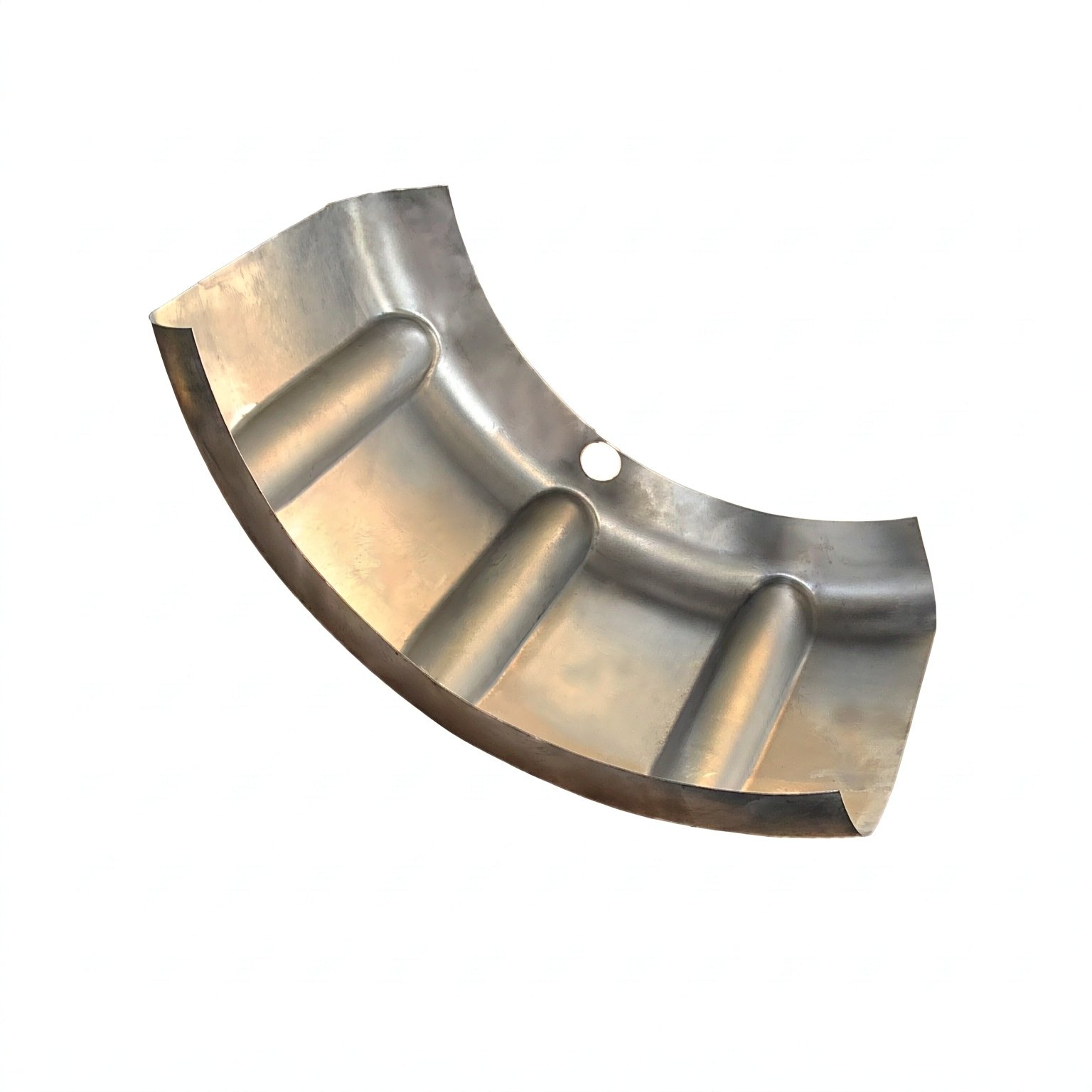
An arch is stiffness bought with shape, not with thickness
An arched carry bracket solves a problem that has only two other solutions and both are worse. If the bracket is flat, it has to be thick to be stiff, and a thick flat strip is heavy and expensive. If it is a boxed section, it is stiff and light but it cannot be formed in one piece from strip. The arch takes the third route: it uses geometry to convert a bending load into axial load in the material, and axial load is carried far more efficiently than bending. A strip an inch wide and a sixteenth thick is floppy when flat and remarkably rigid when arched, and the only thing that changed is where the material sits relative to the load.
What the arch does not do is work by itself. An arch carries load by developing thrust at its ends, and those ends have to be restrained. This is the single most important thing to understand about this part, because a carry bracket is normally a handle, and a handle is normally fixed at two points that are not designed to resist outward thrust. If the ends can spread, the arch behaves like a flat strip with a slight curve and loses most of the benefit it was chosen for.
Rise over span: the number that decides whether the arch earns its keep
The rise over span ratio is the figure that predicts how much the arch helps. Measured as the height of the crown above the line joining the two ends, divided by the distance between the ends, the useful range is roughly 0.1 to 0.25. Below about 0.08 the arch is shallow enough that it behaves almost like a flat strip under a bending moment, and its stiffness advantage largely disappears. Above about 0.3 the arch is deep enough that the compression in the material becomes the limiting factor rather than the stiffness, and a thin strip will fail by buckling at a load below what a flatter arch would have carried.
Two consequences follow for the drawing. The first is that the rise should be a toleranced dimension with a function behind it, not a nominal dimension that gets adjusted to make the part fit a panel. A rise that drifts from 18 to 14 mm over a batch changes the stiffness by an amount that is hard to predict without analysis and impossible to see by looking. The second is that the ends should be kept parallel to each other and perpendicular to the load, because an arch whose ends are not parallel is loaded off axis, and an off axis load on a thin arch produces exactly the lateral buckling that the geometry was meant to avoid.
- Rise over span between 0.1 and 0.25 for a thin strip handle.
- The rise dimensioned and toleranced, not nominal and not free.
- Ends parallel and square to the load direction.
- Span toleranced at the fixing points, not at mid span.
The load case, and the failure that comes after bending
A load applied at the crown of a carried bracket passes into the arch as a combination of axial compression and bending. The axial component grows as the arch gets flatter at the crown relative to its own curvature, and the bending moment peaks at the crown and changes sign along the length. In a bracket made from a thin aluminium strip, the bending stresses are usually modest. The stresses that matter are the compressive ones, and they can produce a failure that has nothing to do with material strength.
There are two instability modes to check. A shallow arch can snap through: it carries load by bending until a critical point, then suddenly inverts and carries nothing. This is a stiffness failure and it happens at a load well below the material’s yield, which is why a shallow arch can feel strong right up to the moment it flips. A deeper arch under a compressive load can buckle laterally out of plane, particularly if the strip is narrow and the ends are not restrained against rotation. Both modes are fixed by the same three things: more rise, wider strip, and restraint at the ends. Thickening the strip does almost nothing for snap through, which is a point worth making before someone solves the problem the expensive way.
Handling loads are also not the only loads. A carry bracket is grabbed, and a grab is a lateral load, not a vertical one. The bracket should be checked for a sideways pull at the crown, because that is the direction in which an arch has the least stiffness and the direction in which the person using the handle will most often load it.
Aluminium has no endurance limit
Steel and aluminium differ in a way that matters enormously for a part that will be picked up thousands of times. Steel has an endurance limit below which a cyclic stress will not cause fatigue failure no matter how many cycles are applied. Aluminium and its alloys have no such limit: any cyclic stress, however small, will eventually produce a crack if enough cycles are applied. There is no safe stress, only a life that is long enough to be acceptable.
For a carry bracket this changes the design question from whether the material is strong enough to how many cycles the bracket has to survive. A bracket picked up twice a day for ten years sees 7000 cycles, which is a trivial fatigue duty for any reasonable design. A bracket that vibrates in transport for hours at a time can see millions of cycles at a low stress and is a real fatigue problem. The distinction has to be made explicitly, because the two cases lead to completely different conclusions about the wall thickness, the end details and the need for a stiffening bead.
If the part does see vibration, the vulnerable location is the fixing point, not the crown. The crack will start at the edge of a hole or at the transition between the arch and a flat end foot, because that is where the stress concentration sits. A generous radius at the transition, a hole that is not too close to the edge, and a bolt with a washer large enough to spread the clamping load are the three cheapest fatigue improvements available, and all three are free at the drawing stage.
The arch is also a handle
This part is touched by a person, which makes it a human interface as well as a structural component, and the human requirements are usually more specific than the structural ones. A hand grip needs a radius big enough that the load is not concentrated on a narrow edge; a cross section with a round or an oval profile around 25 to 30 mm across and an edge radius of at least 5 mm is comfortable, while a sharp 25 mm wide strip with square edges is not, even though it is structurally identical. If the bracket is an arch of strip, the grip is where the hand sits and the edge condition there is a specification, not a finish detail.
Three human factors follow. The edge where the hand goes should be rolled, hemmed or radiused, and the aluminium should be deburred so that no sliver survives handling. The working load should be stated with a factor of safety and, where the product is subject to a lifting standard, with the standard named, because a handle that is also a lifting point is a different legal object from a handle that is not. And the surface should have enough friction that the hand does not slide when the load tilts, which usually means either a wider profile or an anodised surface rather than a polished one.
Forming the arch and keeping the two ends parallel
An arch is normally formed by stretching or bending a strip over a form, and the difficulty is not making the curve. It is making the curve and leaving the two ends parallel and at the correct span. Aluminium springs back considerably, and the amount of springback depends on the alloy, the temper and the amount of stretch the strip has already seen. A roll formed arch will come off the rolls tighter than the form, and the correction is applied by over-bending or by a restrike.
The end details usually have to be formed as well, either as feet with holes or as bent flanges that fix to the cabinet. Forming the feet in the same operation as the arch couples the two, so that a change in springback moves the arch depth and the foot angle together. Forming the feet in a second operation decouples them and allows each to be corrected against a gauge, which is the reason most production arches are made in two steps. After forming, the arch should be allowed to settle before it is measured, because a freshly stretched aluminium arch will continue to move for a short time.
Span is the dimension that decides whether the bracket fits, and it should be measured at the fixing holes, with the feet flat, and with the part unrestrained in the direction it will be free when it is installed. Measuring span by squeezing the ends together will pass parts that do not fit.
Questions that decide whether an arched bracket is right
Why not just use a thicker flat strip? Because stiffness in bending goes with the cube of thickness and only linearly with the shape change an arch provides, but the arch gains far more than a linear factor for the same amount of material. A flat strip that matches an arch of the same width usually has to be several times thicker, which costs weight and, in aluminium, is often not available in the required temper.
What alloy is normal for an aluminium arch? 5052 in the H32 temper for parts that are formed and left, because it forms well and tolerates the stretch, and 6061 where more stiffness or a machined end is needed, accepting that 6061 T6 does not like to be bent and that a formed T6 arch will lose strength locally.
Does the anodised finish weaken the arch? No, but the anodised layer is brittle and will mark in the grip area, and the appearance of an anodised arch depends on the alloy, so an arch and its end feet should be made from the same alloy and ideally the same batch.
How is the arch verified? Span at the fixing points on the first article and in process, rise at the crown, and a functional load test at the rated working load with the ends restrained in the way they will be restrained in service. A load test with free ends measures the wrong structure and will either pass a bad part or fail a good one.
Our deep drawn covers guide puts numbers to the design decisions behind a part like this — draw ratio, wall thinning, radii and trim; the Precision Deep Drawn Parts pages collect the rest of the family.
Specifications
| Item | Aluminum Deep Drawn Arched Carry Bracket |
|---|---|
| Brand | AUNOV |
| Designing | Send the drawing, or a sample we can measure, the quotation comes back with a manufacturability review attached. |
| Tooling | Our own toolroom designs and builds every die, stored under your part number. |
| Samples | First-off samples of the bracket are sent with a dimensional report and material certificate. |
| Materials | Aluminium is the primary stock for this part, alongside carbon steel (SPCC / DC01), 304 / 316 stainless steel, brass and copper, with grade selection confirmed at drawing review. |
| Surface finish | Finish options: plating, e-coat, powder coating, anodising or passivation, as called out on your print. |
| Processing | Deep drawing runs in stages with in-line annealing where the draw ratio requires; piercing and CNC machining stay in house. |
| Equipment | From 5 to 500 T of press capacity across mechanical and hydraulic lines; CNC turning and milling cells plus a climate-controlled CMM room. |
| Tolerance | As-drawn tolerance +/-0.1 mm, +/-0.03 mm on machined surfaces. |
| Delivery terms | Prices FOB, with DDP for EU and US on request, T/T and L/C accepted, D/P for established customers, call-off schedules supported. |
Frequently Asked Questions
Why shape an arched bracket instead of using a thicker flat strip?
An arch turns a bending load into axial load in the material, which a strip carries far more efficiently than bending, so the part gets stiff without getting heavy or expensive. A flat strip the same width would have to be much thicker to match the arch’s stiffness, and a boxed section could not be formed in one piece from strip.
How is the rise held on a deep drawn arched bracket?
The rise over span is a toleranced dimension with a function behind it, not a nominal that gets trimmed to fit a panel, because a drift in rise changes the stiffness in a way that is hard to see. The arch is drawn so the two ends stay parallel and perpendicular to the load, and the rise is checked so the benefit the geometry was chosen for is actually delivered.
Why aluminium for an arched carry bracket?
Aluminium gives the stiffness-to-weight the bracket wants as a handle, and it forms the arch cleanly from strip in one piece. Because aluminium has no endurance limit, the fatigue load is planned into the shape and the section, and the grade and temper are confirmed before tooling so the part survives the repeated lift.
What keeps the ends of an arched bracket from spreading?
The arch works by developing thrust at its ends, so those ends must be restrained, and a carry bracket normally fixes at two points that are not themselves designed to resist outward thrust. The drawing states how the ends are located, because if they spread the arch loses most of the stiffness it was chosen for and behaves like a slightly curved flat strip.
Related Products


Request a Quote for This Part
Send a drawing or sketch — get material advice, tooling cost and a per-piece price within 24 hours (working days).