
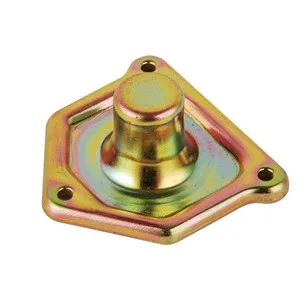
Sheet selection is the first engineering decision on a stamped electric motor cover – it drives draw ratio, corner thinning, springback and unit cost simultaneously. This page walks through how the starting gauge behaves through the press, and when deep drawing is the right answer over plain stamping.
Starting gauge vs finished wall
The blank does not keep its thickness. In drawing, the wall thins where the metal wraps the punch radius – typically 10-20% at the corner on a sound die – while the flange may thicken slightly where metal is drawn in. Practical consequences:
- Specifying the finished wall is not the same as specifying the starting gauge. We calculate the starting thickness so the thinnest section still meets your minimum.
- Tighter corner radii pull more thinning into the corner. Below about 4× sheet thickness, thinning climbs quickly and draw force rises with it.
- Thicker stock is not automatically safer for a deep shell – a thicker blank needs a larger clearance and can wrinkle in the flange if blank-holder pressure is not tuned.
Deep drawing vs plain stamping: where the line sits
Plain stamping (blank + bend + pierce) is right for shallow caps and covers with generous radii where the depth is under roughly half the diameter. Once the shell needs depth beyond that, or a closed bottom with a straight wall, deep drawing takes over: the blank is drawn through the die in one or more stages, with interstage annealing when the work hardening from earlier stages would crack the shell in the next.
Our floor carries both, so the route is chosen by geometry and volume – mechanical presses 5-250 T for progressive stamping, hydraulic presses 250-500 T with in-line annealing for deep shells.
Material notes for motor covers
- SPCC / DC01 carbon steel – the default. Predictable drawing behaviour, takes zinc plating and e-coat well, lowest cost. The workhorse for indoor motors.
- 304 / 316 stainless steel – work-hardens fast, so deep shells need more anneal stages; in exchange, no coating line at all for washdown or outdoor duty. 316 where chlorides are present.
- Aluminium – light and corrosion-safe, but wrinkles more readily; blank-holder control and draw-bead design matter more than on steel.
- Brass / copper – chosen for conductivity or appearance; excellent drawing behaviour, priced accordingly.
Finishing matched to the gauge
Thin walls (0.5-0.8 mm) distort in high-temperature coating; for those, zinc-nickel plating or e-coat is usually the safer choice over powder coating. Heavier gauges take powder well. Where mating faces are machined after coating, masking is quoted in from the start so the plating does not have to be removed later.
Verification per batch
First article CMM-measured against the print; production batches gauged back to the signed sample. On the motor end cover, bearing-bore size and spigot runout are the named checks at first article and in production sampling. Wall-thickness data at the thinnest section is included in the first-article report so the starting-gauge decision is documented, not folklore.
If you are comparing this part with a machined or welded alternative, the guide to deep drawn covers lays out where drawing wins, where it loses, and what it costs either way.
Blank gauge chosen from the draw ratio, not a catalogue
The wall thickness of a stamped motor cover is set at the blank, so we pick the gauge from the draw ratio the shape demands rather than from a preferred stock list. A cover that draws deep needs a thinner, more ductile blank to flow without splitting, while a shallow cover can carry a heavier gauge for stiffness. We compute the blank gauge from the draw depth and the corner radius, then confirm it on a formed sample because the theory and the press never agree perfectly. The finished wall is therefore a consequence of the blank choice, which is why the starting gauge appears in the quotation as a determined value rather than an assumption.
Where a weld is honestly better than a draw
Not every motor cover should be stamped in one piece. When a shape needs an internal bracket, a non-round boss, or a feature on a wall the draw cannot reach, a formed-and-welded construction is the honest answer. We will propose a weld seam where it saves a die or enables a feature, and we locate that seam away from the locating pilot and the gasket face so it never compromises function. The choice is shown in the quote with the reason, because a buyer should know why a cover is built the way it is rather than receiving a part built the way that suited the toolroom.
Finish matched to the gauge
A thin wall dents under a heavy coating and a thick wall hides a light one, so the finish spec is matched to the gauge we chose, keeping protection and fit consistent across the run.
Specifications
| Item | Sheet metal stamping electric motor cover |
|---|---|
| Brand | AUNOV |
| Designing | Send drawings, or send a sample to be measured – a manufacturability review comes back with the quotation; revisions are re-quoted once rather than silently absorbed. |
| Tooling | Dies, fixtures and gauges are made in our own toolroom, so a die can be re-cut against the approved drawing, and the charge is refundable against agreed volumes. |
| Samples | Sample parts are measured and reported before submission, so the approved first article becomes the gauge reference, and later batches are gauged back to the signed sample. |
| Materials | Carbon steel (SPCC / DC01), 304 / 316 stainless steel, aluminium, brass and copper – the grade is matched to the duty of this cover. |
| Surface finish | Plating, coating or polishing to suit the drawing; masking and laser marking available where needed. |
| Processing | Blanking and progressive forming on automated lines, then secondary tapping, bending and finishing. |
| Equipment | 5-250 T mechanical presses, 250-500 T hydraulic presses and annealing furnaces in line, with CNC turning centres for secondary operations and CMM inspection. |
| Tolerance | +/-0.05 mm to +/-0.1 mm across the part, wall thickness held to print; capability is checked on the first article before the run continues. |
| Delivery terms | FOB Ningbo or Shanghai, T/T with deposit and L/C for larger runs; call-off schedules are supported. |
Related Products
Frequently Asked Questions
Starting gauge or finished wall – which belongs on the drawing?
The finished wall, because that is what the assembly loads, corrodes and finishes. Starting gauge is then derived from it rather than chosen from stock. Writing both without stating which governs is the common fault: the supplier is left to pick a blank that forms nicely rather than one that leaves the wall the part needs where it needs it.
Where does the line sit between deep drawing and plain stamping?
At whether the material has to flow. A shallow form mostly bends; once material has to move inward past a die radius, the part is drawing, and wall thinning, blank holder force and possibly staging enter the picture. Depth relative to diameter is what settles it, and it is worth settling early because it decides which route can quote the part at all.
Why is blank gauge chosen from the draw ratio rather than from stock availability?
Because thicker is not automatically better. A blank thicker than the draw wants tends to wrinkle in the flange or exceed available blank holder force, while one too thin tears at the punch radius before reaching depth. The gauge is therefore a consequence of the reduction being attempted rather than something selected independently from a catalogue.
Should finishing be specified against the starting gauge or the finished wall?
Against the finished wall. Coating thickness is a proportion of the section it sits on, and where the drawing has thinned the metal, powder or plating has more effect on fit and edge coverage than it does elsewhere. Specifying finish against nominal gauge regularly produces threads, bores and mating fits that measure differently once treated.


Request a Quote for This Part
Send a drawing or sketch — get material advice, tooling cost and a per-piece price within 24 hours (working days).